
In This Article
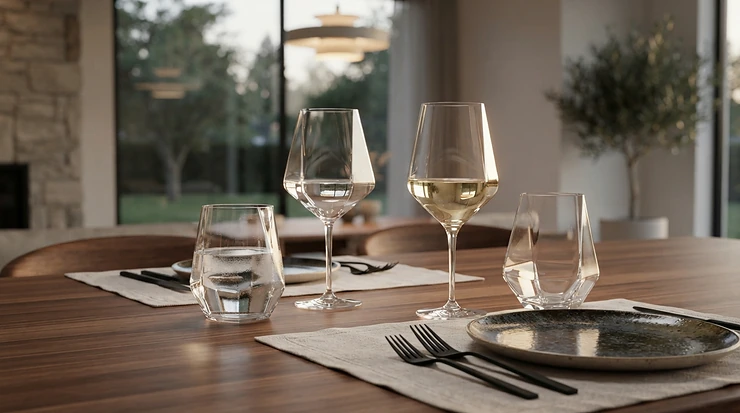
An angular stemmed wine glasses set is a group of four or six stems whose bowls use flat planes, sharp tapers, or faceted edges instead of one smooth curve. The foot and stem follow classic stemware anatomy, but the bowl reads as architecture rather than tradition.

Round bowls had a good run. A few centuries, give or take. But set a balloon goblet down in a loft kitchen with black steel shelving and poured-concrete counters, and it looks like a lace doily at a welding shop. Angles fix that. A tapered, planar bowl catches a pendant bulb the way a cut gemstone does. It tells guests the table was designed, not just set.
Here’s the catch: “angular” covers a wide spectrum. Some glasses nudge the curve into a gentle V. Others go full geometry, with straight walls and hard shoulders. Prices swing from casual-night-in money to sommelier-splurge money. So this guide sorts seven real options by how sharp they are, what they cost, and who they suit.
A quick word on method. Everything below is built from published specs, retailer listings, buying-guide roundups, and the patterns in buyer reviews. It is not hands-on testing. Where review data couldn’t be verified, the text says so. Prices appear as ranges because they move daily. Read on to find the angular stemmed wine glasses set that fits your table.
Quick Comparison: Angular Stemmed Wine Glasses Set Picks at a Glance
Before the deep dives, here’s the whole field on one screen. “How angular?” is the column most buyers wish listings included, so it comes first.
| Pick | Tier | Set Size | How Angular? | Price Range | Best For |
|---|---|---|---|---|---|
| JoyJolt Layla | Budget | 4 | Gentle taper | Around $30 | First-time buyers |
| Libbey Signature Greenwich | Budget to mid | 4 | Clearly angled bowl | Roughly $40–$65 by size | Everyday use and gifting |
| Zwiesel Glas Pure Cabernet | Mid | 4 | Faceted contours | Around the $50 mark (verify) | Dishwasher-heavy households |
| Zwiesel Glas Modo | Mid | 4 | Straight-lined, geometric | Mid-range (check current price) | Mid-century and modern tables |
| Elixir Glassware Square | Mid | 4 | Hand-blown, squared | Around the mid-$50s | Statement gifts |
| LSA Metropolitan | Mid to premium | 4 | Architectural bowl | Roughly £35–£100 UK by size; US pricing varies | Design-led hosts |
| Zalto Denk’Art | Premium | Sold per stem | Sharp-shouldered, thin-walled | High-$50s per glass | Serious tasting |
Looking at the table, the Libbey Signature Greenwich and JoyJolt Layla are the only two that reliably land under the $50 line for a full set of four. The Zwiesel Glas Pure Cabernet hovers right at it. The Zalto Denk’Art plays a different game entirely, because you’re buying stems one at a time. If hard geometry is the goal, the Zwiesel Glas Modo and LSA Metropolitan are the sharpest silhouettes here.
💬 Just one click — help others make better buying decisions too!😊
Top 7 Angular Stemmed Wine Glasses Set Picks: Expert Analysis
Each pick below gets the same treatment: what the specs mean in practice, who it suits, what buyers keep saying, and an honest price verdict.
1. JoyJolt Layla — the lowest-risk way to try angles
The JoyJolt Layla proves an angular stemmed wine glasses set doesn’t need a gallery budget.
Hunker’s editors describe a long, thin stem and a slightly angular bowl, sold as four reds or four whites. Daily Meal’s roundup highlights the reinforced stems. That detail matters because stems are where stemware usually dies: at the sink, in the dishwasher rack, or in a twisting grip. “Slightly” is the operative word, too. This is a soft taper, not a faceted edge.
Based on the spec comparison, the JoyJolt Layla suits anyone who wants to test whether angular design wine glasses under $50 suit their table before spending more. It also works as a spare set for guests. It won’t satisfy someone chasing a hard-edged, industrial look.
On reviews, the aggregated rating and count couldn’t be verified from the sources consulted. Editorial roundups praise it as elegant for the money. Before buying, read the three-star reviews on the live listing. That’s where durability complaints tend to hide.
Pros:
- ✅ Long, slim stem looks pricier than it is
- ✅ Reinforced stem construction for everyday handling
- ✅ Four-glass sets in red or white sizing
Cons:
- ❌ Angle is subtle, not dramatic
- ❌ Thin glass still needs careful washing
Around $30 for four at the time of research; check current price. Verdict: strong value as an entry point.

2. Libbey Signature Greenwich — clean-angled bowls from an American maker
Libbey Signature Greenwich is the rare mainstream line that commits to an angle without going full origami.
Libbey describes a pulled stem flowing straight into an angular bowl, a laser-cut rim, a flat foot, and thinner walls made with its ClearFire formula. Sizes run from roughly 13 to 24 ounces, and the largest stands about 9.4 inches tall. A pulled stem means stem and bowl are one continuous piece of glass, which is where joined stems tend to fail. A laser-cut rim, described as beadless, means there’s no lip of glass to chip.
Here’s what most buyers overlook: capacity changes the price more than the shape does. Retailer listings show the 20-ounce red four-pack often priced below the 16-ounce all-purpose set. Shop by ounces, not by assumption. The 20-ounce size is the sweet spot for Cabernet and still tends to fit an under-$50 budget.
On reviews, retailer snippets lean positive on size and elegance. The review pools are small, though, in the dozens rather than the thousands. Treat the praise as promising, not proven.
Pros:
- ✅ Pulled stem flows seamlessly into the bowl
- ✅ Laser-cut rim resists chipping
- ✅ Multiple sizes, gift-box packaging
Cons:
- ❌ Small review pools limit confidence
- ❌ Pricing swings widely by size and seller
Roughly $40–$65 depending on size and retailer; check current price. Verdict: the best everyday angular stemmed wine glasses set for most people.
3. Zwiesel Glas Pure Cabernet — faceted contours that survive the dishwasher
The Zwiesel Glas Pure Cabernet is the volume leader of the angular world, and the numbers back it up.
It holds 19 ounces, ships as a set of four, and uses Tritan crystal, a lead-free formula built on titanium and zirconium oxide. One 2026 buying guide counted over 1,600 reviews averaging 4.7 stars, with about 84% giving five. Those figures were current when published and will drift. In practice, that mix of faceted contours, German manufacture, and dishwasher tolerance is rare at this price.
What the spec sheet won’t tell you, but reviewers note: care labels sometimes say hand wash only while the listing says dishwasher safe. A minority also report the glasses feel more fragile than the marketing implies. The sensible reading is this. Use a gentle cycle, don’t jam bowls onto rack prongs, and keep a spare in the cupboard.
For households that run the dishwasher nightly and still want edges and angles, the Zwiesel Glas Pure Cabernet is the logical anchor.
Pros:
- ✅ Faceted, light-catching contours
- ✅ Huge review base with strong average
- ✅ Lead-free, break-resistant Tritan crystal
Cons:
- ❌ Care labels conflict with dishwasher claims
- ❌ Some buyers find it more delicate than expected
Pure-line sets in buyer guides cluster around the $50 range; check the current Cabernet price. Verdict: best all-round value in the mid tier.
4. Zwiesel Glas Modo — straight-lined goblets for hard-edge tables
If the Zwiesel Glas Modo were a piece of furniture, it’d be a walnut sideboard with brass feet.
The red version holds 15 ounces, stands about 8.75 inches tall, and comes in sets of four. The bowl is straight-lined and geometric rather than curved. That’s a genuinely different silhouette from the Pure line’s faceted look. A 2026 guide reported roughly 4.7 stars across about 285 reviews, with 84% at five stars. Buyers praise the sturdy feel, and some use the glass for cocktails as well as medium reds like Merlot and Sangiovese.
The trade-off is capacity. At 15 ounces, big Cabernets get less swirl room than in the Pure. Reviewers also warn that it will shatter on tile like any crystal, and stock reportedly runs low at times.
For design-forward buyers, the Zwiesel Glas Modo is the strongest answer to angular wine glasses for industrial style kitchens at a mid-range price. Straight walls echo steel shelving and window mullions. Pair it with matte-black or raw-wood surfaces and the effect is cohesive without trying.
Pros:
- ✅ Distinctive straight-lined geometric profile
- ✅ Strong ratings across hundreds of reviews
- ✅ Doubles as a cocktail glass
Cons:
- ❌ Smaller bowl limits swirl for big reds
- ❌ Stock can run low
Mid-range pricing; check current price. Verdict: the style pick of the Zwiesel family.
5. Elixir Glassware Square — hand-blown angles in a gift box
The Elixir Glassware Square is the statement piece of the middle tier.
Hunker’s editors call it a set of angular, hand-blown, stemmed glasses packaged in a gift box. Their listing sat around the mid-$50s. Another roundup, from BGR, noted the cylindrical bowl shape as unusually distinctive. Hand-blown matters here because each glass can carry tiny variations in thickness and wall angle. That’s charming on a handmade piece and mildly annoying if you want a perfectly matched row of four.
The analysis is straightforward. Choose this set when presentation counts: housewarmings, wedding gifts, or a first “grown-up” glassware purchase. It reads as a deliberate design object more than an everyday workhorse.
On reviews, an aggregated rating couldn’t be verified from the sources consulted, so no sentiment is claimed here. Check the live listing for breakage reports and recent photos. Hand-blown glass is thinner in spots, and shipping damage is the usual complaint with any gift-boxed stemware.
Pros:
- ✅ Squared, hand-blown profile stands out
- ✅ Gift-ready packaging
- ✅ Distinct look versus mass-market sets
Cons:
- ❌ Hand-blown variance between glasses
- ❌ Review data not verified here
Around the mid-$50s at last listing; check current price. Verdict: pay for the look, not the performance.
6. LSA Metropolitan — architectural bowls with a design pedigree
LSA Metropolitan is where angular glassware starts feeling like industrial design.
LSA describes an angular bowl tapering to a fine rim on a tall stem, with cold-cut, fire-polished rims and lead-free crystalline glass. Sizes include a 350 ml white (about 22 cm tall), a 400 ml red (about 20 cm tall), and a large 680 ml Grand Cru. Retailers list the glass as made in Poland, dishwasher-safe on a low cycle. One retailer recommends hand washing to preserve the finish.
A fine, cold-cut rim means a thinner lip and a cleaner sip. The tall stems add elegance and a bit of tip risk, so measure your shelf first. The bigger honesty note is pricing. UK listings span the mid-£30s on resale to well over £90 for the Grand Cru at luxury retailers, and US availability varies by seller. Verify stock and shipping before falling in love.
Based on the spec comparison, LSA Metropolitan suits hosts who treat the table like a styling project.
Pros:
- ✅ Strongly architectural angled bowls
- ✅ Fine, cold-cut and fire-polished rims
- ✅ Three sizes, including a generous Grand Cru
Cons:
- ❌ Wide price spread across sellers
- ❌ US availability inconsistent
Roughly £35–£100 UK depending on size and seller; US pricing varies, so check current price. Verdict: premium looks at near-mid-range money if you find a good seller.
7. Zalto Denk’Art — the sommelier’s angular benchmark
The Zalto Denk’Art is the glass wine professionals argue about, and it’s angular by design.
Retailers describe mouth-blown, lead-free, thin-walled stems that are dishwasher safe. Punch’s buying guide calls Zalto the resounding sommelier choice at the high end, from the high-$50s per glass. Wine Folly’s tasting review priced the Universal near $59. Zalto cites a German magazine comparison in which its glasses placed first, but that claim is brand-reported. One food-and-wine writer found the real appeal was the feel in the hand, and noted the glass was hard to judge without a same-wine comparison.
Angular doesn’t automatically mean better swirling. A sommelier quoted by Punch preferred Zalto’s rounder white glass because the Universal’s sharper angles swirl less gracefully. The Zalto Denk’Art is also famously fragile, and the fear isn’t irrational.
This is the pick for tasting nerds with a replacement budget. For a pure angular stemmed wine glasses set, it’s overkill. Availability through Amazon varies, so confirm an authorized seller.
Pros:
- ✅ Featherlight, thin-walled feel
- ✅ Respected by sommeliers and critics
- ✅ Lead-free, mouth-blown craftsmanship
Cons:
- ❌ High price per glass
- ❌ Fragility anxiety is well documented
High-$50s per glass; check current price. Verdict: a luxury, not a necessity.
Features That Actually Matter (And Those That Don’t)
Marketing copy loves adjectives. Glassware performance depends on a short list of physical facts.
Features worth your attention:
- Stem construction. A pulled stem, like the Libbey Signature Greenwich uses, is one continuous piece of glass. Joined stems can fail at the seam.
- Rim thickness and finish. A cut or laser-finished rim feels cleaner than a rolled bead. This is also where chips start.
- Capacity and fill line. Wine Folly’s tasting-focused review makes the broader case that bowl size and shape drive aroma. Pour about a third of the bowl and you’ll rarely need a bigger glass. See their wine glass tests for the reasoning behind crystal versus standard glass.
- Care reality. If the label and the listing disagree about the dishwasher, trust the more cautious one.
Features that don’t matter much:
- Laser-etched logos on the foot.
- Ten varietal-specific shapes when you drink three kinds of wine.
- “Sommelier-approved” copy with no named source.
The honest conclusion: a good angular stemmed wine glasses set is judged by rim, stem, and care instructions. Faceting is the part you’ll notice at dinner. Those other three decide whether the set is still intact next spring.

How to Choose an Angular Stemmed Wine Glasses Set
- Set a per-stem budget. Divide the set price by the glass count. Four glasses at $40 is $10 each, which is a very different decision from $60 each.
- Pick your angle intensity. Gentle taper (JoyJolt Layla), clear angles (Libbey Signature Greenwich), faceted contours (Zwiesel Glas Pure Cabernet), or hard geometry (Zwiesel Glas Modo, LSA Metropolitan).
- Match capacity to your wine. Big reds love 20 ounces or more. Mixed drinking suits 15–17 ounces.
- Verify care instructions. Look for dishwasher-safe language on both the listing and the packaging.
- Measure your cabinet. Tall stems and wide bowls need real clearance. The Pure Burgundy runs about 4.5 inches wide.
- Confirm lead-free construction. Look for “lead-free” or “crystalline” wording on the listing.
If you want one glass for everything, a mid-sized all-purpose angular stem beats a drawer of specialty shapes.
Angular Wine Glasses vs Curved Bowl Wine Glasses
The honest debate about angular wine glasses vs curved bowl wine glasses is less about taste than about handling, cleaning, and style.
| Factor | Angular | Curved Bowl | Takeaway |
|---|---|---|---|
| Visual impact | Architectural, catches light in planes | Classic, soft | Angular wins on modern tables |
| Swirling | Can be less fluid at hard shoulders | Smooth, forgiving | Curved is easier for beginners |
| Cleaning | Facets can trap residue | Easy to wipe | Curved is simpler by hand |
| Durability | Depends on stem and rim, not shape | Same | A draw |
| Best For | Design-led tables, gifting | Traditional dinners, tasting | Pick by occasion |
Shape does influence how a wine presents. Wikipedia’s wine glass entry notes that glass shape can shape how a wine is perceived. But the effect isn’t dramatic enough to override personal preference, and one writer testing Zalto glasses admitted a same-wine comparison would be needed to prove claims about freshness.
Looking at the table, curved bowls win on forgiveness and angular glasses win on character. If you swirl vigorously, a gentle taper like the JoyJolt Layla is the compromise. If you value looks, the Zwiesel Glas Modo gives you geometry without the fuss of hand-blown fragility.
Angular Design Wine Glasses Under $50: What Your Money Really Buys
The category “angular design wine glasses under $50” is more crowded than you’d expect, but it comes with caveats.
At a four-glass price of $50, you’re spending about $12 per stem. Wine Folly’s testing guidance suggests that beyond roughly $9 a stem, crystal becomes the smart bet over ordinary glass. That makes the Zwiesel Glas Pure Cabernet and its Tritan crystal an interesting reach purchase at the top of the budget.
Realistic options under $50 for a set of four include:
- JoyJolt Layla (around $30): gentle angle, light feel.
- Libbey Signature Greenwich (the 20-ounce and 12.75-ounce four-packs often land near $40): a clearer, committed angle.
- Zwiesel’s budget lines, which sit at or just under the line, depending on size and sale timing.
Here’s how the trade-off plays out. Under $50 you get machine-made glass and moderate angles. Hand-blown geometry and razor-sharp edges live above that line. If you’re equipping a rental or a first apartment, spending closer to $30 on the JoyJolt Layla and buying a second set later is often smarter than overspending on one.
Watch for fine print. “Set of 12” bargains can mean thick rims and weak stems. Compare per-stem cost, not headline price.
Angular Wine Glasses for Industrial Style Kitchens
Industrial kitchen decor runs on honest materials: brushed steel, concrete, exposed brick, black iron, and bulbs you can see the filament in. The glassware has to hold its own against all that hardness.
That’s where angular wine glasses for industrial style kitchens earn their keep. Round, delicate goblets can look apologetic against steel. Straight-lined and faceted stems read as part of the architecture. Based on the shape descriptions, the Zwiesel Glas Modo and LSA Metropolitan are the strongest matches. The Zwiesel Glas Pure Cabernet works if you want a softer facet effect.
A few styling rules make the look land:
- Keep the glass clear. Colored or gold-rimmed stems compete with the metal and wood. Clear glass lets the wine be the color.
- Echo the lines. Straight stems rhyme with shelf brackets and window frames.
- Use open shelving, but don’t overstock. Grease and dust settle on open shelves, so display only the glasses you use weekly and rinse before service.
- Mix finishes. Raw wood boards and matte-black flatware keep hard glass from feeling cold.
Industrial kitchen decor is about contrast as much as hardness. A tall angular stem against a chunky stone counter is the point.
Angular Glass Cutting: How Facets and Sharp Rims Are Made
Angular glass cutting sounds like one process, but it’s really a few stacked steps. Understanding them explains both the price tiers and the care rules.
Shaping. Bowls are mouth-blown, hand-blown into molds, or machine-blown. Hand-blown pieces like the Elixir Glassware Square and Zalto Denk’Art carry subtle variation. Machine-made lines like the Zwiesel Glas Pure Cabernet deliver near-identical glasses.
Faceting. Wikipedia notes that cut, engraved, and enameled glass techniques have long been used on wine glasses. Cutting removes glass to create planes and edges. Those edges refract light, which is the effect you see on faceted stems.
Finishing. This stage drives how a glass feels at your lip. LSA describes cold-cut, fire-polished rims for the LSA Metropolitan. Cold-cutting trims the rim after cooling, and fire-polishing re-melts it slightly for smoothness. Libbey describes a laser-cut, beadless rim for the Libbey Signature Greenwich.
A quick quality check at home: run a fingertip along the rim and down any facet transition. It should feel smooth, with no seams or rough patches. Sharp transitions also collect detergent film, so rinse well.
Glassware Price Tiers: Budget, Mid-Range, and Premium Compared
The language around glassware price tiers is slippery, so here’s a practical frame based on per-stem cost.
| Tier | Typical Per-Stem Cost | Typical Build | Examples Here | Best For |
|---|---|---|---|---|
| Budget | Under about $10 | Machine-made, moderate angle | JoyJolt Layla, Libbey Signature Greenwich | Rentals, gifts, newcomers |
| Mid-range | About $10–$20 | Tritan or crystalline, bolder facets | Zwiesel Glas Pure Cabernet, Zwiesel Glas Modo, Elixir Glassware Square | Daily use, hosting |
| Premium | $20 and up | Hand-blown or thin-walled | LSA Metropolitan (large sizes), Zalto Denk’Art | Tasting, collectors |
Punch’s buying guide offers a useful outside perspective. It frames Zalto as the high-end sommelier choice and positions Zwiesel’s Pure line as the bargain workhorse. It also points out that dishwasher tolerance is key for everyday use. Read their glassware buying guide for how bartenders think about value.
The table says the sweet spot for most people sits in the mid-range. A Zwiesel Glas Pure Cabernet set costs more than a JoyJolt Layla set but saves money if it outlasts two cheaper sets. Total cost of ownership matters more than sticker price. At the premium end, budget for breakage. A set of Zalto Denk’Art stems that never breaks is a great investment. One that loses a glass a year isn’t.
Care and Maintenance: A First-30-Days Guide
Great glass can still die young. Here’s the transformation-level advice no product page offers.
Day one. Wash new stems by hand with warm water and mild soap to remove packing residue. Dry with a lint-free microfiber.
Week one. If using the dishwasher, place stems in the top rack with space between them. Don’t force bowls onto rack prongs, and avoid twisting stem and bowl in opposite directions, which is a handling warning Zwiesel includes for its own lines. Use a low-temperature cycle, as LSA Metropolitan recommends.
Common mistakes in the first 30 days:
- Stacking rims against each other in a cabinet.
- Dropping a hot glass into cold rinse water.
- Holding the bowl instead of the stem while washing.
- Drying with a rough towel that leaves fibers on facets.
Routine. Rinse after use, polish with microfiber, and store upright with space around each stem. Check every month for rim chips by sliding a fingertip around the edge. A small chip becomes a break fast.
Following these steps keeps even a budget angular stemmed wine glasses set looking sharp for years.
Real-World Scenarios: Which Set Fits Which Buyer?
These are hypothetical profiles, built to show how the analysis plays out.
Maya, loft renter, $40 budget, hosts monthly. She wants angles on a small budget. The JoyJolt Layla is the low-risk choice, and the Libbey Signature Greenwich 20-ounce is the upgrade if she sees it near her budget. She’ll hand wash occasionally and dishwasher-wash the rest.
Dan and Priya, two kids, nightly dishwasher, $60 budget. Durability matters more than delicacy. The Zwiesel Glas Pure Cabernet fits, with its large review base and break-resistant crystal. They should use gentle cycles and keep a spare.
Elena, designer, steel-and-concrete kitchen, $120 budget. She wants hard geometry. The Zwiesel Glas Modo or LSA Metropolitan matches her industrial kitchen decor. She should verify seller availability for the LSA Metropolitan first.
Sam, wine enthusiast, $250 budget. The Zalto Denk’Art pays off if he hand washes carefully and treats stems as consumables.
Safety and Lead-Free Guide: What to Check Before You Buy
Angular glassware is gorgeous, but “crystal” is not a safety guarantee. Consumer Reports notes that the FDA regulates lead and cadmium in glassware that touches food, and that properly made decorated glassware should be safe under normal use. Their safety guidance on drinking glasses also advises against giving lead crystal or painted glassware to young children, and suggests lead-free crystalline alternatives.
Practical checks:
- Look for “lead-free” wording. The Zwiesel Glas Pure Cabernet uses titanium-and-zirconium Tritan crystal, LSA Metropolitan is described as lead-free crystalline, and the Zalto Denk’Art is lead-free.
- Avoid “decorative only” labels. If glassware is marked for decoration, don’t drink from it.
- Be careful with vintage. Older “crystal” may contain lead, so use it for display only.
- Skip painted rims on glasses you’ll sip from daily.
When a listing doesn’t state composition, ask the seller. A pretty bowl isn’t worth a mystery material.

FAQ
❓ Are angular wine glasses harder to clean than round ones?
❓ Do angular glasses change how wine tastes?
❓ How many glasses should I buy for a dinner party?
❓ Is an angular stemmed wine glasses set a good housewarming gift?
❓ Can I mix angular glasses with round dinnerware?
Conclusion
The right answer depends on how sharp you want the angle and how much breakage you can stomach.
For most people, the Libbey Signature Greenwich is the best everyday angular stemmed wine glasses set, thanks to its committed shape, pulled stem, and sensible price. If you want the safest introduction at the lowest cost, the JoyJolt Layla gets you in for around $30. The Zwiesel Glas Pure Cabernet is the durable, dishwasher-friendly workhorse with the deepest review base, while the Zwiesel Glas Modo is the style pick for geometric purists.
Gift buyers should look at the Elixir Glassware Square. Design-led hosts can chase the LSA Metropolitan once they’ve confirmed seller availability. And the Zalto Denk’Art remains the premium benchmark for people who’ll hand wash and accept the risk.
Whichever you pick, verify care instructions, confirm lead-free construction, and compare per-stem cost instead of headline price. Prices and availability change often, so check current listings before you decide.
Recommended for You
- Thin Rim Minimalist Wine Glasses For Wine Tasting: 7 Best 2026
- Minimalist Wine Glasses For Small Apartments: 7 Best Picks 2026
- Minimalist All Purpose Wine Glasses: 7 Best Picks For 2026 Cheers
Disclaimer: This article contains affiliate links. As an Amazon Associate, I earn from qualifying purchases. If you purchase products through these links, we may earn a small commission at no additional cost to you.
✨ Found this helpful? Share it with your friends! 💬🤗
