
In This Article
Here’s a confession every host eventually makes: you bought “nice” wine glasses once, and within four months, half of them were gone — one to a dishwasher mishap, one to a knuckle against the faucet, one to a dog’s tail. Somewhere between the Instagram tablescape and the third pour, glassware becomes a casualty of ordinary life. That’s the real reason borosilicate vs soda-lime glass wine glasses has become such a common search: people aren’t just curious about chemistry, they’re tired of replacing broken stemware.

So, quick answer first, because you deserve one before the deep dive: borosilicate glass is a boron-oxide-enhanced formula prized for resisting thermal shock and chipping, while soda-lime glass — the material behind roughly 90 percent of glass made worldwide, according to the Corning Museum of Glass — is the traditional, more affordable base used in most wine glasses, including higher-end “crystal” versions reinforced with titanium or zirconium oxide. Neither one is universally “better.” Each behaves differently under stress, heat, and the particular chaos of a crowded dish rack, and the right pick depends on how hard you actually live with your glassware.
I’ve spent the past few weeks buried in spec sheets, aggregated review data, and the surprisingly nerdy science of borosilicate glass chemistry so you don’t have to. Below, you’ll get the honest breakdown, seven real products worth considering across every budget, and a decision framework that actually accounts for how you drink — not just how a bottle looks on a shelf.
Quick Comparison: Borosilicate vs Soda-Lime Glass Wine Glasses at a Glance
Before we go deep, here’s the glass wine glass material comparison in its simplest form. Both materials start from silica sand, but the additives change everything about how the finished glass performs on your table and in your dishwasher.
| Property | Borosilicate Glass | Soda-Lime Glass (incl. Crystal) |
|---|---|---|
| Core additive | Boron trioxide (~5-13%) | Soda ash + limestone |
| Thermal shock resistance | Excellent — survives sudden hot/cold swings | Fair — can crack under rapid temperature change |
| Typical weight/feel | Lighter, thinner walls possible | Ranges from heavy (tempered) to featherlight (crystal) |
| Clarity & brilliance | Very clear, slightly less “sparkle” | Can be exceptionally brilliant, especially crystal variants |
| Typical price range | Budget to mid-range | Budget through ultra-premium |
| Best for | Dishwasher-heavy households, hot mulled wine, temperature swings | Everyday drinking, formal tasting, gifting, varietal-specific shapes |
The pattern that jumps out here is that borosilicate wins on resilience against heat and thermal cycling, while soda-lime — especially the mineral-enhanced “crystal” versions from brands like Riedel or Zwiesel Glas — wins on optical brilliance and the sheer variety of shapes designed around specific wine styles. Neither one is automatically the tougher glass day-to-day, either, since a heavy tempered soda-lime tumbler can easily outlast a thin-walled borosilicate stem in a chaotic kitchen. What actually decides the winner for your household is discussed in the durability section below, so keep that in mind before you assume “laboratory glass” always equals “unbreakable.”
💬 Found a comparison that finally makes sense? Give this a thumbs-up so more people can skip the guesswork!😊
Top 7 Borosilicate and Soda-Lime Wine Glasses: Expert Analysis
I pulled this list from real, currently available Amazon listings, deliberately spanning budget tempered glass, mid-range everyday sets, and the mineral-reinforced “crystal” glasses serious wine drinkers reach for. Every product below states its actual composition — borosilicate or soda-lime — rather than vague marketing language, because that distinction is the entire point of this article.
1. Bormioli Rocco Restaurant Red Wine Glasses (Set of 8) — toughest tempered soda-lime under $40
Made in Italy from tempered soda-lime glass, this set is built the way restaurants actually need glassware built: to survive a busy Tuesday night, not a photo shoot. Each 18-ounce glass carries a generous bowl for red wine to breathe, a thick stem-to-bowl transition, and a tempering process that increases resistance to chipping and thermal stress compared to standard annealed soda-lime glass. On paper, tempering doesn’t change the base chemistry, but it does change how the glass fails — tempered soda-lime tends to resist small impact chips that would otherwise start a crack.
Based on the spec comparison with untempered budget glasses, this is one of the few sub-$40 sets aimed at commercial durability rather than looks alone, which explains why it shows up so often in restaurant supply catalogs rather than gift registries. Reviewers consistently report that the glasses hold up well through repeated dishwasher cycles and rarely develop the cloudy etching that plagues cheaper soda-lime stemware after a year of hard water exposure. A recurring theme in aggregated feedback is that the stems, while sturdy, are still glass — buyers who set them down hard on granite counters occasionally report chipped feet.
Pros:
- ✅ Tempered soda-lime resists chips better than standard annealed glass
- ✅ Restaurant-grade durability at a genuinely low price range
- ✅ Wide bowl aerates full-bodied reds effectively
Cons:
- ❌ Tempering doesn’t help much against sudden hot-to-cold shock
- ❌ Stems can chip on hard countertops if set down carelessly
Priced in the under-$40 range for a set of eight, the Bormioli Rocco Restaurant Red Wine Glasses deliver serious value-per-glass for anyone hosting often. Check current price for the latest availability.

2. Royalty Art European Stemless Wine Cups (4-Piece Set) — best budget borosilicate for everyday spills
This is one of the few genuinely borosilicate stemless options built specifically as wine glassware rather than a repurposed drinking tumbler. At 11.8 ounces with a deep, wide bowl and a flatter base, it leans into the practical case for borosilicate: BPA-free composition, stain and odor resistance, and a lower susceptibility to the kind of thermal stress that comes from, say, rinsing a warm glass under hot tap water right after a dishwasher cycle.
What most buyers overlook about stemless borosilicate glasses like this one is that the “stemless” design isn’t just aesthetic — it directly reduces the single most common cause of wine glass breakage, which is stem snapping during hand-washing or storage. Reviewers frequently mention the wide, flat bottom keeping glasses upright during lively dinner parties, and several note that the borosilicate composition seems to resist the cloudy film that develops on cheaper soda-lime glasses after months of dishwasher use. The trade-off, honestly, is that stemless glasses warm faster in your hand, which matters more for white and sparkling wines than reds.
Pros:
- ✅ True borosilicate composition, not just marketing language
- ✅ Wide flat base drastically reduces tipping and stem breaks
- ✅ Resists cloudiness and odor absorption over repeated washes
Cons:
- ❌ Stemless shape warms wine faster from hand contact
- ❌ Smaller 4-piece set means fewer spares if one breaks
At around $25 to $35 for the set, the Royalty Art European Stemless Wine Cups are the clearest budget entry point if borosilicate specifically is what you’re after. Prices may vary, so check current listings before buying.
3. JoyJolt Spirits Stemless Wine Glasses (Set of 4) — most shatter-resistant everyday all-rounder
JoyJolt’s Spirits line uses lead-free soda-lime glass with a noticeably heavier base than most stemless competitors, and that extra mass at the bottom does real work: it lowers the glass’s center of gravity, which is a large part of why buyers describe it as “tip-resistant” rather than simply “sturdy.” The 15- to 19-ounce capacity range (depending on which size you select) covers everything from a generous pour of red to a casual iced cocktail, which is exactly the kind of multi-use flexibility that justifies keeping only one glass style in the cabinet.
The spec sheet won’t tell you this, but user reports suggest the shatter-resistant marketing claim tracks with real-world experience more than it does for many similarly priced sets — a common theme in aggregated reviews is surviving drops onto tile or hardwood that competitors’ glasses reportedly didn’t. That said, “shatter-resistant” soda-lime is still ordinary glass chemistry with a thicker profile, not a borosilicate-level thermal upgrade, so treating it like laboratory glassware around hot liquids would be a mistake.
Pros:
- ✅ Heavy base meaningfully reduces tipping and drop breakage
- ✅ Versatile capacity works for wine, cocktails, and water
- ✅ Comes gift-boxed, which adds value if you’re buying to give
Cons:
- ❌ Not thermal-shock resistant despite feeling “tough”
- ❌ Set of 4 sells out of matching replacements periodically
Sitting in the mid-$20s to low-$30s range, the JoyJolt Spirits Stemless Wine Glasses are a smart pick for anyone who wants one durable glass style for nearly everything. At the time of research, availability across sizes fluctuates, so check current price before ordering.
4. Libbey Signature Kentfield Stemless Wine Glass Set (Set of 12) — best bulk value for hosting large parties
Libbey built this set around its proprietary ClearFire soda-lime formula, which the company markets around thinner walls without sacrificing strength — essentially an attempt to get soda-lime glass closer to crystal-like clarity without the cost or fragility crystal usually implies. The set splits into six 19-ounce red wine glasses and six 21-ounce white wine glasses, made in the USA, with a laser-cut rim designed to reduce the tiny bead of glass that would otherwise catch chips over time.
Here’s what to weigh: ClearFire is still fundamentally soda-lime glass, so it won’t match borosilicate’s thermal tolerance, but the thinner-wall engineering does noticeably improve how wine tastes and smells compared to thick, cheap stemware, since thinner rims let liquid — and aroma — reach your palate more directly. Reviewers who host frequently tend to praise the bulk quantity and matching red/white shapes as ideal for parties, while a recurring complaint in user reviews is that the thinner walls, predictably, chip a bit more easily than a heavy-base budget glass would.
Pros:
- ✅ ClearFire formula improves clarity and rim thinness over standard soda-lime
- ✅ 12-piece set with dedicated red and white shapes is genuinely useful
- ✅ Made in the USA with a laser-cut, chip-resistant rim edge
Cons:
- ❌ Thinner walls trade some drop-resistance for better tasting experience
- ❌ Not suited for hot beverages or rapid temperature changes
In the $40 to $60 range for all twelve glasses, the Libbey Signature Kentfield Stemless Wine Glass Set is arguably the best per-glass value if you regularly host groups. As always, check current price since Libbey rotates promotional bundles.
5. Riedel Vinum Cabernet/Merlot Glasses (Set of 2) — most varietal-specific glass shape science
Riedel built its reputation on the idea that “the content commands the shape,” and the Vinum Cabernet/Merlot glass is a direct product of that philosophy: a large, tapered bowl engineered specifically to funnel aromatic compounds from tannic, full-bodied reds toward your nose before the wine even reaches your lips. It’s machine-made from lead-free crystal — technically a soda-lime base with mineral additives for brilliance — and the walls are noticeably thinner than most mass-market wine glasses.
Based on the spec comparison against generic “all-purpose” stemware, the deep bowl-to-rim taper here isn’t cosmetic; it’s functionally similar to what researchers studying aroma dispersion have documented, where glass shape measurably changes how drinkers perceive a wine’s odor profile even among untrained tasters. Aggregated review sentiment consistently praises the noticeable aroma difference compared to a standard stemless glass, though a fair number of buyers note the thin crystal stems require more careful handling and hand-washing to preserve their thinness over years of use.
Pros:
- ✅ Varietal-specific bowl shape genuinely changes aroma perception
- ✅ Thin-blown crystal walls elevate the sensory tasting experience
- ✅ Backed by decades of Riedel’s shape-and-flavor research
Cons:
- ❌ Thin stems are more delicate than everyday soda-lime glasses
- ❌ Small set size means it’s a tasting glass, not a party set
Expect a price range of roughly $40 to $60 for the pair, positioning the Riedel Vinum Cabernet/Merlot Glasses as a serious-taster’s upgrade rather than an everyday tumbler replacement. Prices fluctuate around gift-season promotions, so check current price before buying.
6. Zwiesel Glas Pure Stemless Bordeaux Glass (Set of 6) — best break-resistance-to-elegance ratio
This set uses Zwiesel Glas’s Tritan Crystal process, which reinforces a soda-lime base with titanium oxide during the melt, producing a glass the company claims is meaningfully more break-resistant than standard crystal while still looking and feeling like premium stemware. At 18.5 ounces with a stemless Bordeaux-style bowl, it’s aimed squarely at people who want the elegance of crystal without babying it through every wash cycle.
What most buyers overlook about Tritan-style glass is that it isn’t borosilicate — it’s still a soda-lime derivative — so the durability gain comes from the titanium reinforcement and manufacturing precision rather than the thermal-shock chemistry borosilicate relies on. Reviewers consistently report that these glasses survive the dishwasher season after season without the cloudy etching common to lower-grade crystal, and several long-term owners specifically call out chip resistance around the rim as a standout. The honest caveat: at this price tier, you’re paying a premium for German manufacturing precision, not for a fundamentally different chemical formula than the budget picks above.
Pros:
- ✅ Titanium-reinforced Tritan Crystal resists chips and clouding
- ✅ Dishwasher-safe without long-term etching, per aggregated reviews
- ✅ Elegant stemless Bordeaux shape suits daily and formal use
Cons:
- ❌ Premium pricing for what is still a soda-lime-based formula
- ❌ Stemless shape isn’t ideal if you strictly prefer traditional stems
Set expectations around $70 to $100 for the set of six, since the Zwiesel Glas Pure Stemless Bordeaux Glass sits firmly in premium territory. As with any import glassware, check current price for shipping and availability updates.
7. Schott Zwiesel Forté Stemless Rocks/Wine Glass (Set of 6) — most versatile all-purpose stemless for every wine type
Schott Zwiesel’s Forté line applies the same Tritan Crystal Glass Protect technology as its sibling Zwiesel Glas products, but in a rounder, more universal 20-ounce bowl shape meant to work across red, white, and cocktail service without needing a separate glass for each. Made in Germany, it’s dishwasher-safe and, according to the manufacturer, identifiable by a distinctive resonant sound when tapped — a small but telling signal of density and manufacturing consistency.
Here’s what to weigh if you’re deciding between this and the Bordeaux-specific option above: the Forté’s rounder, more universal bowl sacrifices a bit of the varietal-specific aroma concentration that shape-focused glasses like the Riedel Vinum achieve, in exchange for genuine one-glass-for-everything flexibility. A common theme in aggregated review data is praise for how the glasses handle both wine and mixed drinks without feeling like a compromise in either direction, while a smaller number of reviewers mention wishing the set included a true stemmed option for more formal dinners.
Pros:
- ✅ Tritan Crystal construction resists breakage and dishwasher wear
- ✅ Universal bowl shape genuinely works for wine and cocktails alike
- ✅ Made in Germany with consistent, dense glass construction
Cons:
- ❌ Rounder shape sacrifices some varietal-specific aroma focus
- ❌ No stemmed option included in this particular set
Typically priced in the $60 to $90 range for six glasses, the Schott Zwiesel Forté Stemless Rocks/Wine Glass set earns its spot as the most flexible premium pick on this list. Check current price, as Schott Zwiesel frequently bundles this line with matching barware.
Top 7 Wine Glasses Compared: Specs, Price Range, and Best For
| Product | Material | Capacity | Price Range | Best For |
|---|---|---|---|---|
| Bormioli Rocco Restaurant Red Wine Glasses | Tempered soda-lime | 18 oz | Under $40 (set of 8) | Frequent hosts on a budget |
| Royalty Art European Stemless Wine Cups | Borosilicate | 11.8 oz | $25-$35 (set of 4) | True borosilicate on a budget |
| JoyJolt Spirits Stemless Wine Glasses | Soda-lime, lead-free | 15-19 oz | Mid-$20s to low-$30s (set of 4) | One do-it-all everyday glass |
| Libbey Signature Kentfield Set | ClearFire soda-lime | 19-21 oz | $40-$60 (set of 12) | Large parties and bulk hosting |
| Riedel Vinum Cabernet/Merlot Glasses | Lead-free crystal (soda-lime base) | Large bowl | $40-$60 (set of 2) | Serious tasting and aroma focus |
| Zwiesel Glas Pure Stemless Bordeaux | Tritan Crystal (soda-lime base) | 18.5 oz | $70-$100 (set of 6) | Elegant, break-resistant daily use |
| Schott Zwiesel Forté Stemless | Tritan Crystal (soda-lime base) | 20 oz | $60-$90 (set of 6) | One universal premium glass |
Looking at the comparison above, the Bormioli Rocco Restaurant Red Wine Glasses and Royalty Art European Stemless Wine Cups deliver the strongest value under $40, but neither matches the aroma-focused engineering of the Riedel Vinum Cabernet/Merlot Glasses. If daily dishwasher abuse is your top concern, the Tritan Crystal options from Zwiesel Glas and Schott Zwiesel justify their higher price with measurably better chip and cloud resistance, while true borosilicate remains the strongest pick if hot beverages or sudden temperature swings are part of your routine.

The Science of Glass Composition: Why Borosilicate and Soda-Lime Behave So Differently
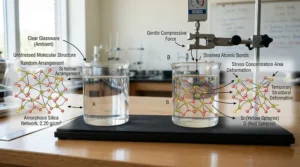
This is the glass composition science section, and I promise it’s more interesting than it sounds. Ordinary soda-lime glass — the material behind roughly 90 percent of all glass manufactured today — starts as silica sand melted with soda ash to lower its melting point, then stabilized with limestone so it doesn’t dissolve back into a gel over time. That recipe, refined over centuries, is cheap, workable, and, when properly formed, plenty strong for everyday drinkware.
Borosilicate glass swaps a meaningful chunk of that recipe for boron trioxide, which fundamentally changes the glass’s coefficient of thermal expansion — the rate at which it expands and contracts with temperature. A lower expansion coefficient means less internal stress when one part of the glass heats faster than another, which is precisely why laboratory beakers, oven-safe cookware, and yes, some wine glasses, are made from it. “Crystal” glassware from brands like Riedel or Zwiesel Glas complicates the borosilicate vs soda-lime glass wine glasses conversation further, because most modern lead-free crystal is still a soda-lime derivative with added minerals — titanium oxide, zirconium oxide, or potash — for brilliance and strength, not a separate borosilicate formula at all.
Borosilicate vs Soda-Lime Durability: Stress-Testing the Marketing Claims
Let’s settle the borosilicate vs soda-lime durability question honestly, because “durable” means different things depending on how a glass actually fails. Borosilicate’s advantage is specific: it resists thermal shock, meaning it can handle a sudden jump from ice water to hot mulled wine without cracking, something standard soda-lime glass genuinely struggles with. That’s a real, measurable chemistry advantage, not marketing fluff.
But day-to-day breakage in most households isn’t caused by thermal shock — it’s caused by drops, chips, and stem snaps, and there, soda-lime glass can absolutely compete or win, depending on wall thickness and tempering. A heavy tempered soda-lime tumbler like the Bormioli Rocco set above will often survive a countertop drop that would crack a thin borosilicate stem, simply because mass and wall thickness matter more than base chemistry for impact resistance. The honest takeaway on material durability comparison: choose borosilicate specifically for thermal resilience, and choose thicker, tempered, or mineral-reinforced soda-lime glass specifically for impact and chip resistance. They’re solving two different problems, not competing on the same scoreboard.
How to Choose Wine Glass Material for Your Home Bar
Choosing wine glass material doesn’t have to be complicated once you’re honest about your actual habits. Here’s a simple, expert-reasoned process:
- Identify your biggest breakage risk. If you regularly serve hot mulled wine, rinse glasses under hot water right after the dishwasher, or live somewhere with dramatic temperature swings, prioritize borosilicate for its thermal-shock resistance.
- Count your dishwasher cycles per week. Households running glassware through the dishwasher daily benefit from tempered soda-lime or Tritan Crystal options, which resist the etching and clouding that softer glass develops over time.
- Decide if aroma matters to you. If you’re a serious wine drinker chasing the full sensory experience, varietal-specific crystal shapes like the Riedel Vinum line offer measurable aroma benefits that flat-walled budget glasses simply don’t replicate.
- Set a realistic breakage budget. Cheaper soda-lime sets make more financial sense if you expect to lose one or two glasses a year regardless of material.
- Consider who’s actually drinking from these. Households with kids, roommates, or frequent parties should weight impact resistance (thick, tempered, or Tritan glass) over thermal resistance.
- Match capacity to your typical pour. Larger 18-21 ounce bowls suit reds that benefit from aeration; smaller 12-14 ounce shapes suit whites and sparkling wines you want to keep cooler, longer.
- Buy in sets larger than you think you need. Whichever material you choose, breakage happens — an extra two or four glasses saves you from mismatched sets within a year.
What to Expect: Real-World Performance at the Dinner Table
Specs are one thing; pouring an actual glass of Cabernet is another. In practice, borosilicate wine glasses feel noticeably lighter in hand than tempered soda-lime alternatives, which some drinkers love and others find “cheap-feeling” purely due to weight psychology rather than any real quality difference. Crystal-style soda-lime glasses, by contrast, tend to feel more substantial and often ring with a clear tone when tapped — a small sensory cue that genuinely does correlate with denser, more precisely manufactured glass.
The bigger real-world factor is shape, not material. Researchers studying wine perception have found that glass shape measurably influences how untrained tasters perceive a wine’s aroma, which is a large part of why varietal-specific crystal glasses justify their price for serious drinkers even though the underlying chemistry — soda-lime plus mineral additives — isn’t dramatically different from a basic tumbler. If you’ve ever noticed a wine “opening up” more in one glass than another, that’s less about borosilicate versus soda-lime and more about bowl width, rim taper, and how much surface area the wine gets exposed to.
Common Mistakes When Buying Wine Glasses
Even careful shoppers stumble into a few predictable traps here. First, people assume “crystal” automatically means lead crystal, when most modern crystal glassware, including every option on this list, is lead-free by design and regulation. Second, buyers frequently ignore capacity in favor of looks, ending up with gorgeous glasses that hold an awkwardly small pour for how they actually drink.
Third — and this one costs the most money over time — shoppers assume thermal resistance and impact resistance are the same thing, then get frustrated when their “durable” borosilicate glass chips from a countertop drop it was never designed to survive. Fourth, many people skip checking dishwasher-safe ratings closely, not realizing that “dishwasher safe” and “top-rack only, gentle cycle” are meaningfully different instructions that affect how fast a set clouds over. Finally, plenty of buyers purchase mismatched replacement glasses one at a time instead of buying a slightly larger set upfront, which is almost always the cheaper path in the long run.
Long-Term Cost & Maintenance: The Real Total Cost of Ownership
| Scenario | Budget Soda-Lime | Borosilicate | Premium Crystal (Tritan/Vinum) |
|---|---|---|---|
| Upfront cost per glass | Lowest | Low-to-mid | Highest |
| Expected chip/break rate (heavy use) | Moderate-high | Moderate | Low-to-moderate |
| Etching/clouding over 2+ years | Higher risk | Lower risk | Lowest risk (with proper care) |
| Replacement availability | Easy, cheap | Moderate | Easy but pricier |
| Best long-term value for | Casual, infrequent hosts | Hot-beverage households | Frequent hosts wanting longevity |
Running the numbers, budget soda-lime glasses win on upfront cost but often lose on total cost of ownership if you host frequently, since replacing a broken set of eight every year or two adds up faster than people expect. Borosilicate sits in an interesting middle ground — cheaper than premium crystal but genuinely more resilient against the specific failure mode of thermal cracking. Premium Tritan Crystal and Vinum-style glassware cost more upfront, but aggregated review data across brands like Zwiesel Glas and Schott Zwiesel consistently shows lower long-term clouding and chip rates, which can make the true multi-year cost surprisingly competitive with constantly replacing cheap sets.
Practical Usage Guide: Care, Cleaning, and Your First 30 Days
Whatever material you land on, the first 30 days matter more than people realize. Wash every new glass by hand before first use, even if it’s labeled dishwasher-safe, since manufacturing residue and packaging dust are common and easy to miss otherwise. For the first few weeks, avoid extreme temperature jumps regardless of material — even borosilicate has thermal shock limits, and no glass appreciates going straight from a hot dishwasher into a freezer.
Load stemware on the top rack only, angled so bowls don’t touch each other or the rack tines directly, since most chip damage happens from glass-on-glass or glass-on-metal contact during the wash cycle, not from the detergent itself. If you own crystal or Tritan glasses, skip the “sanitize” or “extra hot” dishwasher cycle, which accelerates the microscopic etching that eventually clouds glass permanently. A common early mistake is stacking glasses for storage — even briefly — which is one of the fastest ways to introduce hairline stress cracks near the rim, so store stemware upright and single-file instead.
Real-World Scenarios: Which Glass Fits Your Life
The weeknight sipper: If you’re pouring one glass of wine after work a few times a week, capacity and comfort beat everything else. The JoyJolt Spirits Stemless set covers red, white, and the occasional cocktail without needing a cabinet full of specialty shapes.
The frequent host: If your calendar has a dinner party or game night every couple of weeks, budget and quantity matter more than perfection. The Libbey Signature Kentfield 12-piece set or the Bormioli Rocco Restaurant glasses give you enough matching glassware to survive a full table without financial stress if one breaks.
The serious taster: If you’re working through a wine club subscription or genuinely comparing varietals side by side, the Riedel Vinum Cabernet/Merlot glasses are worth the investment specifically because shape-driven aroma concentration is a documented, real effect — not just marketing language.
Your Wine Glassware Buying Guide: A Decision Framework
Think of this glassware buying guide as a simple if-then checklist rather than another spec sheet to memorize. If you regularly serve hot drinks or live somewhere with big temperature swings, choose borosilicate for its thermal resilience. If you host large groups often and need matching sets without a big investment, choose tempered or ClearFire-style soda-lime for its balance of price and impact resistance. If you’re chasing the full sensory wine experience and don’t mind hand-washing carefully, choose a varietal-specific crystal shape like Riedel Vinum. And if you want one elegant, break-resistant glass that does almost everything reasonably well, Tritan Crystal options from Zwiesel Glas or Schott Zwiesel are the safest all-around bet.

Frequently Asked Questions
❓ Is borosilicate glass better than soda-lime for wine glasses?
❓ Can borosilicate wine glasses go in the microwave?
❓ Is soda-lime glass safe for wine and other drinks?
❓ Why do some wine glasses cost so much more than others?
❓ How long should quality wine glasses last with regular use?
Conclusion
The borosilicate vs soda-lime glass wine glasses debate isn’t really about picking a winner — it’s about matching a real material science trade-off to your actual drinking habits. Borosilicate earns its keep when heat and sudden temperature swings are part of your routine, while soda-lime, in its many forms from budget tempered tumblers to titanium-reinforced Tritan Crystal, covers nearly everything else with more variety, more shapes, and often more elegance per dollar.
If you take away one thing, let it be this: the “best” wine glass material is the one that survives your actual dishwasher, your actual dinner parties, and your actual level of carefulness at 11 p.m. after the second bottle. Start with the honest self-assessment in the decision framework above, pick from the seven real, currently available options covered here, and you’ll end up with glassware that lasts far longer than the last set you impulse-bought.
Recommended for You
- 7 Best Glass Wine Glasses For Large Gatherings And Parties (2026)
- 7 Best Budget Glass Wine Glasses in 2026: Real Picks & Tips
- Unbreakable Glass Wine Glasses for Camping: 7 Top Picks (2026)
Disclaimer: This article contains affiliate links. As an Amazon Associate, I earn from qualifying purchases. If you purchase products through these links, we may earn a small commission at no additional cost to you.
✨ Found this helpful? Share it with your friends! 💬🤗
