In This Article
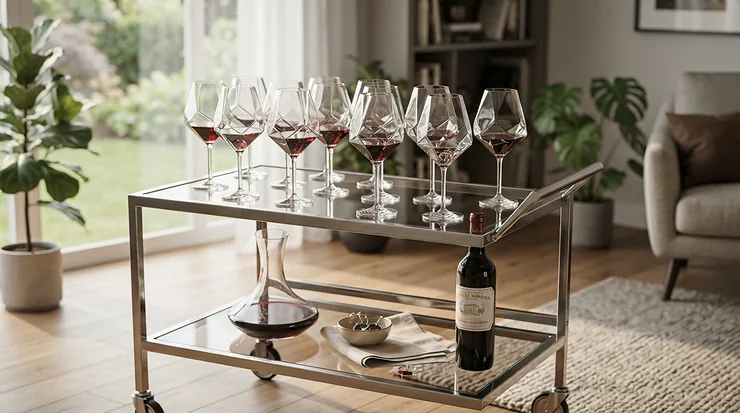
Somewhere between “I need a wine glass” and “I need a whole vibe” sits a very specific kind of shopper — the one who scrolled past a plain stemless glass at the store and felt nothing. If that’s you, welcome. Geometric wine glasses for a modern bar cart are exactly what they sound like: stemware built from angles instead of curves, faceted surfaces instead of smooth ones, and just enough visual drama to make a Tuesday pour feel like an occasion. Think cut crystal that throws little rainbows across your countertop, star-shaped bases, basketweave textures, and bowls that look like they were sketched by an architect rather than a glassblower on autopilot.
This isn’t just a design trend, either — it’s a small return to craftsmanship. For decades, “fancy stemware” meant one of two things: your grandmother’s untouchable china cabinet crystal, or the flimsy stuff that chips if you look at it wrong. Geometric and faceted glassware splits the difference, bringing sculptural personality to glass that’s actually meant to be used, washed, and refilled on a random Wednesday night.
Below, we’ve researched seven real, currently available sets spanning playful budget picks to genuinely investment-worthy crystal, so you can outfit your cart without guessing. Every pick gets honest analysis, not just a spec sheet — because a bar cart is a small stage, and the glassware is the leading actor. One study even used a “sniff-cam” to prove that glass geometry controls where and how vapor rises from wine, influencing how it tastes — so this obsession with shape isn’t just about looks.
What Is a Geometric Wine Glass?
A geometric wine glass is stemware where the bowl, stem, or base is shaped or cut into angular facets — squares, diamonds, hexagons, or star patterns — rather than a single smooth curve. The faceting can be etched, molded, or hand-cut into crystal, and it’s designed to catch and refract light while giving the glass a distinct, sculptural silhouette on a shelf or cart.
The look draws loosely from cut-crystal traditions and, more recently, from the fractured, multi-planed aesthetic popularized by early-20th-century art movements — which is exactly why “cubist” keeps coming up in design conversations about this glassware.
Quick Comparison: Geometric Wine Glasses at a Glance
Before you dive into the full breakdown, here’s the fast version. This table pulls the five most distinct picks from our full list of seven so you can see the range at a glance.
| Glass | Design Style | Price Range | Best For |
|---|---|---|---|
| JoyJolt Geo White Wine Glasses | Etched square/triangle/circle/hexagon | Around $30–$35 | Budget-friendly fun, guest tracking |
| CB2 Stella Optic Wine Glasses | Optic-faceted ribbing | $35–$45 range | Everyday modern minimalism |
| Viski Seneca Faceted Wine Glasses | Star-shaped faceted base | Around $30–$40 | Cocktail-and-wine crossover use |
| LSA International Gems Wine Glasses | Fluted jewel-toned facets | $55–$70 range | Color-loving statement glassware |
| NUDE Round Up Wine Glasses | Sculpted vertical faceting | Around $60–$80 | Design purists, gifting |
Looking at the spread, there’s a clear pattern: the more subtle and refined the faceting, the higher the price climbs, because true hand-finished cuts take longer to produce than a molded pattern. Budget picks like the JoyJolt Geo glasses lean into bold, obvious geometry that reads well from across a room, while NUDE Round Up whispers its geometry through fine vertical lines that only reveal themselves in good light. Neither approach is “better” — it depends on whether your bar cart wants to shout or murmur.
💬 Found a favorite already? Save this list and keep scrolling — the full breakdown explains exactly why each one earns its spot.
Top 7 Geometric Wine Glasses: Expert Analysis
We researched real specs, aggregated review sentiment, and design details for seven genuinely available sets — covering budget, mid-range, and premium tiers, plus a mix of playful and refined aesthetics. Every one of these could anchor a modern bar cart; the right choice just depends on your entertaining style and how much sparkle you want with your Sauvignon Blanc.
1. JoyJolt Geo White Wine Glasses — playful geometric shapes on a budget
The JoyJolt Geo White Wine Glasses kick off this list because they’re the most literally “geometric” set here — four glasses, each etched with a different shape (square, triangle, circle, hexagon), so your guests can find their glass at a glance. Each glass holds 14 ounces, stands roughly 9.3 inches tall, and is made from hand-engraved, blown lead-free crystal that’s dishwasher safe because the pattern is etched rather than painted on. That durability detail matters more than it sounds — painted patterns fade after a few dozen dishwasher cycles, while an etched one is basically permanent.
Based on the spec comparison, this set is best for casual hosts who want personality without a big investment: think game nights, book club, or anyone who’s tired of guests asking “wait, which glass is mine?” Reviewers consistently describe the set as delicate-looking but sturdy in daily use, and multiple buyers specifically praised the subtlety of the shapes — noticeable up close, cohesive from a distance.
Pros:
- ✅ Etched (not painted) pattern survives the dishwasher long-term
- ✅ Four distinct shapes make tracking drinks effortless at parties
- ✅ Gift-boxed presentation feels premium for the price
Cons:
- ❌ 14oz capacity runs smaller than typical modern wine glasses
- ❌ Etching is subtle, so it won’t read as “bold” from across a room
At around $30–$35 for the set of four, this is an easy entry point into geometric glassware, and it earns a strong value verdict for anyone dipping a toe in before committing to pricier crystal.
2. CB2 Stella Optic Wine Glasses — affordable optic-faceted shimmer for daily use
Moving up slightly in polish, the CB2 Stella Optic Wine Glasses bring vertical optic ribbing to a set of six — meaning the glass itself is molded with continuous faceted grooves rather than a printed or etched pattern. What most buyers overlook about optic-cut glass is that the ribbing isn’t purely decorative: it adds rigidity to thin-walled glass, so these can feel more delicate in the hand than they actually are structurally.
Sold in sets of six (both red and white wine silhouettes are available), the CB2 Stella Optic Wine Glasses are designed for people who want geometric texture without a heavy price tag attached to it — CB2’s tableware lines are known for turning over new colorways and finishes regularly, so this is also an easy set to expand later. Here’s what to weigh: at six per set, breakage is less catastrophic than losing one of a pair, which makes this a smart pick for households that host often and occasionally lose a glass to an overzealous dishwasher-loading moment.
Pros:
- ✅ Set of six means you’re covered for real dinner parties
- ✅ Optic ribbing adds durability, not just visual texture
- ✅ Fits CB2’s broader modern tableware ecosystem for mixing
Cons:
- ❌ Thinner glass walls need gentler handwashing for longevity
- ❌ Design reads more “modern minimal” than boldly geometric
Priced in the $35–$45 range for six glasses, the per-glass cost is genuinely hard to beat for daily-use crystal-adjacent stemware.
3. Godinger Dublin Crystal Wine Goblets — classic diamond-cut sparkle on a budget
If you want the traditional cut-crystal look — the kind your eye associates with “fancy” without needing to explain why — the Godinger Dublin Crystal Wine Goblets deliver it. The Dublin collection is Godinger’s flagship crystal-cut line, featuring a brilliant-cut pattern in the bowl with fan, criss-cross, or diamond motifs that refract light, paired with a faceted or multi-sided stem. It’s the closest thing on this list to old-world crystal, just built for a modern price point.
The spec sheet won’t tell you this, but reviewers note the weight distribution feels more substantial than the price suggests — the faceted stem and wider base give it a grounded, “special occasion” heft in hand, even though it’s sturdy enough for regular rotation. Based on the spec comparison, this is the pick for anyone styling a bar cart with a slightly more traditional or transitional aesthetic — think brass accents and warm wood rather than stark Scandinavian minimalism.
Pros:
- ✅ Classic diamond and fan-cut pattern feels timeless, not trendy
- ✅ Faceted stem adds substantial in-hand weight and stability
- ✅ Coordinating decanter and goblet sets are available for matching
Cons:
- ❌ Traditional cut pattern may clash with ultra-minimal modern decor
- ❌ Hand wash recommended despite dishwasher-safe marketing
Expect to pay under $50 for a set of four, making this one of the most accessible ways to get genuinely cut crystal on a bar cart.
4. Viski Seneca Faceted Wine Glasses — a star-shaped base built for cocktails and wine alike
The Viski Seneca Faceted Wine Glasses stand out because their geometry lives in the base, not the bowl — a striking star-shaped base made from lead-free crystal that reflects light beautifully, paired with a clean, modern bowl. That design choice is deliberate: it keeps the drinking experience smooth (no facets against your lips) while still giving the glass a sculptural signature when it’s sitting on the cart.
At 20 ounces per glass, these run larger than most sets on this list, and Viski markets them explicitly as crossover glasses — equally suited to red wine, white wine, Aperol spritz, and other cocktails. Here’s what to weigh: if your bar cart needs to multitask between a dinner party and a backyard cocktail hour, a single glass style that handles both pours means less shelf space dedicated to single-use stemware, which is a real practical win for smaller apartments.
Pros:
- ✅ Star-shaped base is genuinely unique among faceted glassware
- ✅ Generous 20oz capacity works for wine and cocktails alike
- ✅ Versatile enough to skip buying separate cocktail glasses
Cons:
- ❌ Sold in sets of two, so larger gatherings need multiple sets
- ❌ Larger capacity isn’t ideal if you prefer traditional wine pours
At around $30–$40 for a set of two, the per-glass price sits mid-pack, but the versatility helps justify it.
5. LSA International Gems Wine Glasses — jewel-toned faceted texture for color lovers
Most of this list plays it clear and crystalline, but the LSA International Gems Wine Glasses introduce color into the geometric conversation. Each 250ml glass features hand-applied, jewel-coloured lustres inspired by semi-precious stones, with fine walls fluted in a texture like faceted gems that catch the light. It’s less “cut crystal sparkle” and more “wearable jewelry for your bar cart.”
What most buyers overlook about colored glassware like this is how much easier it makes hosting logistics: with garnet, jade, and sapphire colorways available, guests can keep track of their glass by color instead of by memory, solving the same “whose glass is this” problem the JoyJolt Geo set solves through shape instead. Based on the spec comparison, this is the pick for anyone whose bar cart doubles as a decor statement even when no one’s drinking from it — the color alone does visual work that clear crystal can’t.
Pros:
- ✅ Jewel-toned color adds visual interest even when empty
- ✅ Faceted, fluted texture doubles as a tactile grip
- ✅ Hand-applied lustre finish feels more artisanal than mass-produced
Cons:
- ❌ Hand wash only, which adds a maintenance step
- ❌ Colored glass can visually mute lighter white wines
Priced in the $55–$70 range for a set of four, this sits solidly mid-tier, with the value coming from the design statement rather than raw crystal quality.
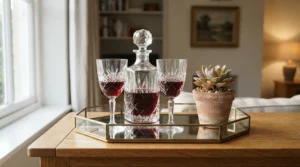
6. Nachtmann Bossa Nova Wine Glass — German-made basketweave cut for refined sparkle
For buyers who want serious crystal credentials, the Nachtmann Bossa Nova Wine Glass delivers a genuinely refined take on faceted design. The collection’s signature is a clean crystal glass surface paired with precisely crafted faceted details in the stem or base, creating subtle texture, exceptional brilliance, and a sense of depth while keeping a sleek, minimalist silhouette. The cut pattern itself is inspired by woven basketweave texture, giving it a graphic presence without looking busy.
Reviewers consistently note the balance this design strikes — bold enough to notice, restrained enough to still look like “quiet luxury” rather than costume-party crystal. Made in Germany at Nachtmann’s own production facilities, the line carries nearly two centuries of crystal-making heritage behind it, which matters if you care about provenance as much as looks. The spec sheet won’t tell you this, but the faceting is concentrated low on the glass (stem or base), meaning the bowl itself stays perfectly clear — ideal if you want the sparkle without any visual distortion of the wine’s actual color.
Pros:
- ✅ German-made crystal with genuine heritage and reputation
- ✅ Faceting is concentrated at the base, keeping the bowl distortion-free
- ✅ Dishwasher-safe despite the refined crystal construction
Cons:
- ❌ Sits at a higher price point than the mass-market options above
- ❌ Understated design may feel too subtle for buyers wanting bold geometry
Expect to pay in the $40–$70 range depending on set size, positioning this as a genuine step up in crystal quality.
7. NUDE Round Up Wine Glasses — handcrafted sculptural lines for the design purist
Closing out the list at the premium end, the NUDE Round Up Wine Glasses are the most design-forward pick here. Each glass is defined by a rounded bottom and tapered rim, shaped to retain aromas and flavors, with sweeping vertical lines patterning the surface, and every piece is handcrafted from lead-free crystal by NUDE’s master glassblowers. The vertical faceting here is more architectural than decorative — closer to fluted columns than cut gemstones.
What most buyers overlook about handmade crystal like this is the built-in variation: because each glass is blown rather than machine-pressed, no two are perfectly identical, which is either a selling point or a dealbreaker depending on how much you value uniformity. Based on the spec comparison, this is the pick for genuine design lovers — the kind of buyer who’d rather own three glasses that feel like small sculptures than a dozen that are merely “nice.” NUDE’s broader design philosophy treats geometry as structural honesty rather than embellishment, which shows up clearly in the restrained, confident silhouette.
Pros:
- ✅ Handblown crystal means genuine artisanal craftsmanship
- ✅ Sculptural vertical faceting feels architectural, not decorative
- ✅ Available across red, white, and sparkling wine shapes for a full set
Cons:
- ❌ Highest price point on this list by a clear margin
- ❌ Sold in sets of two, so full dinner-party coverage gets pricey
At around $60–$80 for a set of two, this is an investment pick — one best reserved for buyers who see glassware as design objects first, drinkware second.
Practical Usage Guide: Styling & Caring for Your Bar Cart
Buying the glasses is the easy part. Getting them to actually look intentional on your cart — instead of just sitting there like unopened mail — takes a little more thought.
Home Bar Styling Essentials
Good home bar styling follows a simple rule: contrast and restraint. If your geometric wine glasses already bring visual complexity through their facets, keep the rest of the cart simpler — a wooden tray, one statement bottle, a small bowl for citrus. Cluttering a faceted glass next to five other patterns just competes for attention. As one styling guide puts it, a bar cart works best when you start with the essentials — spirits you actually drink, a couple of favorite glasses, and a shaker or two, then build outward from there rather than trying to fill every inch at once.
Group your geometric glasses by twos or threes rather than lining them up like soldiers — asymmetry photographs (and looks) more natural. And place your most faceted pieces where they’ll catch ambient light, whether that’s near a window or under a warm bulb; the whole point of cut and faceted glass is the light play, so hiding it in a shadowy cabinet corner wastes the design.
First 30 Days: Common Setup Mistakes
New geometric glassware owners tend to make the same early mistakes: stacking glasses rim-to-rim (which chips faceted edges faster than smooth ones), skipping a first gentle hand wash before use (factory residue can dull the shine), and overcrowding a small cart so nothing has breathing room. Give each glass its own footprint, wash by hand for the first use even if it’s dishwasher-rated long-term, and resist the urge to display every piece you own at once — rotation keeps the cart feeling fresh.
Real-World Scenarios: Matching Glasses to Your Entertaining Style
The apartment host. If you’re entertaining in 600 square feet, your entertaining essentials need to multitask. The Viski Seneca Faceted Wine Glasses, which cross over between wine and cocktails, make more sense than a dedicated single-use set — one glass style, less cabinet space, and a base geometric enough to still feel special.
The frequent dinner-party thrower. Sets of six, like the CB2 Stella Optic Wine Glasses, solve the math problem that sets of two or four create the moment your guest list hits eight people. Budget and volume both matter more here than rarity.
The design-obsessed gift-giver. For weddings, housewarmings, or “just because” gifts to someone who already owns nice things, the NUDE Round Up Wine Glasses or Nachtmann Bossa Nova Wine Glass communicate more thought than a bottle of wine ever could — genuinely one of the better entertaining essentials to gift because the recipient will use them for years, not one evening.
Problem → Solution: Common Geometric Glassware Headaches
Problem: Faceted glasses feel harder to clean than smooth ones. Solution: hand wash with a soft brush that can reach into grooves, and dry immediately — water spots show up more visibly on faceted surfaces because of all the extra light-catching angles.
Problem: Mismatched sets after a few breakages. Solution: buy sets of six instead of two or four when your budget allows, specifically to build in a buffer against the inevitable accident.
Problem: Geometric glasses look “too busy” next to existing stemware. Solution: use them as accent pieces for two or three guests rather than replacing your entire collection — a mixed table with one or two statement glasses often reads more curated than an entirely matched set.
Problem: Colored or patterned glass makes it hard to judge wine color. Solution: reserve heavily tinted pieces like the LSA International Gems Wine Glasses for casual sipping or cocktails, and keep a clear faceted option like the Nachtmann Bossa Nova Wine Glass on hand for actual tasting nights.
How to Choose Geometric Wine Glasses for a Modern Bar Cart
- Decide how bold you want the geometry. Etched shapes and star-bases (like JoyJolt Geo or Viski Seneca) read as playful; subtle vertical faceting (like NUDE Round Up) reads as refined.
- Match capacity to your actual pours. If you drink mostly white wine or rosé, a smaller 12–14oz bowl concentrates aroma better than an oversized 20oz cocktail-crossover glass.
- Check the wash instructions before you buy. Hand-wash-only pieces are gorgeous but add friction to weeknight use — fine for special occasions, less fine for Tuesday.
- Consider set size relative to your guest list. Sets of two suit couples; sets of four or six suit anyone who regularly hosts.
- Think about where the faceting sits. Base-only faceting (Nachtmann Bossa Nova) keeps the wine’s color true; bowl faceting or tinting changes how the wine actually looks in the glass.
- Factor in your existing bar cart palette. Clear crystal pairs with almost anything; colored glass like the LSA Gems set needs a cart designed around it.
- Set a real budget band before you shop. This category spans roughly $30 to $80+ per set, and knowing your ceiling up front prevents impulse-buying past it.
What to Expect: Faceted Crystal Wine Glasses for Entertaining
Specs only tell half the story — here’s what faceted crystal wine glasses for entertaining actually feel like in daily rotation. Expect a slightly heavier in-hand feel than plain stemware, since cut and faceted patterns typically require thicker glass walls to hold their shape. Expect more frequent hand-drying, since water beads and spots are simply more visible across dozens of tiny reflective surfaces than on smooth glass.
On the upside, expect compliments — faceted crystal is one of the few genuinely conversation-starting objects you can put on a table without saying a word about it. And expect the light show to change depending on your setup: candlelight makes faceted crystal look warm and golden, while daylight brings out sharper, cooler sparkle. If you switch up your lighting for different occasions, your glassware will look almost like a different set each time.
Cubist Design Wine Glasses for Design Lovers
If you’re drawn to glassware because it reminds you of art rather than tableware, you’re responding to a real lineage. Cubism, created by Pablo Picasso and Georges Braque in Paris between 1907 and 1914, took the geometric forms critics called “cubes” and used them to reduce and rearrange familiar objects into fractured, multi-angled compositions. Read the full history at the Metropolitan Museum of Art’s Cubism overview if you want the deeper design context.
That fractured-plane sensibility is exactly what shows up in faceted glassware today — a bowl or base broken into distinct flat surfaces rather than one continuous curve. For design lovers, the NUDE Round Up Wine Glasses and Nachtmann Bossa Nova Wine Glass lean closest to this aesthetic lineage: restrained, architectural, more about structure than decoration. If you want the reference more literally, look for pieces marketed with terms like “faceted,” “cut,” or “prism” — that’s the direct descendant of the cubist visual language, translated into functional glass.
Geometric Wine Glasses vs Traditional Stemware
| Factor | Geometric / Faceted Glasses | Traditional Smooth Stemware |
|---|---|---|
| Visual impact | High — catches and refracts light | Low — relies on shape alone |
| Cleaning effort | Slightly higher (grooves, facets) | Lower (flat surfaces wipe clean) |
| Price range | $30–$80+ depending on craftsmanship | $10–$60 depending on brand |
| Best for | Statement bar carts, gifting, entertaining | Everyday use, formal wine tasting |
| Aroma/tasting performance | Comparable, base-faceting doesn’t affect bowl shape | Purpose-built bowl shapes optimize aroma |
The tradeoff here isn’t really about function — whether glass shape actually changes the taste of wine has never been decisively proven by any single study and remains debated, so neither style has a definitive tasting advantage. It’s about what your bar cart is for. If you’re building a display piece as much as a drinking set, geometric wins on personality. If you’re chasing serious tasting-glass performance for a specific varietal, a purpose-shaped traditional bowl (like a Bordeaux or Burgundy glass) still has the edge in bowl geometry designed around aroma concentration.
✨ Ready to mix both? A lot of the best bar carts pair one geometric statement set with a traditional everyday set — best of both worlds.
Common Mistakes When Buying Statement Glassware
The most common mistake is buying statement glassware based purely on a photo without checking capacity — a glass that looks striking online can turn out to hold a stingy 10 ounces, which is frustrating for anyone who actually pours generously. Another frequent misstep: buying a single showpiece glass instead of a full set, then realizing there’s nothing to pair it with when guests arrive.
Buyers also commonly skip the care instructions entirely, only to discover after the first wash that a hand-wash-only piece has gone through the dishwasher and lost some of its shine or developed cloudiness. And a subtler mistake: choosing heavily patterned or colored statement glassware as your only set, then finding it doesn’t work for every wine or occasion — a bar cart genuinely benefits from having at least one clear, simple option in the mix alongside the showpieces.
Safety, Care & Long-Term Value
A fair number of “crystal” wine glasses — including vintage cut patterns like Godinger’s Dublin line — are traditionally made with lead oxide, which raises the glass’s refractive index and creates that extra sparkle. It’s worth knowing the actual guidance here rather than guessing: government health authorities note that regular use of leaded crystal glassware isn’t recommended for daily use, particularly for children and pregnant women, given lead’s potential health effects. For full detail, Health Canada’s consumer guidance on lead crystalware is a clear, practical reference.
In practice, this means: check whether a set is marketed as “lead-free crystal” (most modern brands on this list, including NUDE, Viski, and Nachtmann, use lead-free formulations) versus traditional leaded crystal, and avoid storing wine or spirits in leaded decanters for extended periods regardless of which glass you drink from.
On the value side, geometric and faceted glassware tends to hold up well over time if it’s cared for properly — hand washing extends the life of any faceted or cut pattern by years compared to repeated dishwasher cycles, which can dull edges and introduce micro-scratches that catch light unevenly. Buying a slightly pricier, well-made set (like Nachtmann Bossa Nova or NUDE Round Up) and maintaining it properly often works out cheaper per year of use than repeatedly replacing budget glasses that chip.
FAQ
❓ What makes wine glasses 'geometric'?
❓ Are geometric wine glasses dishwasher safe?
❓ Do faceted wine glasses change how wine tastes?
❓ What's the difference between cut crystal and faceted glass?
❓ How many geometric wine glasses should I buy for entertaining?
Conclusion
A bar cart is one of the few pieces of furniture in a home that’s allowed to be a little theatrical, and geometric wine glasses are the easiest way to lean into that without redecorating anything else. Whether you start with the playful, budget-friendly JoyJolt Geo White Wine Glasses, land somewhere in the refined middle with the Nachtmann Bossa Nova Wine Glass, or go all-in on the sculptural NUDE Round Up Wine Glasses, the underlying idea is the same: let the glass do a little of the decorating for you.
There’s no single “correct” pick here — a design lover chasing that cubist-inspired fractured-plane look wants something very different from a weeknight host who just needs six sturdy glasses that survive the dishwasher. Use the comparison tables above to match your budget and style, start with one set rather than trying to overhaul your entire glassware collection at once, and let your bar cart evolve as your entertaining habits do. The right geometric wine glasses won’t just hold your wine — they’ll make the whole cart look like it was styled on purpose.
Recommended for You
- Faceted Wine Glasses Set: 7 Stunning Geometric Picks For 2026
- Modern Stemless Wine Glasses: 7 Best Picks For Everyday Use (2026)
- 7 Genius Modern Wine Glasses For Small Kitchens (2026 Picks)
Disclaimer: This article contains affiliate links. As an Amazon Associate, I earn from qualifying purchases. If you purchase products through these links, we may earn a small commission at no additional cost to you.
✨ Found this helpful? Share it with your friends! 💬🤗
