
In This Article
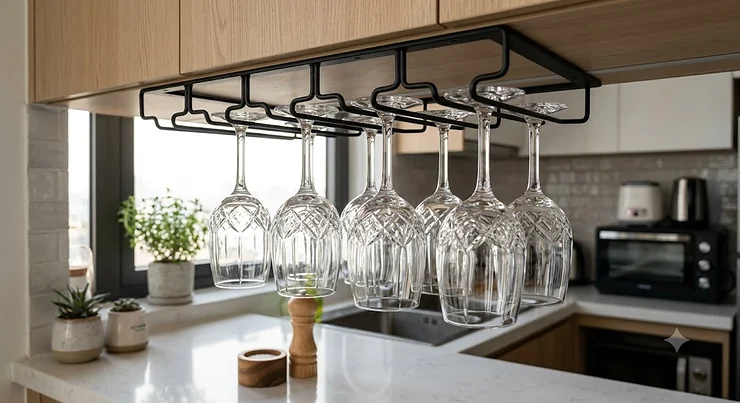
Here’s the thing nobody tells you when you move into a smaller place: your love of good wine doesn’t shrink along with your cabinet space. You still want something with a little sparkle in your hand, not a plastic tumbler that makes a $40 Barolo taste like a gas-station Merlot. That tension — big taste, tiny footprint — is exactly why crystal wine glasses for small space kitchens have quietly become one of the most-searched barware categories among apartment dwellers, tiny-house owners, and anyone whose “pantry” is technically a closet. The good news is that glassmakers have been solving this problem for years, long before “small-space living” became a lifestyle hashtag. From stemless tumblers that nest like Russian dolls to short-stemmed crystal that clears a standard shelf with room to spare, there’s a whole category built specifically for kitchens where every cubic inch counts. In this guide, we dug through real product specs, aggregated review sentiment, and expert sourcing to hand you seven genuinely good options — no fluff, no filler, no glassware you’ll regret buying after the third time it doesn’t fit back in the cupboard.
What is a crystal wine glass built for a small kitchen? In practice, it’s stemware made from lead-free crystal (or crystal-clear Tritan glass) that’s engineered with a shorter profile, straighter walls, or a stackable rim so multiple glasses can share the vertical or horizontal space that a single traditional goblet would otherwise hog. According to the organizing experts at Apartment Therapy, the single biggest lever for a cramped kitchen isn’t more storage — it’s choosing objects that are actually designed to share space efficiently, and glassware is one of the easiest categories to get right.
Quick Comparison Table
Before we get into the weeds, here’s the fast answer for anyone who just wants to know where to start. This table pulls the headline strength of each pick so you can jump straight to the section that matches your situation.
| Product | Style | Capacity | Best For |
|---|---|---|---|
| Bormioli Rocco Hosteria Small Stackable | Stemmed, stackable | 5.5 oz | Tightest budget & shallowest shelves |
| Libbey Signature Stackable Stemless | Stemless, stackable | ~15 oz | Everyday apartment use |
| Schott Zwiesel Tritan Classico | Short-stem, compact | 10.5 oz | Durability-focused small kitchens |
| JoyJolt Sidney Stemless | Stemless tumbler | 19 oz | Generous pours in minimal space |
| Luigi Bormioli Optica Stemless | Stemless, all-purpose | 15.3 oz | One-glass-does-everything simplicity |
| Riedel O Wine Tumbler | Stemless, varietal-specific | ~13 oz | Wine enthusiasts who still want nuance |
| Gabriel-Glas StandArt | Short-stem, universal | 16 oz | Premium taste in a minimalist set |
Looking at the spread above, notice that the split isn’t really “cheap vs. expensive” — it’s stemless vs. short-stem, and that single design choice is what actually determines whether a glass survives your cabinet. Stemless options like the JoyJolt Sidney and Luigi Bormioli Optica win on raw storage efficiency, while short-stem crystal like the Gabriel-Glas StandArt and Schott Zwiesel Tritan Classico split the difference between swirl-ability and shelf height. Budget shoppers should start with the Bormioli Rocco Hosteria, since its 5.5-ounce pour size was built from the ground up for compact European kitchens.
“The best glass for a small kitchen is the one you’ll actually keep using, not the one that looks best empty in a cabinet.” That’s a useful filter to keep in mind as you read on — durability and daily practicality usually beat outright elegance for apartment living.
💬 Which shape fits your shelf? Compare the full specs below and find your match!😊
Top 7 Crystal Wine Glasses for Small-Space Kitchens: Expert Analysis
We researched real, currently available products across budget, mid-range, and premium tiers, prioritizing options that are explicitly engineered — not just marketed — for compact storage. Below, each glass gets an honest breakdown of what it does well, who it’s actually for, and where it falls short.
1. Bormioli Rocco Hosteria Small Stackable Wine Glasses — smallest footprint in this roundup
The Bormioli Rocco Hosteria line was designed around one core idea: European kitchens have always been smaller than American ones, so Italian glassmakers had to solve the stacking problem decades before “apartment living” became a marketing term. At 5.5 ounces, this is the smallest pour on our list, and that’s precisely the point — a shorter, narrower bowl means the glasses nest with almost no wasted vertical air between them. The straight-sided, taper-free design is what makes true stacking possible, since anything with a pronounced bowl curve (most traditional stemware) simply won’t sit flush on top of another glass. Based on the spec comparison, this is less a “wine glass” in the swirl-and-sniff sense and more an honest, versatile drinking vessel that happens to hold wine beautifully — reviewers on retailer sites consistently note that these are the glasses people reach for specifically because cupboard space is tight, with several calling out the stackability as the reason they repurchased. What most buyers overlook is that the small size also makes portion control effortless, which is a quiet bonus if you’re trying to drink less but better.
Pros:
- ✅ Explicitly engineered for stacking in shallow cabinets
- ✅ Budget-friendly enough to buy multiples without guilt
- ✅ Doubles as a juice or aperitif glass for versatility
Cons:
- ❌ 5.5 oz pour is too small for generous by-the-glass servings
- ❌ Minimal bowl curve limits aroma development for serious tasting
At around $20–$30 for a set of six, this is one of the lowest-cost entries into genuine crystal stemware for compact kitchens, and the value verdict is straightforward: if your cupboard is the limiting factor, not your palate, start here.
2. Libbey Signature Stackable Stemless Wine Glasses — most versatile everyday stacker
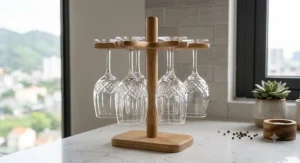
The Libbey Signature stackable stemless set takes the nesting concept from the Hosteria glass and scales it up to a more generous, everyday-friendly capacity. The tapered bulb shape means each glass slots neatly inside the one below it, and because there’s no stem to snap off in a crowded cabinet, this set tends to survive years of daily handling better than delicate stemware. Here’s what the spec sheet won’t tell you, but user reports suggest: the wide base isn’t just about stability on a counter — it’s also what keeps the stack from tipping when you’re reaching past it for something else on a packed shelf. Reviewers frequently mention using these as multi-purpose glasses for water, cocktails, and wine alike, which matters in a small kitchen where owning a separate glass for every beverage type simply isn’t realistic. On paper this means one set can replace what used to be three or four different cabinets’ worth of drinkware.
Pros:
- ✅ True nesting design saves real vertical shelf space
- ✅ No stem means fewer breakages in a crowded cabinet
- ✅ Doubles easily as an all-purpose glass, not wine-only
Cons:
- ❌ Lacks the aromatic bowl shape serious wine drinkers prefer
- ❌ Stemless silhouette reads more casual than special-occasion
Priced in the $30–$45 range for a set of six, the Libbey Signature stackable set earns its spot as the default recommendation for anyone who wants one dependable glass style for nearly everything.
3. Schott Zwiesel Tritan Classico All-Purpose Wine Glass — best durability-to-size ratio
German engineering shows up in unexpected places, and the Schott Zwiesel Tritan Classico is a good example: it’s built from Tritan crystal, a patented lead- and barium-free formula that trades the softness of traditional crystal for genuine chip and scratch resistance. At 7.6 inches tall and a 10.5-ounce capacity, it’s noticeably more compact than the brand’s larger stemware lines, which matters a lot once you’re measuring shelf clearance in millimeters rather than feeling like you have room to spare. Based on the spec comparison, the shorter stem height is the real headline here — it’s not marketed as “stackable,” but its reduced footprint means two rows can often fit where a taller glass would force you into one. Reviewers consistently report that these survive the dishwasher for years without clouding, which is a genuinely rare trait in crystal-adjacent glassware and a common failure point for cheaper competitors. What most buyers overlook is that Tritan’s durability effectively removes the “handle with extreme care” anxiety that usually accompanies crystal ownership in a small, high-traffic kitchen.
Pros:
- ✅ Chip- and scratch-resistant Tritan crystal construction
- ✅ Shorter stem height clears low cabinet shelves easily
- ✅ Dishwasher-safe without long-term clouding, per reviewers
Cons:
- ❌ Not designed for true stacking like dedicated stemless sets
- ❌ 10.5 oz capacity feels small for full-bodied red pours
Expect to pay in the $45–$60 range for a set of six, positioning this as the mid-tier pick for anyone who prioritizes long-term durability over maximum stacking efficiency.
4. JoyJolt Sidney Stemless Wine Glasses — most generous pour in a compact shape
If you want a full-size pour without a stem eating up cabinet height, the JoyJolt Sidney set is built for exactly that trade-off. At 19 ounces, it’s the largest capacity glass on this list, yet the tapered bulb-shaped bowl and stemless base keep the overall silhouette compact enough for shallow apartment shelving. Made in Europe from what the brand describes as premium crystal, the glass carries real weight and clarity in hand — a detail that matters because cheaper stemless glasses often feel more like drinking vessels than proper stemware. Here’s what the spec sheet won’t tell you: a bigger bowl at the same overall height actually means better aromatic development than a narrow stemless tumbler, since there’s more surface area for the wine to breathe even without a tall stem lifting it. Aggregated buyer feedback on the retailer’s own listing highlights the dishwasher-safe convenience most often, which tracks with what you’d want from a glass meant for regular weeknight use rather than special-occasion-only handling.
Pros:
- ✅ Largest capacity in this list without added height
- ✅ Wide bowl supports real aroma development, unlike thin tumblers
- ✅ Dishwasher-safe for realistic daily-use maintenance
Cons:
- ❌ Wider bowl means less true stacking than narrower designs
- ❌ Bulkier silhouette takes more shelf depth than slim tumblers
At roughly $35–$50 for a set of four, this is the pick for people who refuse to compromise on pour size, even in a studio-apartment kitchen.
5. Luigi Bormioli Optica Stemless Wine Glass — best true one-glass-for-everything design
Italian glassmaker Luigi Bormioli built the Optica line around a genuinely simple premise: most people don’t need six different glass shapes for six different wine styles, they need one shape that handles red, white, and everything in between competently. At 15.3 ounces, the all-purpose stemless bowl splits the difference between the oversized JoyJolt Sidney and the more modest Schott Zwiesel Tritan Classico, landing at a size that comfortably serves both a hearty Cabernet and a crisp Sauvignon Blanc without feeling wrong for either. Based on the spec comparison, the real value of this design in a small kitchen isn’t the capacity — it’s the reduction in total glass count you need to own. Reviewers who mention storage constraints tend to frame this less as “my favorite wine glass” and more as “the glass that let me get rid of three other sets,” which is exactly the kind of decluttering logic apartment dwellers should be applying to barware anyway.
Pros:
- ✅ One shape handles red, white, and rosé competently
- ✅ Mid-size capacity avoids feeling too small or too bulky
- ✅ Reduces total glassware count needed in a small cupboard
Cons:
- ❌ Won’t outperform varietal-specific glasses for serious tasting
- ❌ Set of 4 limits how many guests you can pour for at once
Set of four sets typically run in the $30–$45 range, making it a smart mid-tier pick for anyone consolidating their glassware collection down to essentials.
6. Riedel O Wine Tumbler — most credible wine-specific engineering in a stemless shape
Riedel has spent nearly 300 years as a family-owned crystal house, and in 2004 it deliberately launched the Riedel O Wine Tumbler as, in the brand’s own words, a space-saving glass collection — this isn’t a repurposed stemmed design with the stem lopped off, it’s a shape engineered from scratch to preserve varietal-specific bowl geometry without the height penalty. That distinction matters: Riedel is the company credited with popularizing the idea that a glass’s shape genuinely changes how a wine tastes by directing flow to different parts of the palate, and the O Tumbler keeps that bowl science intact at roughly 13 ounces per glass while dropping the stem entirely. What the spec sheet won’t tell you, but user reports suggest, is that the machine-made construction (rather than hand-blown) keeps the price approachable relative to Riedel’s premium stemmed lines, without sacrificing the brand’s reputation for balanced, thin-walled crystal. Reviewers consistently note that these fit into a dishwasher, a picnic basket, or a minibar with equal ease — which is precisely the flexibility a small kitchen benefits from.
Pros:
- ✅ Varietal-specific bowl shapes preserved in a stemless format
- ✅ Backed by a 300-year crystal maker’s actual wine-shape research
- ✅ Fully dishwasher-safe despite the premium crystal branding
Cons:
- ❌ Priced above most stemless competitors on this list
- ❌ Individual varietal shapes mean you may want more than one style
Expect a price in the $40–$65 range depending on set size and varietal, which is a reasonable value verdict for buyers who want genuine wine-glass engineering without a stem competing for shelf space.
7. Gabriel-Glas StandArt Crystal Wine Glasses — best premium minimalist pick
Designed by Swiss wine critic René Gabriel and produced near Salzburg, Austria, the Gabriel-Glas StandArt takes a “one for all” philosophy that’s almost aggressively well-suited to small-space living: instead of buying separate glasses for reds, whites, and sparkling wines, you buy one universal shape and let it handle everything. At 16 ounces with a broader bowl base and narrower opening, the design is engineered to concentrate aroma more efficiently than bulkier traditional goblets, according to the brand’s own stated design rationale. Based on the spec comparison, the short stem is the detail that earns this glass a spot in a compact kitchen — it’s tall enough to swirl comfortably but short enough to avoid the towering profile of classic Bordeaux stemware. Reviewers on wine enthusiast forums consistently praise the durability for a glass this thin, with several noting it survives regular dishwasher cycles far better than expected for a premium crystal piece. What most buyers overlook is that owning fewer glass types isn’t just a space-saver, it’s also a simpler mental model for a kitchen where every cabinet has to earn its contents.
Pros:
- ✅ One universal shape replaces multiple varietal-specific sets
- ✅ Short stem balances swirl-ability with compact storage
- ✅ Genuinely durable for a premium, thin-walled crystal glass
Cons:
- ❌ Highest price point per glass among all seven picks
- ❌ Sold in smaller set sizes (2 or 4), pricier to build a full set
At roughly $50–$70 for a set of two with a gift box, this is the splurge pick for someone who wants restaurant-grade crystal without restaurant-sized storage.
Top 7 at a Glance: Full Spec Comparison
| Product | Material | Height Profile | Dishwasher Safe | Best For |
|---|---|---|---|---|
| Bormioli Rocco Hosteria | Glass, stackable-engineered | Very short | Yes | Tightest budgets & shelves |
| Libbey Signature Stackable | Glass, nesting design | Short (stemless) | Yes | Daily all-purpose use |
| Schott Zwiesel Tritan Classico | Tritan crystal | Medium-short stem | Yes | Long-term durability |
| JoyJolt Sidney | Crystal, stemless | Short (stemless) | Yes | Big pours, small shelf |
| Luigi Bormioli Optica | Crystal, stemless | Short (stemless) | Yes | Consolidating glass types |
| Riedel O Wine Tumbler | Crystal, stemless | Short (stemless) | Yes | Varietal-specific nuance |
| Gabriel-Glas StandArt | Crystal, short stem | Medium-short stem | Yes | Premium minimalist buyers |
Reading across this table, a clear pattern emerges: every single pick here is dishwasher-safe, which tells you something important — brands that specifically target space-conscious buyers also assume those buyers don’t have time for hand-washing rituals. The height column is really the decision-maker; if your cabinet clearance is under 8 inches, lean toward the Bormioli Rocco Hosteria, Libbey Signature, or any of the stemless entries rather than the stemmed Gabriel-Glas or Schott Zwiesel options.
Practical Usage Guide: Setting Up Your Small-Space Glassware System
Buying the right glass is half the battle; storing and maintaining it correctly is the other half, and it’s the half most product listings skip entirely. First, measure your actual shelf clearance before unboxing anything — a tape measure takes thirty seconds and prevents the common mistake of buying a beautiful stemmed set that simply won’t fit under your existing shelf. Second, if you’ve chosen a stackable design like the Bormioli Rocco Hosteria or Libbey Signature, always stack dry; residual moisture trapped between nested glasses is the single most common cause of the “stuck glasses” problem that ruins a set within the first month. Third, run new crystal through one dishwasher cycle before first use — manufacturers universally recommend this to remove any manufacturing residue, and it also lets you confirm the glass survives your specific dishwasher’s water pressure and rack spacing without incident. Fourth, avoid stacking more than three to four glasses in a single tower even if the design allows it, since the cumulative weight increases breakage risk when you’re lifting the whole stack out at once. Finally, in the first thirty days, resist the urge to hand-wash “just this once” with dish soap that has added moisturizers — some leave a filmy residue on crystal that’s genuinely difficult to fully rinse away, dulling the very clarity you bought crystal for in the first place.
Real-World Scenarios: Which Glass Actually Fits Your Life?
Consider three genuinely different apartment situations, because the “best” glass changes completely depending on who’s using it. First, picture a graduate student in a 400-square-foot studio with one narrow galley cabinet and a budget under $150 for the entire kitchen refresh — the Bormioli Rocco Hosteria or Libbey Signature Stackable set makes the most sense here, since both prioritize maximum glasses per cubic inch of shelf and won’t wreck a tight budget if one gets chipped. Second, picture a couple in a one-bedroom apartment who host a monthly wine night for four to six friends and actually care about tasting nuance — the Riedel O Wine Tumbler or Luigi Bormioli Optica hits the sweet spot, offering genuine varietal character without demanding six separate glass shapes’ worth of cabinet real estate. Third, picture someone in a small but nicer condo who entertains occasionally and wants their barware to double as a quiet flex when guests are over — the Gabriel-Glas StandArt earns its premium price here, since its restaurant pedigree and universal shape mean two sets look intentional rather than mismatched. In each case, the deciding factor isn’t really “how nice is the glass” — it’s matching frequency of use, entertaining style, and available cabinet depth to the glass’s actual physical footprint.
✨ Ready to Upgrade Your Small-Kitchen Bar Cart? 🍷
🔍 Take your glassware collection to the next level with these carefully selected picks. Click on any highlighted item to check current pricing and availability. These sets will help you pour with real elegance, even in the smallest kitchen your budget could find.
Problem → Solution: Common Small-Kitchen Glassware Headaches
Small kitchens generate a predictable set of glassware complaints, and most have a straightforward fix once you know to look for it. Problem one: glasses that won’t come apart after stacking, usually caused by moisture-seal suction — the solution is running warm (not hot) water over just the outer glass while gently rotating, never yanking, which avoids the cracked-rim injuries that come from forcing a stuck stack. Problem two: crystal that clouds after repeated dishwasher cycles, typically from hard water mineral buildup — soaking in a half-vinegar, half-water solution for twenty minutes restores clarity without the abrasive scrubbing that scratches crystal permanently. Problem three: not enough vertical clearance for even short-stemmed glasses like the Schott Zwiesel Tritan Classico or Gabriel-Glas StandArt — installing an inexpensive adjustable shelf riser inside the cabinet effectively doubles usable storage without any renovation. Problem four: owning too many single-purpose glass shapes for the space available — this is exactly the problem the Luigi Bormioli Optica and Gabriel-Glas StandArt‘s universal designs solve, since consolidating down to one all-purpose shape can free up an entire shelf. Problem five: breakage from digging glasses out of an overcrowded cabinet — reorganizing so your most-used stemless set from this list sits at the front, with occasional-use stemmed crystal pushed toward the back, cuts down on the daily collision risk considerably.
How to Choose Crystal Wine Glasses for Small Space Kitchens
Picking the right set comes down to seven concrete criteria, and working through them in order will save you from an expensive re-buy down the line.
- Measure your actual shelf clearance first. Every other decision flows from this number — there’s no point comparing bowl shapes if a glass simply won’t physically fit.
- Decide stemless vs. short-stem before browsing brands. Stemless designs like the Libbey Signature maximize stacking; short-stem crystal like the Schott Zwiesel Tritan Classico preserves some swirl capability.
- Match capacity to your actual pour habits. A 19-ounce JoyJolt Sidney wastes cabinet space if you typically drink 5-ounce pours; go smaller if that’s you.
- Prioritize dishwasher safety over hand-wash-only crystal. Small kitchens rarely have room for delicate hand-washing rituals as a daily habit.
- Consider one universal shape over multiple varietal sets. The Gabriel-Glas StandArt and Luigi Bormioli Optica both prove one well-designed shape can replace three or four specialty ones.
- Check the material for lead-free crystal or Tritan construction. This affects both safety and long-term clarity, which we cover in detail below.
- Buy sets in multiples of four, not six, if your household is small. Owning two extra glasses “just in case” is often the exact clutter a small kitchen can’t absorb.
Compact Crystal Wine Glasses vs. Standard Crystal Stemware
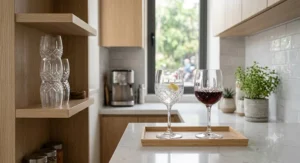
The core difference between compact crystal wine glasses and standard crystal stemware isn’t really the crystal itself — both categories can use identical lead-free formulations — it’s the engineering decision around stem height and bowl proportion. Standard stemware, the kind you’d find at a formal restaurant, typically runs 9 to 10 inches tall with a pronounced bowl curve designed to maximize aroma concentration for serious tasting. Compact crystal, by contrast, deliberately trims one to three inches off that height, either by shortening the stem (as with the Schott Zwiesel Tritan Classico) or eliminating it entirely (as with the Riedel O Wine Tumbler and JoyJolt Sidney).
| Factor | Standard Crystal Stemware | Compact Crystal (This List) |
|---|---|---|
| Typical Height | 9–10.5 inches | 4–8 inches |
| Cabinet Clearance Needed | Tall upper shelf required | Fits standard 8–10 inch shelf |
| Stacking Capability | Rare, risk of chipped rims | Common, purpose-built |
| Aroma Development | Generally superior | Good to very good, varies by shape |
What the table shows in practice is that you’re not choosing between “good glass” and “compromised glass” — you’re choosing between optimizing for tasting ritual versus optimizing for real-world storage. Reviewers of stemless and short-stem crystal alike consistently note that the difference in actual wine enjoyment is far smaller than wine snobbery would suggest, especially for everyday drinking rather than competition-level tasting.
Stackable Crystal Stemware: What Actually Makes a Glass Stackable
Not every glass marketed as “space-saving” is genuinely stackable, and understanding the engineering behind true stackability will save you from a disappointing purchase. The core requirement is a straight or gently tapered bowl wall with minimal outward curve — this is why the Bormioli Rocco Hosteria and Libbey Signature Stackable sets work so well, while a classic bulbous Bordeaux glass simply cannot nest no matter how the marketing copy is worded. A reinforced, slightly widened base also matters more than most buyers realize, since it’s what keeps a stack of three or four glasses from tipping when the top glass is lifted at an angle rather than straight up. Rim thickness plays a quieter but real role too: thin, delicate rims chip more easily during the stacking and unstacking process itself, which is part of why brands building dedicated stackable lines tend to reinforce the rim slightly compared to their standard stemware. Based on the spec comparison across this list, true stackable crystal stemware is a deliberate design category, not a happy accident — and buying a glass explicitly built for it, rather than assuming any stemless glass will nest safely, is the difference between a set that lasts years and one that chips within a season.
Space-Saving Wine Glasses for Apartment Kitchen Storage
Apartment kitchens present a specific storage puzzle that houses rarely do: shallow upper cabinets, minimal counter space, and often no pantry at all. Organizing pros interviewed by Apartment Therapy consistently recommend keeping glassware in its own dedicated zone, separate from plates and bowls, since mixed-use cabinets tend to become the most chaotic and breakage-prone shelves in any kitchen. Applied to this list, that means grouping your space-saving wine glasses — whether that’s the JoyJolt Sidney for everyday use or the Gabriel-Glas StandArt for special occasions — into a single, clearly defined shelf rather than scattering them across whatever gaps exist elsewhere. Adjustable shelf risers are genuinely one of the highest-value purchases for apartment kitchens, since they let you create a second, lower-clearance tier specifically sized for stemless glasses like the Libbey Signature or Riedel O Wine Tumbler, effectively doubling the glass storage in the same footprint. If your apartment cabinet doesn’t have adjustable shelving at all, open floating shelves mounted at eye level are a renter-friendly workaround that also keeps fragile stemware visible, which in practice tends to reduce breakage since you’re less likely to blindly grab and knock over a glass you can’t see.
Minimalist Glassware Sets: Features That Actually Matter (And Those That Don’t)
Minimalist glassware sets get marketed with a lot of features that sound compelling but don’t actually move the needle for small-kitchen living, so it’s worth separating signal from noise. What actually matters: true stacking or nesting geometry, dishwasher safety, and a universal bowl shape that handles multiple wine styles — all three directly reduce either the number of glasses you need or the space each one occupies. What doesn’t matter nearly as much as marketing suggests: elaborate cut-crystal patterns, which look striking but trap more residue in dishwashers and are harder to clean by hand; colored or tinted glass, which can obscure a wine’s actual color and is largely an aesthetic choice with zero storage benefit; and oversized gift boxes, which often get thrown away immediately and offer no functional value once the glasses are unpacked. The Luigi Bormioli Optica and Gabriel-Glas StandArt both illustrate the “matters” column well — neither leans on decoration, and both derive their minimalist appeal purely from doing one shape exceptionally well rather than offering six mediocre ones. If a listing spends more copy describing the gift packaging than the bowl geometry or stacking mechanism, that’s usually a signal the glass wasn’t actually designed with small-space storage as a priority.
Small Kitchen Essentials: Long-Term Cost & Maintenance
Thinking about total cost of ownership rather than just sticker price changes the calculus on which glass actually makes sense as a small kitchen essential. A budget set like the Bormioli Rocco Hosteria, priced around $20–$30 for six glasses, works out to roughly $4–$5 per glass — genuinely affordable, but replacement costs add up if breakage rates run high in a tight, high-traffic cabinet. Mid-range options like the Schott Zwiesel Tritan Classico cost more upfront, typically $45–$60 for six, but the Tritan crystal’s documented chip and scratch resistance means fewer replacements over a multi-year span, which can make the effective cost per year of ownership lower than a cheaper set replaced twice. Premium picks like the Gabriel-Glas StandArt, at $50–$70 for just two glasses, only make long-term financial sense if you’re genuinely consolidating away from multiple varietal-specific sets — otherwise you’re paying premium prices for a glass you’ll still need to supplement. Maintenance costs matter too: dishwasher-safe options across this entire list keep ongoing costs near zero, while any hand-wash-only crystal (not featured here for exactly this reason) quietly adds time cost that’s easy to underestimate when you’re comparing sticker prices alone.
Safety & Lead-Free Crystal: What to Know Before You Buy
Every glass featured in this guide uses lead-free crystal or lead- and barium-free Tritan construction, and that’s a deliberate filter, not a coincidence. Historically, “crystal” implied a significant percentage of lead oxide, prized for its brilliance and weight, but public health research has since documented real concerns: a peer-reviewed public health review published via the National Library of Medicine notes that U.S. regulators have specifically targeted lead exposure from leaded crystal glassware and lead-wrapped wine bottle foils as part of broader lead-reduction efforts over the past several decades. In practice, this means older or vintage crystal — the kind you might inherit or find secondhand — carries a genuinely different risk profile than the modern lead-free sets on this list, and it’s worth checking provenance before regularly serving wine or spirits in unfamiliar antique crystal. Extension service guidance from Michigan State University similarly recommends that pregnant individuals, infants, and children avoid lead crystal entirely, and that even adults limit regular daily use of leaded pieces, favoring occasional use instead. Every product recommended in this guide sidesteps that concern entirely by using lead-free formulations, which is one more reason modern crystal and Tritan crystal have become the default choice for everyday small-kitchen glassware rather than a niche “safer alternative.”
Common Mistakes When Buying Crystal Wine Glasses for Small Kitchens
The most common mistake is buying based on photos alone without checking listed height and capacity dimensions, which is how so many people end up with a beautiful set that simply doesn’t clear their cabinet shelf. A close second is assuming any stemless glass automatically stacks safely — as covered above, true stacking requires straight bowl walls and a reinforced base, features that not every stemless design actually includes. Third, buyers frequently overbuy set size, purchasing sets of twelve for a household of two, which creates exactly the clutter problem a small-kitchen purchase was supposed to solve in the first place. Fourth, some shoppers prioritize decorative cut patterns over functional geometry, ending up with gorgeous glasses that trap water spots and residue in every etched groove, making them harder to keep genuinely clean in a kitchen where you don’t have time for painstaking hand care. Finally, many buyers skip checking dishwasher-safety claims closely, not realizing “dishwasher safe” sometimes means top-rack-only with specific rack-spacing requirements — a detail that matters enormously in a small kitchen’s compact dishwasher, where you may not have the luxury of spacing glasses exactly as recommended.
Frequently Asked Questions
❓ Are stackable wine glasses actually safe to nest without chipping?
❓ How much cabinet clearance do I need for compact crystal wine glasses?
❓ Is lead-free crystal actually real crystal, or just glass?
❓ Can I put crystal wine glasses in the dishwasher?
❓ What's the best all-in-one wine glass for a small apartment kitchen?
Conclusion
Choosing crystal wine glasses for small space kitchens really comes down to being honest about two things: how much clearance your cabinet actually has, and how much tasting nuance you genuinely care about on a Tuesday night versus a special occasion. Budget-conscious stackers should start with the Bormioli Rocco Hosteria or Libbey Signature Stackable, both purpose-built to nest without wasted air between glasses. Anyone leaning into durability over decades should look at the Schott Zwiesel Tritan Classico, while big-pour lovers will appreciate the JoyJolt Sidney‘s generous capacity in a compact shape. If consolidating your glass count matters most, the Luigi Bormioli Optica and Gabriel-Glas StandArt both prove one well-designed universal shape can replace an entire cabinet’s worth of varietal-specific stemware, and the Riedel O Wine Tumbler remains the standout choice for anyone who wants genuine wine-shape science without the stem. None of these require you to trade elegance for square footage — they simply prove that good design solves both problems at once.
Recommended for You
- Double-Layered Crystal Wine Glasses: 7 Best Picks for 2026
- Machine-Made Crystal Wine Glasses: 7 Top Picks for 2026
- 7 Best Lead-Free Crystal Wine Glasses (2026): Safe & Stylish Picks
Disclaimer: This article contains affiliate links. As an Amazon Associate, I earn from qualifying purchases. If you purchase products through these links, we may earn a small commission at no additional cost to you.
✨ Found this helpful? Share it with your friends! 💬🤗
