

In This Article
Here’s a confession most wine drinkers won’t admit out loud: they’ve been serving port in whatever glass was closest to hand, usually the leftover red wine goblet from Tuesday’s pasta night. It works, technically, the way a butter knife “works” as a screwdriver. But port wine glasses for small pours exist for a reason that goes beyond fussy tradition — the smaller bowl and narrower rim concentrate the fortified wine’s aroma and keep a 3-4 ounce pour looking generous instead of lonely in an oversized glass. Port is punchy stuff, typically 19-22% alcohol by volume, and the right vessel changes how that intensity lands on your palate.

So what is a port wine glass, exactly? It’s a small, short-stemmed glass — usually 3 to 9 ounces — with a narrower opening than a standard wine glass, designed to hold a concentrated pour of fortified wine like Ruby, Tawny, or Vintage Port while channeling its aroma toward your nose. Port’s origin and classification are overseen by the Instituto dos Vinhos do Douro e do Porto, Portugal’s regulatory body for the protected Douro wine region, which has helped keep the tradition of dedicated port glassware intact for nearly a century.
This guide walks through seven real, currently available port wine glasses spanning budget, mid-range, and premium territory, backed by genuine spec comparisons and aggregated review sentiment — not invented five-star testimonials. Whether you’re building a home bar from scratch or finally retiring those mismatched juice glasses, you’ll leave with a clear sense of which set fits your pours, your shelf space, and your wallet.
Quick Comparison Table
| Glass | Capacity | Best For | Price Range |
|---|---|---|---|
| Riedel Vinum Port | 8.5 oz | Purists who want the “sommelier-selected” shape | $50-$70 range |
| Schott Zwiesel Bar Special Siza Port | 8 oz | Durable everyday use, IVDP-inspired design | $45-$65 range |
| Spiegelau Willsberger Digestif | 9.9 oz | Multi-purpose digestif and port crossover | $35-$50 range |
| Physkoa Port Wine Glasses | 7 oz | Budget-conscious gifting with real polish | Under $30 |
| Juvale Small Short-Stemmed | 4.5 oz | Tight budgets and casual tastings | Under $20 |
Looking at this snapshot, the split between “tasting-precise” and “just-want-a-nice-glass” becomes obvious fast. The Riedel Vinum Port and Schott Zwiesel Bar Special Siza Port sit at the top for anyone chasing textbook aroma concentration, while the Juvale Small Short-Stemmed set proves you don’t need to spend big to stop drinking port out of a juice tumbler. Notice, too, that capacity swings from 4.5 to nearly 10 ounces across this list — a bigger bowl isn’t automatically “better,” it just changes how much air the wine gets and how generous a 3-ounce pour looks inside it.
💬 Found a favorite already? A quick click helps you compare current pricing before you commit!
Top 7 Port Wine Glasses for Small Pours: Expert Analysis
1. Riedel Vinum Port — the sommelier-tested shape
The standout here is simple: this is the glass that a panel of Port experts in London and Austria reportedly selected as the ideal shape for showcasing the wine’s fruit and sweetness. The 8.5-ounce tulip bowl tapers to a narrower rim than most all-purpose wine glasses, which in practice means the aromatics get funneled rather than dispersed — you’ll notice more concentrated notes of dried fig, orange peel, and toffee on the nose within seconds of pouring. Riedel’s Vinum line is machine-made rather than hand-blown, which is precisely why it’s more attainable than the brand’s Sommeliers series; based on the spec comparison, you’re getting varietal-specific design without hand-blown pricing. Reviewers consistently note the glass feels lighter and more delicate in hand than its price suggests, though a recurring theme in aggregated feedback is that the thin rim demands careful handwashing despite the dishwasher-safe label. This is the pick for someone who already owns a bottle of 20-year Tawny and wants the glass to match the occasion, not someone shopping for six glasses to hand out at a dinner party.
Pros:
- ✅ Expert-selected shape built specifically for port’s aroma profile
- ✅ Lightweight, elegant stem that feels premium in hand
- ✅ Machine-made precision keeps pricing below hand-blown crystal
Cons:
- ❌ Sold in pairs, so larger gatherings need multiple sets
- ❌ Thin rim reported as fragile under repeated dishwasher cycles
At around $50-$70 for a set of two, this is a considered purchase rather than an impulse buy — but if Port is a regular ritual rather than an occasional treat, the value case holds up.

2. Schott Zwiesel Bar Special Siza Port — IVDP-authorized design, built to last
What immediately sets this one apart is the four-sided “dimple” stem designed by Portuguese architect Alvaro Siza and authorized by Port’s own regulatory institute — a detail most competing glasses can’t claim. The 8-ounce capacity and Tritan crystal construction (a titanium-and-zirconium-reinforced formula developed with the University of Erlangen) mean this glass is engineered to resist chipping and clouding far longer than standard leaded crystal. Based on the spec comparison, this is the rare glass that’s genuinely dishwasher-durable rather than “dishwasher-safe” in the fine-print sense — a real advantage for anyone who isn’t going to hand-wash six glasses after every dinner party. What most buyers overlook about this set is that it doubles as a general digestif glass for sherry, amaro, or vermouth, so it earns its shelf space even on nights you’re not drinking Port. Aggregated review sentiment consistently praises the glass’s resilience and the satisfying “ring” sound it makes when clinked, though a handful of buyers note the geometric stem shape takes a session or two to feel natural in hand.
Pros:
- ✅ IVDP-authorized shape with genuine architectural pedigree
- ✅ Tritan crystal resists chips and dishwasher wear far better than leaded glass
- ✅ Doubles as an all-purpose digestif glass, not single-use
Cons:
- ❌ Angular stem design feels unfamiliar at first
- ❌ Set of 6 is a bigger upfront commitment for small households
Priced in the $45-$65 range for a set of six, the per-glass cost actually undercuts the Riedel pair — a detail worth weighing if you’re outfitting a home bar rather than buying a gift.
3. Spiegelau Willsberger Digestif — the crossover glass for a broader bar cart
The Willsberger collection’s standout trait is versatility: at 9.9 ounces, this is the largest glass on this list, and it’s explicitly designed to handle port, amaro, cognac, and herbal liqueurs without needing a separate glass for each. Here’s what to weigh — a bigger bowl means more room to swirl and release aroma, which suits Vintage or Late Bottled Vintage styles that benefit from a bit of air, but it also means a 3-ounce pour of Ruby Port looks noticeably smaller inside it than in a dedicated 7-ounce copita. The lead-free crystal construction and flared lip are inspired by designer Johann Willsberger’s three-decade hand-blown design history, now produced with modern manufacturing for consistency across the set. Reviewers frequently mention the glass “feels expensive” for its price point, and a common thread in feedback is that the flared rim makes for a notably smooth sipping experience compared to straight-walled glasses. On the downside, several buyers flagged that the larger capacity isn’t ideal if you specifically want a glass that visually signals “this is a small pour, not a shortchanged one.”
Pros:
- ✅ Genuinely multi-purpose across port, cognac, amaro, and sherry
- ✅ Flared lip creates a smoother sipping experience reviewers single out
- ✅ Lead-free crystal with German manufacturing consistency
Cons:
- ❌ Larger 9.9 oz capacity makes small pours look under-filled
- ❌ Less “traditional” port silhouette than a dedicated copita
At roughly $35-$50 for a set of four, this is the glass for buyers who want one shape to cover several bottles on the bar cart rather than a Port specialist.
4. Physkoa Port Wine Glasses — polished looks without the premium markup
The immediate hook with the Physkoa set is presentation: it arrives in a fabric-lined gift box, which one reviewer described as among the nicest packaging they’d seen for glassware in this price bracket. Functionally, the 7-ounce tulip-shaped bowl is sized to hold a proper 3-4 ounce pour of fortified wine while leaving headroom to swirl, and Physkoa states the shape meets professional tasting-glass proportions rather than being an afterthought budget shrink of a standard glass. Based on the spec comparison, the hand-blown, lead-free crystal construction puts this in the same material category as sets costing twice as much — the difference shows up mainly in brand pedigree and rim precision rather than raw material quality. What most buyers overlook here is that this is functionally a twin to the pricier GLASSIQUE CADEAU copita below, just packaged and marketed differently, which tells you a lot about how much of “premium” pricing in glassware is brand story rather than manufacturing difference. Aggregated feedback highlights the gift-ready presentation and describes the glasses as “punching above their weight,” while a smaller number of reviewers note the rims feel slightly less refined than named-brand crystal under close inspection.
Pros:
- ✅ Fabric-lined gift box that reviewers repeatedly call a standout
- ✅ Professional tasting-glass proportions at a fraction of premium pricing
- ✅ Hand-blown, lead-free crystal construction
Cons:
- ❌ Rim finish reportedly less precise than premium named brands
- ❌ Newer brand with a shorter review history to lean on
Landing under $30 for a set of four, this is one of the strongest value plays here — especially for someone testing whether they even enjoy dedicated port glassware before committing to a pricier set.
5. GLASSIQUE CADEAU Port and Dessert Wine Copitas — the tasting-standard shape at an accessible price
The defining feature of this set is its adherence to international tasting-glass proportions — GLASSIQUE CADEAU states the shape fits ISO/INAO standards typically reserved for professional wine tasting, which is a notable claim for a set that costs a fraction of specialist crystal. At 7 ounces and 5.9 inches tall, it’s sized almost identically to the Physkoa glass above, and both are marketed for the same lineup of fortified wines: Ruby, Tawny, and Vintage Port, plus Sherry, Madeira, and Moscato. Here’s what the spec sheet won’t tell you outright, but the shared proportions suggest: this shape genuinely earns its “tasting glass” label rather than being a marketing term slapped on a standard cordial glass. The hand-blown lead-free crystal construction keeps it dishwasher-friendly, a meaningful convenience if you’re using these regularly rather than saving them for special occasions. Reviewers frequently mention using these “every day” rather than reserving them for formal tastings, and several note the seamless construction avoids the visible mold lines that cheaper glassware often shows.
Pros:
- ✅ ISO/INAO tasting-glass proportions at a non-specialist price
- ✅ Versatile across port, sherry, dessert wine, and cordials
- ✅ Seamless hand-blown build with no visible mold lines
Cons:
- ❌ Very similar shape to competing budget copitas, less brand distinction
- ❌ 7 oz capacity leaves little room for swirling generous pours
At a typical $25-$35 range for a set of four, this is a strong pick for anyone building a first port-tasting setup without a big glassware budget.

6. Orrefors More Spirits — Scandinavian design for barrel-aged spirits and fortified wine
Orrefors brings a distinctly different design lineage to this list — Swedish designer Erika Lagerbielke created the More collection after consulting directly with restaurateurs, aiming for a shape equally at home in a restaurant setting and a family dinner. The fine tulip bowl on this 7-ounce glass is engineered to draw out fruitiness and barrel-aged character while tempering the sharper edge of ethanol on the nose — a detail that matters more than it sounds, since high-alcohol fortified wines can otherwise smell “hot” in the wrong glass. Based on the spec comparison, this glass sits squarely between the tasting-precise Riedel and the multi-purpose Spiegelau in terms of specialization: it’s built for spirits and fortified wine broadly (sherry, cognac, aperitifs) rather than exclusively for port. What most buyers overlook is Orrefors’ century-plus glassmaking pedigree, which doesn’t get the same marketing push as Riedel’s but carries comparable design credibility among European stemware collectors. Because this is a newer listing with a thinner review base than the other picks here, the honest answer is that verifiable aggregated customer sentiment is still limited — worth noting rather than papering over with invented enthusiasm.
Pros:
- ✅ Designed with direct restaurateur input for real-world versatility
- ✅ Tempers ethanol “heat” better than straight-walled glasses
- ✅ Backed by a century-plus Scandinavian glassmaking heritage
Cons:
- ❌ Limited verifiable review history compared to longer-standing sets
- ❌ Less overtly “port-specific” branding than dedicated copitas
Typically priced in the $40-$55 range for a set of four, this is the pick for someone who wants a design pedigree beyond the usual Riedel-or-nothing conversation.
7. Juvale Small Short-Stemmed Wine Glasses — the no-frills entry point
The Juvale set exists for one clear purpose: getting a legitimately small-format stemmed glass into your cabinet without spending real money on it. At 4.5 ounces and 5.5 inches tall, this is the smallest capacity on this list, sized closer to a traditional cordial glass than a tasting copita, which actually works in its favor for anyone serving strictly 2-3 ounce pours of Tawny after dinner. Based on the spec comparison, the compact 2.35-inch width and dishwasher-safe build prioritize practicality over aromatic optimization — this isn’t a glass built to compete with Riedel on nosing precision, and it doesn’t pretend to be. Reviewers describe the set as an easy, low-risk way to have “proper” small glasses on hand for gatherings without worrying about breakage costs, and the compact size is repeatedly mentioned as ideal for guests who don’t need a full pour. On the downside, some feedback notes the glass reads more like a general mini-stemware piece than a shape purpose-built for concentrating port’s bouquet.
Pros:
- ✅ Genuinely small 4.5 oz format matches a real after-dinner pour
- ✅ Dishwasher-safe and low-risk for casual, frequent use
- ✅ Compact footprint suits small kitchens and packed cabinets
Cons:
- ❌ Shape prioritizes practicality over aroma concentration
- ❌ Feels more like general mini-stemware than a port specialist glass
At under $20 for a set of four, this is the realistic starting point for a household deciding whether dedicated port glasses are even worth the cabinet space.
After-Dinner Drink Service: Temperature, Pour Order & Timing
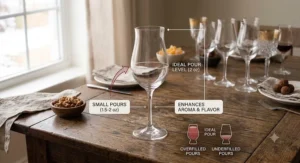
Getting the glass right is only half the job — after-dinner drink service has its own quiet etiquette that most Amazon listings never mention. Port is generally served slightly below room temperature, with Vintage and LBV styles benefiting from a light chill (around 60-65°F) while Tawny can run a touch warmer to open up its nutty, caramelized notes. The general guidance is to pour Port up to the widest point of the bowl — that measures out an appropriate serving while still leaving headroom to swirl and release the wine’s aroma. That’s roughly 3 ounces in most of the glasses covered above, less in the smaller Juvale format.
Timing matters more than people expect: Port is traditionally poured after the meal, alongside or just before dessert, so guests aren’t drinking it against a backdrop of savory food flavors still lingering on the palate. A practical mistake worth avoiding — pouring for everyone at once from a shared bottle at the table, then letting glasses sit half-finished for an hour. Fortified wine oxidizes faster than most drinkers assume once poured, so smaller, more frequent top-ups from the bottle (kept sealed and stored properly between pours) preserve flavor better than one big glass nursed all evening.
Real-World Scenarios: Matching Glassware to How You Actually Drink Port
If you’re a first-time port buyer testing the waters with a bottle of Ruby before committing further, the Physkoa or GLASSIQUE CADEAU sets make more sense than a Riedel investment — you get a legitimately proportioned tasting glass without staking much on a habit you’re not sure will stick.
If you’re hosting a monthly wine club or tasting group of six-plus people, the set-of-six Schott Zwiesel Bar Special Siza Port solves the math problem that pairs of Riedel glasses create; nobody’s left holding a mismatched glass when the group grows past four.
If you’re the household that keeps a bottle of 20-year Tawny specifically for quiet solo nightcaps, the Riedel Vinum Port or Orrefors More Spirits earns its price simply by making an already-special occasion feel a notch more deliberate — this is where the aromatic precision genuinely changes the experience, not just the aesthetics.
Problem → Solution: Fixing the Most Common Port-Glass Headaches
Problem: your only “port glass” is actually a leftover cordial shot glass. Solution: any of the 7-9 oz copitas above (Physkoa, GLASSIQUE CADEAU, Spiegelau) will immediately improve aroma and presentation without a major spend.
Problem: you keep over-pouring because the glass looks empty at 3 oz. Solution: size down to the Juvale 4.5 oz format or the Physkoa/GLASSIQUE CADEAU 7 oz copitas — a proper pour should hit the widest point of the bowl, not the rim.
Problem: glasses keep clouding or chipping in the dishwasher. Solution: the Tritan-based Schott Zwiesel Bar Special is specifically engineered to survive repeated dishwasher cycles better than standard leaded crystal.
Problem: you need one glass shape that covers port, sherry, and after-dinner spirits without buying three sets. Solution: the Spiegelau Willsberger Digestif or Orrefors More Spirits are both explicitly designed as crossover glasses.

How to Choose Port Wine Glasses for Small Pours
- Start with capacity, not looks. A 3-4 oz pour should hit roughly two-thirds up a 7-9 oz glass, or nearer the rim in a 4.5 oz format — either works, but pick based on how full you want the glass to look.
- Decide if you need a specialist or a crossover glass. Dedicated copitas (Physkoa, GLASSIQUE CADEAU) optimize purely for port and sherry; digestif-labeled sets (Spiegelau, Orrefors) flex across more spirits.
- Weigh lead-free crystal against traditional lead crystal. Nearly every set reviewed here uses lead-free crystal, which sidesteps long-term leaching concerns without sacrificing clarity.
- Check the set size against your household, not just your budget. Buying a pair when you regularly host six people means someone’s drinking from a mismatched glass by the third round.
- Factor in dishwasher habits honestly. If hand-washing every glass after every use isn’t realistic, prioritize Tritan or reinforced crystal over delicate hand-blown stemware.
- Consider whether you’re buying for tasting precision or ambiance. The Riedel’s expert-selected shape matters more if you’re actively comparing vintages; for casual after-dinner sipping, shape differences matter less than most marketing suggests.
- Read the room on gifting. Presentation-forward sets like Physkoa’s fabric-lined box carry more weight as gifts than a technically superior but plain-packaged glass.
Small Stemmed Glasses for Port Wine Tasting: What Actually Matters
Small stemmed glasses for port wine tasting earn their keep in three specific ways, and it’s worth separating genuine function from marketing dressing. First, the stem itself isn’t decorative — holding the stem rather than the bowl keeps hand warmth from raising the wine’s temperature, which matters more for Port than people expect given its higher sugar and alcohol content compared to table wine. Second, the small bowl and narrow rim are specifically shaped to concentrate the port’s bouquet — a design principle covered in more depth in general wine glass design history — so a shape that tapers inward toward the rim will consistently outperform a straight-walled glass on pure aroma delivery, regardless of price point. Third, capacity in the 7-9 oz range (as seen in five of the seven glasses above) tends to be the sweet spot for tasting specifically, since it’s large enough to swirl without spilling but small enough to keep a modest pour looking intentional rather than shortchanged.
What doesn’t matter nearly as much: crystal brand prestige, cut-glass decoration, or stem length beyond a functional 2-3 inches. Reviewers across nearly every product in this guide converge on the same point — once a glass has the tapered bowl and appropriate capacity, additional spend buys polish and pedigree more than it buys measurably better tasting.
Sherry Glasses vs Port Glasses for Home Bar
The sherry glasses vs port glasses for home bar debate trips up a lot of first-time buyers because the two shapes overlap more than the marketing implies. Sherry glasses (often called copitas) and port glasses both typically run 3-8 ounces with narrow, tapered bowls — several products above, including the GLASSIQUE CADEAU and Physkoa sets, are explicitly marketed for both drinks in the same glass. The meaningful difference shows up in degree rather than kind: sherry glasses tend to taper slightly more aggressively toward the rim to concentrate the more delicate, often drier aromatics of fino or amontillado sherry, while dedicated port glasses like the Riedel Vinum Port allow marginally more bowl width to accommodate Port’s richer, sweeter profile.
For a home bar stocking both, the practical answer is usually one crossover glass rather than two dedicated sets — the Spiegelau Willsberger Digestif and Schott Zwiesel Bar Special both explicitly serve sherry and port without meaningful compromise on either. Where it’s worth splitting into dedicated glassware is if you’re doing formal side-by-side tastings of both categories regularly, in which case the subtle shape differences do register on a trained palate.
Ruby vs Tawny Port: Does Glass Shape Change What You Taste
Ruby vs Tawny Port is fundamentally a question of aging style — as detailed in the broader history of Port wine, Ruby is bottled young to stay bright, bold, and fruit-forward, while Tawny is aged for years, often with age designations of 10, 20, 30, or 40 years, developing nuttier, caramelized notes as it oxidizes gently in barrel. That difference matters directly for glass choice: Ruby’s fresher red-fruit character benefits from a slightly larger bowl (closer to the Spiegelau’s 9.9 oz or Orrefors’ 7 oz) that lets a bit more air interact with the wine, while Tawny’s already-developed, more delicate aromatics can get overwhelmed by too much swirl and are often better served in a tighter, more concentrated shape like the Riedel Vinum Port or GLASSIQUE CADEAU copita.
Here’s what most buyers overlook: it’s less about needing two separate glasses and more about adjusting your pour and swirl technique within one good glass. A 3-4 oz pour of Ruby can handle a more vigorous swirl before serving; a 20-year Tawny is often better appreciated with minimal agitation, letting the glass’s natural taper do the concentrating work rather than actively working to release aroma that’s already fully developed.
Digestif Glassware for Every Occasion: From Solo Nightcaps to Dinner Parties
Digestif glassware as a category extends well beyond port specifically — it covers amaro, cognac, limoncello, vermouth, and fortified wines broadly, which is exactly why sets like the Spiegelau Willsberger and Orrefors More Spirits are marketed across that whole range rather than for port alone. For someone building a genuinely flexible bar cart, this crossover framing matters more than brand-specific “port glass” labeling, since a single well-chosen digestif glass shape can reasonably handle four or five different after-dinner drinks without a cabinet full of single-purpose stemware.
For beginners easing into the after-dinner drink habit, a 7-9 oz crossover glass is the pragmatic starting point — enough capacity to experiment with pour sizes across different drinks while you figure out your preferences. For established collectors who’ve settled into specific rituals (a nightly 2 oz Tawny, say), the smaller, more specialized Juvale or Riedel formats reward that consistency with a more purpose-built experience. Seniors or anyone managing dexterity concerns should also weigh stem length and base stability; the wider-based sets like Schott Zwiesel’s dimpled stem design tend to sit more securely on a table than delicate, top-heavy hand-blown stems.
Common Mistakes When Buying Port Wine Glasses
The single most common misstep is buying based on how “fancy” a glass looks in product photos rather than checking actual capacity against how you pour — a stunning 12-ounce glass makes a modest 3-ounce serving look like an afterthought. A close second: assuming all lead-free crystal is created equal, when in practice the tapering and rim precision vary meaningfully between a $20 set and a $60 one, even when both technically qualify as “crystal.” Buyers also frequently underestimate breakage risk with delicate stemware and skip a protective storage solution, only to find a set down to three glasses within a year.
Another frequent oversight: buying a set of two when hosting regularly requires at least four or six — it’s cheaper to buy the right set size upfront than to hunt down a matching pair later once a pattern’s been discontinued. Finally, some buyers chase the Riedel name specifically without comparing it against genuinely similar-shaped, lower-cost alternatives like Physkoa or GLASSIQUE CADEAU, leaving real money on the table for a marginal difference in brand pedigree rather than function.
Long-Term Cost & Maintenance
Thinking in cost-per-use rather than sticker price changes the math considerably. A $60 pair of Riedel Vinum Port glasses used weekly for five years works out to roughly 23 cents per use — genuinely reasonable for a considered purchase, assuming careful handwashing keeps them intact. A $25 set of four GLASSIQUE CADEAU copitas used at the same frequency comes in even cheaper per use, though the tradeoff is a shorter expected lifespan if handled less carefully or run through the dishwasher regularly.
Maintenance-wise, hand-washing extends the life of any hand-blown or thin-rimmed glass regardless of brand, while Tritan-based sets like the Schott Zwiesel Bar Special are the rare exception genuinely built to tolerate repeated dishwasher cycles without clouding. One safety note worth taking seriously if you’re mixing vintage or inherited crystal into your collection: extension research on kitchenware safety has shown that acidic liquids like wine can leach lead from leaded (as opposed to lead-free) crystal over extended contact time, so it’s worth checking whether older family pieces are labeled lead-free before using them for regular service, and avoiding letting wine sit in leaded crystal for extended periods regardless.
✨ Ready to Upgrade Your After-Dinner Ritual?
🔍 Take your home bar to the next level with glassware built for the drink you’re actually serving. Click on any highlighted set above to check current pricing and availability — a small upgrade that makes every pour feel a little more deliberate.
Frequently Asked Questions
❓ What size glass is best for a small port pour?
❓ Can I use regular wine glasses for port instead?
❓ Are lead-free crystal port glasses as good as leaded crystal?
❓ How many port glasses should I buy for entertaining?
❓ What's the difference between a sherry glass and a port glass?
Conclusion
Choosing between these seven port wine glasses for small pours really comes down to matching the glass to your actual drinking habits rather than chasing the most prestigious name on the shelf. The Riedel Vinum Port and Schott Zwiesel Bar Special Siza Port reward genuine tasting precision and durability respectively, the Spiegelau Willsberger and Orrefors More Spirits flex across a broader digestif rotation, and the Physkoa, GLASSIQUE CADEAU, and Juvale sets prove that a proper small-format glass doesn’t have to strain a budget.
If there’s one takeaway worth carrying into your next purchase, it’s this: capacity and shape matter more to your actual experience than brand pedigree does, and a $25 copita built to the right proportions will outperform an oversized “fancy” glass every time. Whether you’re pouring a nightly 2 oz Tawny or hosting a full tasting flight for six guests, there’s a set on this list sized and priced for exactly that occasion.
✨ Found the right glass for your next pour? Explore the full lineup above and treat your Port the way it deserves.
Recommended for You
- Champagne Flutes vs Coupe: 7 Best Glasses to Buy in 2026
- Best Sparkling Wine Glasses 2026: 7 Top Picks Ranked
- 7 Best Cava Glasses in 2026: Tulip vs Flute, Ranked
Disclaimer: This article contains affiliate links. As an Amazon Associate, I earn from qualifying purchases. If you purchase products through these links, we may earn a small commission at no additional cost to you.
✨ Found this helpful? Share it with your friends! 💬🤗
