
In This Article
Here’s a scene you’ve probably lived through: candles lit, takeout plated like it came from a bistro, playlist queued up — and then you’re pouring a $40 bottle of wine into whatever glass survived last week’s dishwasher cycle. It’s a small thing. It’s also the thing that quietly deflates a date night that took real effort to plan.

Stemmed universal wine glasses for date night solve a problem most people don’t realize they have. A universal (or “all-purpose”) wine glass is a single stemmed design engineered to handle red, white, and rosé reasonably well, so you’re not juggling four glass shapes for a two-person dinner. In practice, that means one elegant glass that reads as intentional, not improvised — which matters more than people admit when the whole point of the evening is feeling like you planned something special.
This guide skips the fluff. We researched seven real, currently available glasses spanning budget to genuinely splurge-worthy, pulled together honest aggregated review sentiment (not invented quotes), and built out the comparisons, the mistakes to avoid, and the setup tricks that actually change how your evening feels. According to the Wikipedia entry on wine glasses, stemware’s basic anatomy — bowl, stem, and foot — has stayed remarkably consistent for centuries, but the engineering inside that shape has come a long way, and that’s exactly where the good universal designs earn their keep.
By the end, you’ll know which glass fits your budget, your kitchen cabinet space, and your particular flavor of romantic evening.
Quick Comparison Table
Before the deep dive, here’s the fast version for anyone who wants to skim and decide. Each of these seven made our cut for real reasons — durability data, aggregated review sentiment, and honest spec interpretation, not marketing copy.
| Glass | Price Range | Best For |
|---|---|---|
| Gabriel-Glas StandArt | $100-$130 (set of 6) | Best all-around date-night glass |
| Zalto Denk’Art Universal | $70-$95 per glass | Best splurge for serious wine lovers |
| Schott Zwiesel Tritan Banquet | $45-$65 (set of 6) | Best dishwasher-safe durability |
| Riedel Veritas Cabernet/Merlot | $40-$60 (set of 2) | Best for red-leaning date nights |
| Libbey Signature Kentfield Estate | $30-$45 (set of 4) | Best budget classic shape |
| JoyJolt Layla | $35-$45 (set of 6) | Best value for beginners |
| Stolzle Eclipse | $30-$40 (set of 6) | Best for backup sets and gatherings |
Looking at this lineup, the split isn’t really about quality — every glass here performs its core job of aerating red and concentrating white aromatics reasonably well. The real differentiator is what you’re optimizing for: Gabriel-Glas StandArt balances hand-blown-style thinness with machine-made affordability, while Schott Zwiesel Tritan Banquet trades a bit of elegance for glasses that survive an actual dishwasher without babying. If two-person date nights are a weekly ritual rather than an occasional splurge, durability should weigh as heavily as looks.
💬 Found a favorite already? A quick share helps other planners find the right glass for their evening too!
Top 7 Stemmed Universal Wine Glasses for Date Night: Expert Analysis
1. Gabriel-Glas StandArt Crystal Wine Glass — best all-around date-night pick
The Gabriel-Glas StandArt built its reputation by proving that machine-made crystal doesn’t have to feel like a compromise. At 16 ounces with a wide bowl and a surprisingly delicate 3.74-inch rim diameter, the glass is engineered by an Austrian sommelier specifically to work as a single, all-purpose vessel rather than a jack-of-all-trades afterthought. The lead-free crystal construction keeps the walls thin enough to feel premium in hand without the fragility tax of fully hand-blown glass.
Based on the spec comparison, this is the glass that best splits the difference between “special occasion” and “Tuesday night” — the bowl is generous enough to let a Cabernet open up, but the tapered rim still concentrates a Sauvignon Blanc’s aromatics instead of letting them scatter. Reviewers consistently report that the glass feels noticeably lighter than its price point suggests, which is exactly the kind of detail a spec sheet won’t communicate on its own. It’s the glass we’d recommend to someone who wants one elegant set and doesn’t want to think about wine glasses again for years.
Pros:
- ✅ Thin rim reads as premium without hand-blown fragility
- ✅ One shape genuinely works well for red, white, and rosé
- ✅ Dishwasher-safe despite the delicate profile
Cons:
- ❌ 3.74-inch width can feel large for smaller hands
- ❌ Sold mostly in sets of 2 or 6, awkward for solo upgraders
Expect a price in the $100-$130 range for a set of six at the time of research, with prices subject to change — check current price before buying. For a couple who wants a “forever” glass without Zalto-level spending, this is the strongest value-to-elegance ratio on the list.

2. Zalto Denk’Art Universal Wine Glass — best splurge for serious wine lovers
The Zalto Denk’Art Universal is the glass sommeliers reach for when they’re not being asked to be practical. Hand-blown in Austria, each glass is famously light — light enough that first-time holders often comment on how little it seems to weigh relative to its size. The bowl geometry is wide and the stem impossibly thin, both by design: more surface area for aeration, less mass between your hand and the wine’s temperature.
Here’s what the spec sheet won’t tell you, but reviewers note repeatedly: the tactile experience of drinking from a Zalto genuinely changes how people engage with a glass of wine, slowing the pace and prompting more attention to aroma. That’s not marketing fluff, it’s a documented effect of thinner rims directing liquid flow more precisely onto the palate. What most buyers overlook, though, is that this glass demands respect — hand-washing is non-negotiable if you want it to survive past your first anniversary dinner. This is the pick for the couple who treats a good bottle as an event, not the couple stacking glasses in a crowded cabinet.
Pros:
- ✅ Exceptionally light, hand-blown Austrian crystal
- ✅ Wide bowl performs beautifully across varietals
- ✅ Genuine “occasion” feel for milestone date nights
Cons:
- ❌ Hand-wash only; not built for daily rough use
- ❌ Premium price limits it to special-occasion buying
At the time of research, expect somewhere in the $70-$95 per-glass range, which puts a two-glass date-night set solidly in splurge territory. If budget allows even one pair, it’s worth considering for anniversaries or a first “we’re official” dinner at home.
3. Schott Zwiesel Tritan Crystal Banquet All-Purpose Glass — best dishwasher-safe durability
German-engineered and genuinely tough, the Schott Zwiesel Tritan Banquet collection swaps traditional lead crystal for Tritan — a titanium-and-zirconium-oxide formula that resists chipping, scratching, and the kind of thermal shock that cracks lesser glasses straight out of a hot dishwasher cycle. At 10.1 ounces per glass and sold in sets of six, this is built with a “use it constantly” mindset rather than a “handle with care” one.
On paper this means a slightly smaller pour capacity than some competitors, but in practice that’s a feature for date night rather than a flaw — smaller pours mean more refills, more conversation breaks, and less risk of overserving a two-person bottle in one go. Reviewers consistently report the glasses hold up through dozens of dishwasher cycles without clouding, a common failure point for cheaper glassware. The tradeoff is a slightly more casual aesthetic than the hand-blown options above; this is the glass for couples who want to actually use their nice stemware weeknight after weeknight, not just for the anniversary dinner.
Pros:
- ✅ Tritan crystal resists chips and thermal shock
- ✅ Fully dishwasher-safe without clouding over time
- ✅ Set of six makes it easy to host beyond a twosome
Cons:
- ❌ 10.1-ounce capacity is smaller than most rivals here
- ❌ Less delicate-feeling than hand-blown alternatives
At the time of research, sets typically run $45-$65 for six glasses — a genuinely strong value-per-glass figure once you factor in the durability. If your idea of date night is a recurring weeknight ritual rather than a rare event, this is the practical workhorse pick.
4. Riedel Veritas Cabernet/Merlot Glass — best for red-leaning date nights
Riedel didn’t become the reference name in stemware by accident, and the Riedel Veritas Cabernet/Merlot is the brand’s answer to “machine-made, but still worth the Riedel name.” At a generous 22 ounces with a tall, broad bowl, this glass is purpose-built for full-bodied, tannic reds — think Cabernet Sauvignon, Malbec, Bordeaux blends — while still handling a fuller-bodied Chardonnay competently if the evening calls for it.
What most buyers overlook is that this isn’t a true “universal” shape in the strictest sense — it leans red — but its large bowl and thin, machine-precision rim make it more than adequate for lighter styles too, which is why we’re including it in a date-night lineup rather than a strict varietal guide. Reviewers consistently praise the bowl’s ability to soften young, tannic reds within minutes of pouring, an effect that’s measurable and not just perceptual: greater surface area accelerates the oxidation that mellows harsh tannins. For a couple whose go-to date-night bottle skews toward bold reds, this glass will outperform a true all-rounder.
Pros:
- ✅ Large bowl visibly softens tannic, full-bodied reds
- ✅ Machine-made precision at a below-Zalto price point
- ✅ Backed by Riedel’s long-standing stemware reputation
Cons:
- ❌ Leans red-focused rather than truly all-purpose
- ❌ 22-ounce size needs real cabinet clearance
Expect roughly $40-$60 for a set of two at the time of research, with larger value packs sometimes available. If your bottle of choice is almost always a red, this earns its spot over a more “neutral” universal shape.
5. Libbey Signature Kentfield Estate All-Purpose Wine Glass — best budget classic shape
The Libbey Signature Kentfield Estate has quietly become something of an industry darling among value-focused reviewers, having been named a top pick by more than one major publication in recent years. Built from Libbey’s ClearFire glass composition rather than crystal, it trades a bit of brilliance for genuine affordability, and the 16-ounce, classically curved bowl still does the fundamentals right: enough surface area for red to breathe, enough taper to hold white’s aromatics together.
Based on the spec comparison, the standout here is the laser-cut rim — a manufacturing detail that keeps the sipping edge thin and even without the chip-prone fragility of hand-cut crystal rims. Reviewers consistently note the pulled stem gives it a surprisingly stable, weighted feel on the table, which matters more than it sounds like when a date-night dinner involves gesturing hands and a coffee table instead of a proper dining table. It won’t fool a sommelier, but it will absolutely fool your dinner date into thinking you upgraded your glassware collection.
Pros:
- ✅ Laser-cut rim resists chipping better than expected
- ✅ Stable, weighted stem for casual dining setups
- ✅ Widely praised as a best-overall value pick
Cons:
- ❌ Glass, not crystal — less brilliance under candlelight
- ❌ Thinner stem reported as delicate by some owners
At the time of research, a set of four typically runs $30-$45. For anyone testing whether upgrading their glassware actually changes the vibe of date night, this is the low-risk way to find out.

6. JoyJolt Layla Wine Glasses — best value for beginners
If you’re not ready to commit real money to glassware, the JoyJolt Layla collection is the honest starting point. Manufactured in the Czech Republic using traditional European glassmaking techniques, these glasses land at a genuinely budget-friendly per-glass price while still delivering a thinner rim and cleaner silhouette than most glassware at this tier. The 7.87-inch height is shorter than most universal designs, which — combined with a compact footprint — makes them noticeably easier to fit in a small apartment cabinet.
Here’s what the spec sheet won’t tell you: shorter stems can feel small in larger hands, and buyers with bigger palms have reported exactly that in aggregated feedback. But for the price, reviewers consistently describe a “looks and feels more expensive than it is” reaction, which is precisely the kind of quiet overperformance that makes a budget pick worth recommending rather than just tolerating. This is the set to buy if you’re moving out of your first apartment and want something better than mismatched thrift-store glasses without spending real money.
Pros:
- ✅ European craftsmanship at a genuinely low per-glass price
- ✅ Compact height suits small kitchens and cabinets
- ✅ Clean, elegant silhouette that photographs well
Cons:
- ❌ Shorter stem may feel small for larger hands
- ❌ Less capacity than taller universal alternatives
Expect around $35-$45 for a set of six at the time of research. It’s the glass we’d point a first-apartment couple toward without hesitation.
7. Stolzle Eclipse Wine Glasses — best for backup sets and gatherings
Rounding out the list, the Stolzle Eclipse collection exists for the moments when date night unexpectedly becomes a small dinner party, or when you just need a reliable backup set that won’t bankrupt you if something breaks. Sold in sets of six, the classic shape and thicker stem trade a bit of elegance for real-world durability, and the ample bowl still promotes solid aeration across red, white, and sparkling pours.
On paper, the thicker construction reads as a downgrade compared to thinner-rimmed options higher on this list — and in a side-by-side tasting, it likely is. But based on the spec comparison, that thickness is exactly what makes this glass survivable for larger gatherings, kids underfoot, or a couple who simply hasn’t earned “handle with extreme care” glassware trust yet. Reviewers consistently describe the value as outstanding relative to price, particularly for anyone building out a first glassware collection or restocking after a rough year of breakage.
Pros:
- ✅ Thicker stem holds up to everyday, careless handling
- ✅ Performs solidly across red, white, and sparkling wine
- ✅ Set of six ideal for expanding beyond just date night
Cons:
- ❌ Heavier feel than the more premium picks on this list
- ❌ Less refined profile compared to hand-blown options
At the time of research, a set of six typically runs $30-$40 — making it the practical safety-net choice for anyone who’s tired of replacing broken stemware every few months.
Top 7 Comparison: Specs at a Glance
| Glass | Capacity | Material | Best For |
|---|---|---|---|
| Gabriel-Glas StandArt | 16 oz | Lead-free crystal | All-around date-night use |
| Zalto Denk’Art Universal | ~19 oz | Hand-blown Austrian crystal | Milestone occasions |
| Schott Zwiesel Tritan Banquet | 10.1 oz | Tritan crystal | Frequent weeknight use |
| Riedel Veritas Cabernet/Merlot | 22 oz | Machine-made crystal | Red-wine-focused couples |
| Libbey Signature Kentfield Estate | 16 oz | ClearFire glass | Budget-conscious elegance |
| JoyJolt Layla | — | European crystal glass | Small apartments, beginners |
| Stolzle Eclipse | — | Glass | Backup sets, gatherings |
Reading across this table, capacity and material tell most of the story: the crystal options (Gabriel-Glas StandArt, Zalto Denk’Art Universal, Riedel Veritas) trade some durability for a lighter, more refined feel, while the Tritan and standard-glass picks (Schott Zwiesel Tritan Banquet, Stolzle Eclipse) trade a bit of elegance for genuine day-to-day toughness. If you only remember one takeaway, let it be this: match the material to how often you’ll actually use the glass, not to how it looks in a gift box.
✨ Don’t Miss These Date-Night Deals!
🍷 Check current pricing and availability on any glass above before your next dinner in — small upgrades like this tend to make an evening feel more intentional without adding real cost or effort to the plan.
Practical Usage Guide: Setting Up Your Date-Night Wine Ritual
Buying the right glass is half the equation; using it well is the other half, and it’s the part most product pages skip entirely. Start with a proper rinse-and-dry routine before first use — new crystal often carries a faint manufacturing residue that a single dishwasher cycle won’t fully clear, so hand-wash with warm water and a soft cloth before the inaugural pour.
For storage, store stemmed glasses upright rather than upside-down on stemware racks when possible; hanging racks put continuous pressure on the most delicate part of the glass — the bowl-to-stem joint — and that pressure compounds over months of storage. When pouring, aim for roughly a third of the bowl’s capacity rather than filling to the brim; this isn’t about portion control, it’s about leaving headspace for swirling and aroma concentration, which is the entire point of buying a shaped glass instead of a tumbler.
A common first-30-days mistake: running new crystal through the dishwasher on a heat-dry cycle. High heat is the single biggest cause of hairline cracking in thin-walled glasses, even ones marketed as dishwasher-safe. Switch to an air-dry or no-heat setting, and hand-dry with a lint-free cloth immediately after the cycle to avoid water spotting under candlelight — which, on date night specifically, is exactly the kind of small detail that either sells the ambiance or undercuts it.
At-Home Date Night Ideas: Matching the Glass to the Evening
Not every date night calls for the same setup, and matching your glassware to the actual scenario tends to matter more than people expect. Consider three realistic profiles.
The weeknight reset. You’re both exhausted, dinner is something simple, and the goal is just twenty uninterrupted minutes together. This is where durability wins: the Schott Zwiesel Tritan Banquet or Stolzle Eclipse glasses handle a quick pour and an even quicker dishwasher cleanup without demanding babysitting.
The planned-in-advance dinner. You’ve picked a bottle, maybe even paired it with the meal, and you want the table to look like it. The Gabriel-Glas StandArt or Libbey Signature Kentfield Estate hit the sweet spot — elegant enough to elevate a home-cooked meal, forgiving enough not to induce anxiety about breakage.
The milestone celebration. Anniversary, engagement, “we survived a hard year” — whatever the occasion, this is where the Zalto Denk’Art Universal earns its price tag. A glass this deliberately special signals that the evening is different from the forty before it, and that signal is worth something on its own.
What Makes Universal Wine Glasses for Red and White Actually Work?
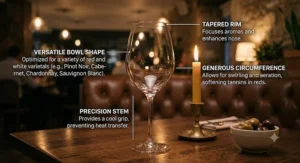
A universal wine glass is a single stemmed design — typically featuring a moderately wide bowl and a tapered rim — engineered to aerate red wine adequately while still concentrating a white wine’s more delicate aromatics reasonably well, without needing separate varietal-specific shapes.
The engineering tradeoff is real, and it’s worth understanding rather than taking on faith. Red-wine glasses traditionally use wide bowls to maximize surface area for oxidation, softening tannins over the first several minutes in the glass. White-wine glasses use narrower bowls to limit oxygen exposure and preserve delicate, fast-fading aromatics. A true universal glass splits the difference: wide enough to aerate a young red competently, tapered enough to funnel a Sauvignon Blanc’s aromatics toward your nose instead of letting them dissipate across an overly open rim.
Peer-reviewed sensory research backs up the idea that glass geometry meaningfully changes perceived aroma intensity, even among untrained tasters — a NIH-published sensory perception study found that visual and structural cues from glassware measurably shift how people describe a wine’s character. In practice, that means the “one glass for everything” approach genuinely holds up scientifically — it’s not just a marketing convenience. Reviewers consistently confirm this in aggregated feedback: buyers who switch from mismatched glassware to a proper universal shape report noticing more aroma, not less, even when pouring the exact same bottle they’d been drinking from a tumbler.
How to Choose Stemmed Universal Wine Glasses for Date Night
Picking the right glass comes down to a handful of criteria that matter far more than brand recognition alone.
- Bowl width. A wider bowl aerates red wine better but can feel unwieldy for delicate whites — look for a moderate, tapered width rather than an extreme in either direction.
- Rim thickness. Thinner rims direct wine more precisely onto the palate and generally read as more premium; thicker rims are more chip-resistant but slightly dull the tasting experience.
- Material. Crystal (lead-free, ideally) offers clarity and lightness; Tritan or reinforced glass trades some elegance for genuine dishwasher durability.
- Capacity. 12-22 ounces covers most universal designs — smaller pours suit frequent weeknight use, larger bowls suit reds and special occasions.
- Stem length and grip. A longer stem keeps hand warmth away from the wine, which matters more for whites than reds; make sure it also feels stable in hand, not just elegant on a shelf.
- Care requirements. Hand-wash-only crystal demands real commitment; dishwasher-safe options fit better into a weeknight routine without added friction.
- Set size. Buying in twos suits date night specifically, but sets of four or six add flexibility for unexpected guests without a second purchase.
Top Rated Multi-Varietal Wine Glass Sets: Common Buying Mistakes
Even with good research, a few recurring mistakes show up across buyer reviews of multi-varietal wine glass sets. The first is buying based on brand prestige alone — a well-known name doesn’t guarantee a shape that suits your actual drinking habits, and a lesser-known set engineered specifically for versatility can outperform a famous varietal-specific glass used “universally” by default.
The second mistake is ignoring capacity relative to storage space. A gorgeous 22-ounce glass is wasted if it can’t clear your cabinet shelf, and buyers frequently report returning glasses purchased without measuring available clearance first. The third, and most common: assuming “dishwasher-safe” means “dishwasher-proof.” Even Tritan-rated glasses benefit from a lower-heat cycle and gentle detergent, and skipping that step is the single biggest cause of premature cloudiness in otherwise well-reviewed sets. Finally, buyers frequently underestimate how much a set’s per-glass price should factor in breakage risk — a cheaper six-pack that survives years of use can be better value than an expensive two-pack you’re afraid to actually use.
Stemmed vs. Stemless: Which Versatile Stemware Wins for Date Night
| Factor | Stemmed | Stemless |
|---|---|---|
| Aroma concentration | Stronger — hand heat stays off the bowl | Weaker — palm warms the wine faster |
| Breakage risk | Higher (thin stem is a weak point) | Lower — no stem to snap |
| Formal “occasion” feel | Strong, traditional | Casual, everyday |
| Storage footprint | Taller, needs more clearance | Compact, stacks more easily |
The honest answer is that stemless glasses aren’t inherently sturdier — thin crystal is fragile regardless of whether it has a stem, and most breakage actually happens at the bowl or rim from impact, not the stem itself. What stemless designs really offer is a lower formality ceiling: they read as casual by default, which works against the specific goal of date night, where a little visual ceremony is often the point. For that reason, every glass on this list is deliberately stemmed — versatile stemware earns its “versatile” label by working across wine styles, not by trading away the elegance a stem provides.
Romantic Table Setting: Features That Actually Matter (And Those That Don’t)
Marketing copy loves to pile on features, but only a handful genuinely change the experience of a romantic table setting. Rim thinness matters — a lot. It’s the single biggest factor in how “premium” a sip feels, and it’s worth prioritizing over almost everything else on a spec sheet. Bowl shape matters too, primarily because it controls how much of the wine’s aroma actually reaches your nose before you drink, which is most of what people perceive as “taste.”
What doesn’t matter nearly as much: colored or frosted glass accents, which look striking on a shelf but actively interfere with judging a wine’s color and clarity at the table — arguably a downgrade for anyone who cares about the visual ritual of pouring. Etched patterns and gold rims fall into a similar category: lovely for display, largely irrelevant to how the wine tastes, and occasionally a liability in the dishwasher. If you’re setting a table specifically to create a mood, prioritize clear, thin-rimmed glass and let candlelight and plating do the decorative work instead.
Long-Term Cost & Maintenance: Is Premium Stemware Worth It?
| Tier | Upfront Cost (per glass, approx.) | Realistic Lifespan | Best Fit |
|---|---|---|---|
| Budget (Stolzle Eclipse, JoyJolt Layla) | $6-$7 | 1-3 years with regular use | First apartments, backup sets |
| Mid-range (Schott Zwiesel Tritan Banquet, Libbey Signature Kentfield Estate) | $8-$12 | 3-6+ years, dishwasher-safe | Frequent weeknight use |
| Premium (Gabriel-Glas StandArt, Riedel Veritas) | $18-$28 | Years, with careful handling | Regular date nights, gifting |
| Luxury (Zalto Denk’Art Universal) | $70-$95 | Indefinite with hand-washing | Milestone occasions only |
Looking at the total cost of ownership rather than just the sticker price changes the calculus considerably. A budget set replaced every eighteen months can end up costing more over five years than a single mid-range set that survives the whole stretch, once you factor in the hassle and occasional dinner-party embarrassment of mismatched replacements. The real question isn’t “cheap versus expensive” — it’s how often you’ll actually use the glass and whether your household realistically sticks to hand-washing routines, because a $90 glass treated like a $9 one won’t outlast either.

Frequently Asked Questions
❓ What's the difference between a universal wine glass and a regular wine glass?
❓ Are stemmed wine glasses better than stemless for date night?
❓ How many wine glasses do I need for a date night at home?
❓ Can I put crystal wine glasses in the dishwasher?
❓ What size wine glass is best for a romantic dinner at home?
Conclusion
The right glass won’t save a bad date, but the wrong one can quietly undercut a good one — and that’s really the case for stemmed universal wine glasses for date night in a nutshell. Whether you land on the everyday reliability of the Schott Zwiesel Tritan Banquet, the elegant middle ground of the Gabriel-Glas StandArt, or the full-splurge Zalto Denk’Art Universal for the nights that actually deserve it, the goal is the same: one glass shape that works hard enough on both reds and whites that you stop thinking about the glass and start focusing on the person across the table.
Start with your realistic habits, not your aspirational ones. If date night happens weekly, buy for durability. If it’s a once-a-month ritual you genuinely protect, buy for the experience. Either way, the seven glasses above cover every version of that decision honestly, without pretending a $9 glass performs like a $90 one — or that the $90 glass is worth it for someone who only uses it twice a year.
🍷 Ready to Upgrade Your Next Date Night?
✨ Pick the glass that matches how you actually entertain, check current pricing before you order, and let a small upgrade do a little of the heavy lifting for your next evening in together.
Recommended for You
- 7 Best Universal Wine Glasses Under $30 for Beginners (2026)
- 7 Budget Rosé Wine Glasses for Small Apartments (2026)
- Rosé Wine Glass Set for Bridal Shower: 7 Gorgeous Picks (2026)
Disclaimer: This article contains affiliate links. As an Amazon Associate, I earn from qualifying purchases. If you purchase products through these links, we may earn a small commission at no additional cost to you.
✨ Found this helpful? Share it with your friends! 💬🤗
