In This Article
Here’s a confession: for years I drank cava out of whatever glass was closest to the fridge. A juice tumbler. A chipped flute from a wedding a decade ago. It wasn’t until a friend from Barcelona handed me a proper tulip glass, poured a Reserva, and said “now smell it” that I understood what I’d been missing. The bubbles didn’t just look prettier — the whole wine woke up.

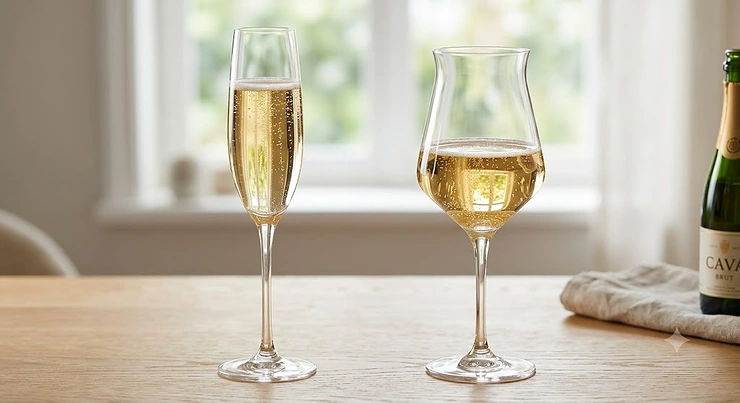
So, what is the best glass for cava? In short, it’s a tulip-shaped stem with a bowl that curves inward at the rim — wide enough to release aroma, narrow enough at the top to keep the bubbles alive. A straight flute preserves fizz beautifully but mutes the nose; a wide coupe does the opposite. The best cava glasses split the difference, and picking the right one changes how the wine actually tastes, not just how it photographs.
Cava is Spain’s answer to Champagne, made using the same traditional bottle-fermentation method but almost entirely in the Penedès region of Catalonia. It’s a genuinely different animal from the mass-market prosecco most Americans default to, and it deserves stemware that matches its ambition. As Wikipedia’s overview of the wine explains, cava has been produced this way since the late 19th century, and its production has since grown into one of the largest traditional-method sparkling wine categories in the world.
This guide walks through seven real glasses you can actually buy on Amazon today — budget, mid-range, and splurge-worthy — plus honest analysis on cava vs champagne glass shapes, cava flute vs tulip comparison, how Catalan tradition still shapes what’s on the table, and a straightforward decision framework so you’re not guessing at checkout.
Cava Sparkling Wine Glasses: Quick Comparison
Before diving into the full breakdown, here’s a fast snapshot of how these seven cava sparkling wine glasses stack up on price tier, shape, and who they’re really for.
| Glass | Shape | Price Range | Best For |
|---|---|---|---|
| Riedel Veritas Champagne Wine Glass | Tulip/egg-shaped | $60-$80 (set of 2) | Aged Cava Reserva, gifting |
| Schott Zwiesel Tulip Champagne Glass | True tulip | $50-$70 (set of 4) | Everyday tulip drinkers |
| Spiegelau Prosecco Sparkling Wine Glasses | Diamond-cut tulip | $30-$45 (set of 4) | Lighter, fruit-forward cava |
| Schott Zwiesel Classico Champagne Flute | Traditional flute | $40-$55 (set of 6) | Parties, bubble-first drinkers |
| JoyJolt Layla Champagne Flutes | Slim flute | $25-$35 (set of 4) | Budget crystal upgrade |
| Libbey Preston Champagne Flute Set | Classic flute | Under $25 (set of 4) | Casual, everyday use |
| JoyJolt Milo Stemless Flutes | Stemless flute | $30-$40 (set of 8) | Outdoor and no-fuss serving |
Looking at this lineup, the split is really about aroma versus spectacle. Riedel Veritas Champagne Wine Glass and Schott Zwiesel Tulip Champagne Glass sit at the top because their bowls actually do something for a wine as aromatically complex as aged cava. Meanwhile, Libbey Preston Champagne Flute Set and JoyJolt Milo Stemless Flutes are built for volume and durability rather than nosing depth, which is exactly the right trade-off for a backyard mimosa bar or a wedding with 80 guests.
💬 Already have a favorite in mind? Scroll down to see exactly why it made — or didn’t make — our top pick.
Top 7 Best Cava Glasses: Expert Analysis
1. Riedel Veritas Champagne Wine Glass — best for aged Cava Reserva
The egg-shaped bowl on this one is the whole story. Instead of the tight tunnel of a standard flute, Riedel gives the wine room to breathe before it ever reaches your nose. Specs-wise, you’re looking at machine-blown lead-free crystal, a roughly 16-ounce capacity (far larger than a flute, since it’s designed to be poured only two-thirds full), and a built-in “sparkling point” etched into the glass to keep a steady bead of bubbles rising from base to rim. In practice, that etched point matters more than it sounds — it’s the difference between a lazy trickle of bubbles and a continuous, photogenic stream.
Based on the spec comparison with flute-style glasses, this shape is squarely built for cava that’s spent real time on the lees — think Cava Reserva or Gran Reserva, where toasty, brioche-like notes need a bigger bowl to unfold. Budget-conscious buyers drinking a young Brut on a Tuesday won’t get much extra from this glass; it’s the aged-cava crowd and gift-givers who benefit most.
Reviewers consistently report that these feel remarkably light in hand for how sturdy they are, with several noting they’ve survived years of regular dishwasher use without clouding. A common complaint in user reviews is that the wide bowl makes them awkward to store in shallow cabinet shelving, and a few buyers mention the box packaging arriving slightly dented despite the glass itself surviving intact.
Pros:
- ✅ Egg-shaped bowl unlocks aroma in aged Cava Reserva
- ✅ Etched sparkling point sustains a steady bubble stream
- ✅ Lightweight despite genuine durability
Cons:
- ❌ Overkill for simple, young Brut cava
- ❌ Wide bowl needs taller cabinet clearance
At around $60-$80 for the pair, this sits solidly in premium territory, but it’s priced fairly against other hand-finish-quality European crystal — you’re not paying a logo tax here, you’re paying for a shape that was engineered around how sparkling wine actually behaves.

2. Schott Zwiesel Tulip Champagne Glass — most authentic tulip shape
If you want the textbook tulip silhouette without stepping into luxury pricing, this is it. The bowl swells out from the stem and tapers back in toward a narrower rim — the exact geometry sommeliers point to when they explain why tulips outperform flutes. Made from Schott Zwiesel’s Tritan crystal, it holds about 10 ounces and comes in at roughly 9 inches tall, with the brand’s signature effervescent point at the base of the bowl.
Here’s what most buyers overlook about Tritan crystal specifically: it’s not just marketing language for “durable glass.” The titanium and zirconium oxide added to the mix genuinely reduce micro-fracturing at the stem, which is usually where cheaper stemware fails first. For anyone who’s snapped a stem loading a dishwasher, that’s a real, practical upgrade — not a nice-to-have.
Reviewers consistently praise how thin the rim feels against the lip, a small detail that meaningfully changes how a wine reads on the palate compared to thicker, rolled-rim glasses. Some reviewers do note that the tulip shape feels unfamiliar for guests used to a standard flute, and a handful mention wishing the set came in larger quantities than four.
Pros:
- ✅ True tulip shape balances aroma and bubble retention
- ✅ Tritan crystal resists stem breakage far better than average
- ✅ Thin rim noticeably improves mouthfeel
Cons:
- ❌ Guests unfamiliar with tulips may find the shape odd
- ❌ Only sold in sets of four, not six or eight
In the $50-$70 range for a set of four, this is the glass I’d point most home cava drinkers toward first — it’s the rare case where the “correct” scientific shape and a reasonable price actually meet in the middle.
3. Spiegelau Prosecco Sparkling Wine Glasses — best diamond-cut tulip for fruit-forward cava
Spiegelau took a slightly different route to the same destination: instead of a smooth, rounded tulip, this glass has an angular, diamond-cut bowl that opens up surface area in a different way. At 9.1 ounces with a tall stem, it’s designed specifically for lighter sparkling styles — originally built with Italian prosecco in mind, but it translates well to young, fruit-driven Cava Brut and Extra Dry.
What the spec sheet won’t tell you outright is that the angled facets on this bowl actually change how quickly aromatics volatilize compared to a perfectly smooth tulip — sharper edges create more surface disruption as you swirl, which nudges fruitier, more citrus-driven cava styles to open up faster. That’s genuinely useful if you’re serving cava that’s meant to be bright and immediate rather than complex and aged.
Reviewers frequently mention that these photograph beautifully for entertaining and hold up well through repeated dishwasher cycles — Spiegelau’s own testing claims 1,500 cycles without clouding, and buyer feedback largely backs that durability claim up. A common complaint is that the diamond-cut bowl shows fingerprints and water spots more visibly than a plain-surfaced glass, meaning hand-drying is basically mandatory if you care about presentation.
Pros:
- ✅ Angular bowl accelerates aroma release in young cava
- ✅ Genuinely dishwasher-durable across repeated cycles
- ✅ Distinctive, modern look for entertaining
Cons:
- ❌ Shows fingerprints and water spots easily
- ❌ Less ideal for complex, long-aged Cava Reserva
Priced in the $30-$45 range for a set of four, this is a smart mid-tier pick for anyone whose cava rotation leans young and citrusy rather than toasty and aged.
4. Schott Zwiesel Classico Champagne Flute — best traditional flute for parties
Sometimes you just want the classic silhouette — tall, narrow, and built to show off a long column of bubbles. This flute holds about 6.9-7 ounces, stands roughly 9.5 inches tall, and keeps the same Tritan crystal construction as Schott Zwiesel’s tulip line, just in the traditional straight-sided shape.
The narrow bowl does exactly what a flute is engineered to do: it minimizes surface area, which slows CO2 escape and keeps that satisfying bead of bubbles rising for far longer than a wide-bowled glass would allow. On paper this means less aromatic complexity than a tulip, but for celebratory settings — toasts, New Year’s Eve, a table of ten where nobody’s stopping to swirl and sniff — that trade-off makes sense. It’s the right tool for the job, not a compromise.
Reviewers consistently note that these feel sturdier than typical flute glassware at this price, with several longtime owners reporting years of regular use without a single cracked stem. A common complaint is that the narrower bowl makes it harder to fully appreciate aroma-heavy Cava Gran Reserva, which tracks with what the shape is actually built to prioritize.
Pros:
- ✅ Classic tall-flute bubble display for celebrations
- ✅ Tritan crystal holds up to years of party use
- ✅ Sold in sets of six for larger gatherings
Cons:
- ❌ Narrow bowl underdelivers on aroma for aged cava
- ❌ Less visually distinctive than a tulip shape
At $40-$55 for a set of six, this is the practical choice for hosts who need enough glasses to actually run a party, not just admire a pair on a shelf.
5. JoyJolt Layla Champagne Flutes — best budget crystal upgrade
This is the glass I’d recommend to someone upgrading from grocery-store flutes for the first time without wanting to spend real money. Made in the Czech Republic from lead-free crystal, the Layla Collection holds about 6.7 ounces with a slim, straightforward flute bowl and a noticeably thin rim for the price point.
Based on the spec comparison against similarly priced flutes, the thin rim is the standout feature here — most budget glassware compensates for lower manufacturing cost with a thicker, rolled rim, which genuinely does dull how a sparkling wine reads on the tongue. JoyJolt skipping that shortcut is what separates this set from typical big-box store options selling at a similar price.
Reviewers consistently rate this line highly, and it’s worth noting the collection carries a strong overall review volume on Amazon with ratings clustering solidly above 4.5 stars — a meaningfully strong signal for glassware at this tier. A common complaint in user reviews across JoyJolt’s flute lines generally is that the capacity runs small if you’re used to a fuller pour, and a handful of buyers note the box’s foam packaging can be snug enough that removing glasses feels tense the first time.
Pros:
- ✅ Thin rim rare at this price point
- ✅ Strong, consistent review ratings across buyers
- ✅ Made in Europe from lead-free crystal
Cons:
- ❌ Smaller capacity than most premium flutes
- ❌ Tight foam packaging on first unboxing
At $25-$35 for a set of four, this is the clearest “punches above its price” pick in this entire lineup for anyone starting a proper cava glass collection on a real budget.

6. Libbey Preston Champagne Flute Glass Set — best everyday, no-worry option
Not every cava night calls for crystal. The Preston set is a straightforward glass (not crystal) flute at 6.25 ounces, and it’s exactly what it claims to be: an affordable, dishwasher-safe flute for regular use without any pretense.
Here’s the honest trade-off: standard glass lacks the clarity and thin-walled feel of lead-free crystal, so aromatics won’t concentrate quite the same way, and the visual sparkle is duller under light. What most buyers overlook, though, is that this is genuinely the right call for a household where glasses get knocked over by kids, borrowed for backyard parties, or used daily without a second thought — replacing a $10 glass stings far less than replacing a $70 crystal one.
Reviewers consistently mention buying this exact set specifically because it was affordable and didn’t feel like plastic, with several noting they bought multiples after the first set held up well through regular dishwasher cycles. A common complaint is that a few units arrive with minor rim imperfections or air bubbles in the glass, which tracks with the lower manufacturing tier this set occupies.
Pros:
- ✅ Genuinely affordable for daily, low-stress use
- ✅ Real glass feel, not plastic, at a budget price
- ✅ Dishwasher-safe with reported long-term durability
Cons:
- ❌ Lacks crystal clarity and thin-wall aroma benefits
- ❌ Occasional rim imperfections reported
At under $25 for a set of four, this is the sensible pick if cava is a regular weeknight thing in your house rather than an occasion.
7. JoyJolt Milo Stemless Champagne Flutes — best for outdoor and casual serving
Stemless glassware trades elegance for practicality, and the Milo set leans hard into that trade. At 9.5 ounces with a slim, weighted base, these are built to survive picnic tables, pool decks, and the kind of gathering where someone inevitably bumps the table.
The lack of a stem changes more than aesthetics — without a stem to hold, your hand warms the wine faster, which matters for a sparkling wine best served cold. On paper this means stemless glasses are a worse technical choice for serious cava tasting, but for casual mimosa brunches or an outdoor toast where you’re draining the glass in ten minutes anyway, warming isn’t really a factor.
Reviewers consistently highlight the stability of the flat, weighted base as the standout feature, with several mentioning it survives uneven outdoor surfaces that would tip over a stemmed glass. A common complaint is that the wider, shorter shape shows fingerprints more than a stemmed flute, and a few buyers note the crystal feels slightly less refined than stemmed alternatives in the same price bracket.
Pros:
- ✅ Stable, weighted base built for outdoor use
- ✅ No stem to snap during travel or cleanup
- ✅ Set of 8 covers larger casual gatherings
Cons:
- ❌ Hand warmth reaches the wine faster than stemmed glasses
- ❌ Shows fingerprints more visibly than stemmed styles
Priced around $30-$40 for a set of eight, this is the practical grab for anyone whose cava drinking happens more often outdoors than at a formal table.
Cava Glasses vs Traditional Drinkware: Benefits Breakdown
It’s worth pausing to compare purpose-built cava glassware against what a lot of households actually reach for — regular water glasses, all-purpose wine glasses, or mismatched flutes from past events.
| Feature | Purpose-Built Cava Glass | All-Purpose Wine Glass | Standard Water Glass |
|---|---|---|---|
| Bubble retention | High (etched sparkling point) | Moderate | Low |
| Aroma concentration | High (tulip/flute taper) | Moderate to high | Low |
| Serving temperature hold | Good (stemmed, minimal hand contact) | Good | Poor |
| Best For | Riedel Veritas / Schott Zwiesel Tulip for serious tasting | Casual sipping in a pinch | Not recommended |
The gap here isn’t marginal. A dedicated cava glass, whether it’s the tulip-shaped Schott Zwiesel Tulip Champagne Glass or the traditional Schott Zwiesel Classico Champagne Flute, is engineered with an etched nucleation point specifically to sustain bubble formation — something a standard water glass simply doesn’t have. An all-purpose wine glass is a reasonable backup in a pinch since its bowl shape still allows some aroma development, but it lacks the bubble-preserving geometry that makes purpose-built stemware worth the investment for anyone drinking cava regularly.
Spanish Sparkling Wine Serving: Practical Usage Guide
Getting the glass right is half the battle; serving cava correctly is the other half, and it’s where most home drinkers lose value without realizing it.
Start with temperature: cava should be served between 42-46°F, colder than most red wines but not icy enough to numb the palate entirely. Chill the bottle in the fridge for at least four hours, or use an ice bucket with equal parts ice and water for about 20-30 minutes if you’re in a hurry — a bucket of ice alone chills unevenly and wastes time.
When opening, skip the theatrical pop. Hold the cork firmly, twist the base of the bottle (not the cork), and ease it out slowly to release pressure with a soft hiss rather than a loud bang — this preserves more dissolved CO2 in the wine itself rather than losing it in the initial burst. Pour at a slight angle down the side of the glass, filling to about two-thirds full in a tulip glass like the Schott Zwiesel Tulip Champagne Glass, which gives the bubbles room to rise without overflowing on the first pour.
A common first-30-days mistake: washing new crystal glasses with regular dish soap. Residue from scented or oily dish soap clings to the glass surface and actively kills bubble formation on your next pour. Rinse with hot water only, or use a dedicated glassware-safe detergent, and always air-dry upside down on a rack rather than toweling the inside, which can leave lint that disrupts the bead of bubbles.
For maintenance, hand-washing is gentler on etched sparkling points over the long run, even for glasses marketed as dishwasher-safe like the Spiegelau Prosecco Sparkling Wine Glasses — the repeated heat cycles of a dishwasher can gradually dull the etching that creates that steady bubble stream.
✨ Ready to upgrade your serving setup? Check current pricing on the glasses above and start pouring cava the way it deserves to be poured.
Catalan Wine Glass Tradition: From Porrón to Modern Stemware
Cava’s home is Catalonia, and the region’s drinking culture runs deeper than any single glass shape. Long before tulip stemware existed, Catalans drank wine from the porró — a spouted glass vessel poured from a distance directly into the mouth, shared communally at the table without ever touching lips to rim. It’s still used today at festivals and casual gatherings, a reminder that Spanish wine culture has always prioritized sharing and celebration over strict formality.
That communal spirit carried into how cava itself developed. Cava has been produced using the traditional bottle-fermentation method since the late 1800s, largely centered in Catalonia’s Penedès region, and it grew up as a wine meant for celebration first, serious tasting second — which is part of why the flute became so culturally dominant there for so long, even as sommeliers elsewhere pushed toward tulips.
Modern Catalan cava houses have shifted alongside the rest of the sparkling wine world. The Cava Regulatory Board’s official site outlines quality tiers like Cava de Guarda and Cava de Guarda Superior that now reward extended aging on the lees, and that shift toward more complex, Champagne-rivaling styles is exactly why tulip glassware has gained ground even in cava’s home region — a young Brut poured for a toast still suits a flute, but a Reserva aged 18 months genuinely benefits from the aromatic room a tulip provides. If you’re building a home bar that leans into this tradition, pairing something like the Riedel Veritas Champagne Wine Glass for special-occasion Reservas with a set of Schott Zwiesel Classico Champagne Flute glasses for casual toasts mirrors how a lot of Catalan households actually stock their cabinets today.
Cava Glasses for Every Occasion: Real-World Buyer Scenarios
Scenario 1: The weekend host on a budget. You throw casual get-togethers every few weeks, cava is usually a young Brut or Extra Dry, and you need six-plus glasses that survive a dishwasher and the occasional guest who sets their glass down too hard. The Schott Zwiesel Classico Champagne Flute set of six is built exactly for this — durable Tritan crystal, a classic look, and enough glasses that nobody’s drinking from a mismatched backup.
Scenario 2: The apartment dweller building a first real bar. Limited cabinet space, a tighter budget, but you want something that feels like a genuine upgrade from grocery-store glassware. The JoyJolt Layla Champagne Flutes, at four glasses and a compact footprint, fits both the space and the price constraint while still delivering a noticeably thinner, nicer rim than what you’re replacing.
Scenario 3: The serious home taster exploring aged Cava Reserva. You’re buying cava that costs more than a Tuesday-night bottle, you care about nosing out the toasty, brioche-like complexity that comes with lees aging, and you’re willing to pay for a glass that actually shows it off. The Riedel Veritas Champagne Wine Glass or Schott Zwiesel Tulip Champagne Glass are the two glasses in this lineup engineered specifically for that use case — pick Riedel if you want a gift-worthy set of two, Schott Zwiesel if you want four glasses for entertaining fellow tasters.
Cava vs Champagne Glass: Same Bubbles, Different Rules
The honest answer is that cava and Champagne don’t strictly need different glassware — both are traditional-method sparkling wines, and the same tulip or flute shapes that work for one generally work for the other. Where the distinction actually matters is in style and typical serving context, not some hidden technical incompatibility.
Champagne, on average, tends to run drier and leaner with more pronounced autolytic (bready, yeasty) character, especially from producers who age longer on the lees as standard practice. Cava’s Brut and Extra Dry styles are frequently a touch fruitier and rounder, particularly from the native Xarel·lo, Macabeo, and Parellada grape blend that gives cava its distinct character compared to Champagne’s Chardonnay and Pinot Noir base. That fruit-forward profile is exactly why a glass like the Spiegelau Prosecco Sparkling Wine Glasses, designed with lighter, more aromatic styles in mind, tends to flatter a young cava Brut just as well as it flatters prosecco.
Where cava genuinely earns its own glass conversation is at the top tier. Cava de Paraje Calificado and long-aged Gran Reserva bottlings are built to rival vintage Champagne in complexity, and at that level, the same egg-shaped tulip logic behind something like the Riedel Veritas Champagne Wine Glass — originally designed with Champagne in mind — applies just as directly to cava. In short: don’t buy a separate “cava glass” and “Champagne glass.” Buy the right shape for the wine’s complexity, and let it do double duty.
Cava Flute vs Tulip Comparison: Which Shape Actually Wins
This is the debate that actually matters more than brand or price. The flute’s narrow, straight bowl minimizes surface area, which slows carbon dioxide loss and keeps that dramatic, uninterrupted column of bubbles rising for the longest possible time — it’s a genuinely superior shape if bubble persistence and visual drama are your priority, which is exactly why it dominates at weddings and New Year’s toasts.
The tulip trades a little of that bubble longevity for aroma. The Wine & Spirit Education Trust’s breakdown of champagne glass shapes points out that a glass’s depth and liquid surface area strongly influence how aroma is released, and that the in-curving tops common to tulip-shaped glasses help funnel released aromas toward the nose in a way that straight-sided flutes don’t. In practical terms, that means a tulip like the Schott Zwiesel Tulip Champagne Glass will consistently show more of a complex, aged cava’s toasty or nutty character, while a flute like the JoyJolt Layla Champagne Flutes will show off the bubbles themselves more dramatically.
So which wins? Honestly, neither — it depends entirely on the wine and the moment. A young, straightforward Brut cava at a party genuinely doesn’t lose much in a flute, and the visual payoff is real. A Cava Reserva you’re actually sitting down to taste and discuss deserves a tulip, full stop. If you can only own one shape, lean tulip — it handles both scenarios reasonably well, while a flute struggles to show complexity no matter what’s inside it.
🔍 Take your cava glasses collection to the next level — check current pricing on the tulip and flute options above and see which shape wins at your table.
How to Choose the Best Glass for Spanish Sparkling Wine
Picking the right glass gets a lot simpler with a checklist. Here’s how to approach it:
- Identify your typical cava style first. Young Brut and Extra Dry lean toward flutes or diamond-cut tulips; aged Reserva and Gran Reserva lean toward true tulip or egg-shaped bowls.
- Decide how many glasses you actually need. A set of two or four suits date nights and small gatherings; sets of six or eight (like the Schott Zwiesel Classico Champagne Flute or JoyJolt Milo Stemless Flutes) suit regular entertaining.
- Weigh crystal against standard glass honestly. Crystal’s thin walls genuinely improve aroma and mouthfeel, but if breakage risk is high — kids, pets, frequent outdoor use — standard glass like the Libbey Preston Champagne Flute Glass Set is the more sensible call.
- Check for an etched sparkling point. This small manufacturing detail sustains bubble formation far longer than a plain-bottomed bowl; most of the glasses in this guide include one.
- Consider stemmed versus stemless based on setting. Stemless options like the JoyJolt Milo Stemless Champagne Flutes trade a little serving elegance for real stability outdoors.
- Match your budget to your drinking frequency, not your aspirations. If cava is a weekly habit, prioritize durability and price over prestige; if it’s occasional and celebratory, splurge a little.
- Buy for your actual cabinet space. Wide tulip bowls need more vertical clearance than flutes — measure before you order if shelving is tight.
Common Mistakes When Buying Cava Glasses
A few recurring errors show up again and again in reviews and buying guides, and they’re worth flagging before you check out.
The first is buying a single “do everything” glass and expecting it to handle both a casual Tuesday Brut and a serious sit-down Reserva equally well. No shape does both perfectly — accept the trade-off rather than searching for a mythical universal glass.
The second is ignoring capacity and pour ratio. A flute meant to be filled two-thirds full looks half-empty if you pour it that way without knowing that’s intentional, leading buyers to assume they bought an oddly small glass when it’s actually working exactly as designed.
The third is skipping the dishwasher-safe check and then being surprised when a hand-wash-only glass clouds after a few automatic cycles. Always verify care instructions rather than assuming all modern crystal is dishwasher-safe by default.
The fourth is underestimating how much rim thickness affects perceived taste. Buyers often default to the cheapest option in a category without realizing a thin rim, like the one on the JoyJolt Layla Champagne Flutes, meaningfully changes how the wine feels against the lip compared to a thicker, rolled-edge glass at a similar price.
The fifth is overlooking storage footprint entirely, then discovering a wide-bowled tulip set doesn’t fit existing cabinet shelving — a frustrating and avoidable mistake if bowl height and diameter are checked against your storage before ordering.
Features That Actually Matter (And Those That Don’t)
With so much marketing language attached to stemware, it helps to separate genuine performance features from decorative fluff.
What actually matters: an etched sparkling or effervescent point at the base of the bowl, since this single manufacturing detail is directly responsible for a sustained, attractive bubble stream. Rim thickness matters too — thinner rims, like those found on the Schott Zwiesel Tulip Champagne Glass, measurably change mouthfeel. Bowl shape matters most of all, since it’s the single biggest driver of whether a glass favors bubble retention (flute) or aroma release (tulip). Lead-free crystal composition also genuinely matters for both safety and long-term clarity — modern lead-free formulations like Tritan achieve similar optical brilliance to leaded crystal without the associated health concerns of lead leaching into liquid over time.
What matters less than marketing suggests: elaborate cut-glass patterns and colored tints, which look striking on a shelf but can interfere with judging a cava’s true color and clarity when you’re actually tasting. Extremely tall stems are another feature that photographs well but add little functional benefit beyond a certain height, since the primary purpose of a stem — keeping hand warmth away from the wine — is achieved well before a stem becomes dramatically long. Branding and packaging, while nice for gifting, have zero impact on how the wine tastes in the glass, so don’t let attractive retail packaging outweigh the actual bowl geometry when you’re comparing options like the Riedel Veritas Champagne Wine Glass against a less famous but similarly engineered alternative.
Long-Term Cost & Maintenance: Are Crystal Cava Glasses Worth It?
Crystal glassware asks for a bigger upfront investment, so it’s worth running the actual math on value over time rather than just comparing sticker prices.
| Glass | Price Range | Typical Lifespan (with reasonable care) | Cost Per Year (rough estimate) |
|---|---|---|---|
| Riedel Veritas Champagne Wine Glass | $60-$80 (pair) | 5-8+ years | ~$8-$16/year |
| Schott Zwiesel Tulip Champagne Glass | $50-$70 (set of 4) | 5-8+ years | ~$7-$14/year |
| Libbey Preston Champagne Flute Set | Under $25 (set of 4) | 2-4 years | ~$6-$12/year |
Interpreting this table honestly: premium crystal isn’t actually the budget-breaking choice it looks like on day one. Because Tritan and lead-free crystal formulations resist the chipping and stem-snapping that cuts short the life of cheaper standard glass, the annualized cost of something like the Schott Zwiesel Tulip Champagne Glass ends up roughly comparable to replacing budget flutes every couple of years. The real cost consideration isn’t crystal versus standard glass — it’s how carefully any glass is handled, since hand-washing and careful storage extend the life of even budget options considerably.
Maintenance-wise, the biggest long-term cost driver is dishwasher wear on etched sparkling points, which can dull gradually over hundreds of cycles regardless of price tier. Hand-washing with hot water only, storing rim-up on open shelving rather than crammed into cabinets, and avoiding stacking glasses inside one another are the three habits that meaningfully extend lifespan across every glass in this guide, from the JoyJolt Milo Stemless Champagne Flutes to the pricier tulip options.
Worth noting: cava’s own quality framework rewards the same patience good glassware maintenance requires. As Wikipedia’s overview of Spain’s denominación de origen system explains, each wine region’s regulatory council sets aging minimums and production standards that directly shape how long a cava spends developing complexity before release — the same long-game thinking worth applying to how you care for the glass you drink it from.

Frequently Asked Questions
❓ What is the best type of glass for cava?
❓ Can you drink cava from a regular wine glass?
❓ Is cava served in the same glass as champagne?
❓ Do cava glasses need to be crystal?
❓ How full should you pour a cava glass?
Conclusion
Choosing the best cava glasses really comes down to being honest about how you actually drink. If cava shows up at your table every week as a casual pour, don’t overthink it — a durable, affordable flute like the Libbey Preston Champagne Flute Glass Set or the JoyJolt Layla Champagne Flutes will serve you well for years. If you’re regularly reaching for an aged Cava Reserva and want to taste every bit of complexity in the bottle, the tulip-shaped Schott Zwiesel Tulip Champagne Glass or the more premium Riedel Veritas Champagne Wine Glass are worth the extra investment.
There’s no single “correct” answer here, and that’s genuinely fine. What matters is understanding the actual trade-off between flute and tulip — bubble drama versus aromatic depth — and matching that trade-off to the cava you actually pour most often. Get that part right, and the rest is just picking a price point that fits your bar cart.
✨ Don’t Miss These Exclusive Deals!
🔍 Take your cava glasses collection to the next level with these carefully selected picks. Click on any highlighted glass above to check current pricing and availability, and pour your next bottle the way it deserves to be poured!
Recommended for You
- Best Prosecco Glasses in 2026: 7 Sets Worth the Toast
- Tulip Champagne Glasses: 7 Best Picks for 2026
- 7 Best Coupe Glasses for Cocktails in 2026: Ultimate Buying Guide
Disclaimer: This article contains affiliate links. As an Amazon Associate, I earn from qualifying purchases. If you purchase products through these links, we may earn a small commission at no additional cost to you.
✨ Found this helpful? Share it with your friends! 💬🤗
