

In This Article
What is traditional stemware for formal dinner parties? It’s classic footed drinkware, usually crystal or crystal-grade glass, often cut or faceted. It’s sized and shaped for a multi-course meal: water goblet, red wine, white wine, and sparkling. The stem keeps warm hands off the bowl, and the weight and sparkle tell guests this evening is not takeout.

Here’s the thing. Guests rarely remember the exact roast. They remember the feel of the room, and glass is half of that feel. Candlelight hits a cut goblet and the whole table seems to exhale. Put the same candle behind a thin, cloudy tumbler and you’ve got a diner.
This guide covers seven real sets across budget, mid-range and premium tiers. I’ve leaned on published specs, retailer-listed review sentiment, and etiquette guidance rather than pretending I’ve swirled wine in all seven. You’ll see exactly where reviews are strong and where I couldn’t verify much.
We’ll also cover how a formal table is traditionally laid, what crystal really is, and how to build seasonal hosting sets without a cabinet the size of a small cathedral.
Prices below are ranges or tiers only, because they move constantly. Check current pricing before you buy.
Quick Comparison: Traditional Stemware for Formal Dinner Parties at a Glance
| Product | Material / Style | Care | Price Tier | Best For |
|---|---|---|---|---|
| Waterford Lismore Essence | Cut crystal, classic Lismore pattern | Dishwasher safe (per retailer) | Premium | Heirloom-minded hosts |
| Marquis by Waterford Markham | Traditional crystal goblet | Check listing | Mid to premium | Waterford look, softer commitment |
| Villeroy & Boch Boston | Heritage crystal goblet | Check listing | Mid-range | Clean traditional lines |
| Lenox Tuscany Classics Grand Bordeaux | Lead-free European crystal | Dishwasher safe, break-resistant | Mid-range ($50-$75 range for four) | Red wine lovers |
| Schott Zwiesel Tritan Forte | Tritan crystal (titanium, zirconium) | Dishwasher safe | Mid to premium | Frequent hosts |
| Godinger Dublin | Floral-cut crystal goblet | Hand wash advised | Budget | First formal set |
| Lenox Tuscany Classics Champagne Flutes | Lead-free European crystal | Dishwasher safe | Budget to mid (under $75 for six) | Toasts and big guest lists |
Look at the “Best For” column and you’ll see the pattern. The Waterford Lismore Essence is the emotional purchase, the Godinger Dublin the low-risk entry, and the Schott Zwiesel Tritan Forte the one built for people who actually host. Hand-wash-only patterned crystal looks gorgeous but demands a gentler lifestyle. If your sink is a war zone after every party, lean toward the dishwasher-safe options.
💬 Just one click — help others make better buying decisions too!😊
Top 7 Traditional Stemware Sets for Formal Dinner Parties: Expert Analysis
1. Waterford Lismore Essence — heirloom pattern, lighter in the hand
The Lismore pattern is the one people picture when they hear “crystal.” The Waterford Lismore Essence line keeps those famous cuts but makes the glass about 35% lighter than the originals and dishwasher safe, according to the retailer listing. In practice, that fixes the classic complaint: gorgeous, but you’re scared to touch it.
Why does lightness matter at a dinner party? Because a guest holding a glass for three hours is holding it, not admiring it. A lighter bowl and a slender stem reduce wrist fatigue and the “don’t drop it” tension. The tradeoff is that purists sometimes prefer the heft of older, heavier Lismore, which vintage sellers describe as more richly cut than later reissues.
Based on the retailer reviews I could verify, buyers praise the pattern and sparkle. Classic Lismore stemware carries a 4.9/5 average across 63 reviews at one department store, with praise for weight and heirloom quality. The Essence line sits at 4.6/5 across 76 reviews at another, where one packaging complaint mentioned shattered champagne saucers on arrival. Availability on Amazon varies by seller, so confirm the seller and breakage terms.
Pros:
- ✅ Iconic cut pattern that photographs beautifully
- ✅ Lighter than classic Lismore, easier to hold
- ✅ Dishwasher safe, per the retailer listing
Cons:
- ❌ Premium pricing, so build the set slowly
- ❌ Shipping breakage reported in some reviews
Price tier: premium (check current price). The value verdict: worth it if you want one pattern to last decades, not if you’re furnishing a first apartment.

2. Marquis by Waterford Markham — Waterford styling at a gentler tier
The Marquis by Waterford Markham goblet set is Waterford’s more accessible sub-line. It’s listed as a four-piece traditional crystal wine glass set. Think of it as the cousin who dresses well but doesn’t need a trust fund.
I couldn’t verify detailed capacity or review data for the goblet set itself. A roundup of crystal entertaining sets did name the Markham double old fashioned as the best Waterford value, which at least suggests the line’s reputation for value. Treat that as a hint, not proof.
On paper, a goblet shape (wide bowl, short, sturdy stem) suits a formal table in a way flutes can’t. The wider bowl lets red wine breathe, and the shorter stem makes it stable for guests who gesture while telling stories. What the spec sheet won’t tell you is how thin the rim feels, so read the seller’s current reviews before committing.
Who should buy it? Hosts who want the Waterford name on the table without the premium commitment of the signature Lismore line. If you’re building a set across seasons, the four-piece packaging also lets you scale up one box at a time.
Pros:
- ✅ Waterford design heritage at a lower tier
- ✅ Goblet shape suits red wine and water alike
- ✅ Four-piece sets make gradual collecting easy
Cons:
- ❌ Care instructions vary, so check the listing
- ❌ Detailed review data hard to verify
Price tier: mid to premium (check current price). Verdict: a smart middle road if you can confirm the seller’s return policy.
3. Villeroy & Boch Boston — clean heritage lines without the fuss
Villeroy & Boch is one of Europe’s oldest tableware names, and the Villeroy & Boch Boston wine goblet appears in fine-dining roundups as a heritage crystal pick. The design leans classic rather than ornate. It’s a good answer to the question, “I want traditional, but I don’t want my table to look like a jewelry counter.”
Understated stems matter more than people think at a formal dinner. A heavily cut goblet competes with the china, the centerpiece and the candles. A cleaner profile lets the food and the flatware lead. If your dinnerware is patterned, the Villeroy & Boch Boston gives your plates room to breathe.
Review data I could verify for this specific set was thin, so I won’t invent a rating. What I can say from the category is that German and European crystal makers typically market their pieces on rim thinness and clarity. Those are exactly the details worth checking in the product photos and recent buyer comments.
Best fit: hosts with patterned or heirloom china, a neutral linen palette, or a preference for restraint. Skip it if you want dramatic sparkle.
Pros:
- ✅ Understated profile that lets china shine
- ✅ Respected European heritage brand
- ✅ Works equally well for water and wine
Cons:
- ❌ Less visual drama than cut patterns
- ❌ Limited verifiable review data
Price tier: mid-range (check current price). Verdict: reliable and handsome, best for people who like quiet luxury.
4. Lenox Tuscany Classics Grand Bordeaux — big red-wine bowl, lead-free crystal
The Lenox Tuscany Classics Grand Bordeaux set of four is built for red wine and big gatherings. According to the retailer listing, it’s European lead-free crystal, break-resistant, dishwasher safe, and about 10.75 inches tall. It also sits under the Lenox Breakage Replacement Program, which matters when you’re hosting twelve.
A tall bowl gives a robust red room to open up, and it’s honest about what it is: a formal-looking glass that survives a real dishwasher. That combination is rarer than it should be.
Reviewer sentiment is mixed in an instructive way. The Grand Bordeaux listing shows a 4.4/5 rating across 98 ratings, with roughly 80% five-star and about 11% one-star. Across the whole Tuscany Classics collection, the average is 4.5/5 over more than 2,000 ratings. Some reviewers praise the shape, delicate rims and nice weight, while a minority report breakage or quality complaints, and Lenox’s responses point them to replacement support.
My honest read: the 1-star minority is the reason to buy from a seller with a clear return policy and to open the box right away. Everything else points to a solid mid-range workhorse.
Pros:
- ✅ Lead-free crystal, dishwasher safe
- ✅ Tall bowl suits full-bodied reds
- ✅ Backed by a breakage replacement program
Cons:
- ❌ Noticeable minority of low-star reviews
- ❌ Plain base means less sparkle than cut crystal
Price tier: around $50-$75 for four at the time of research (check current price). Verdict: strong value for practical hosts.
5. Schott Zwiesel Tritan Forte — the “I actually host” crystal
The Schott Zwiesel Tritan Forte is built around Tritan crystal, a formula that adds titanium and zirconium for strength. Roundups of crystal stemware repeatedly call it the best everyday fine-dining pick, and dishwasher safety is the headline convenience.
Here’s why that matters: the biggest barrier to using good stemware is the sink. People keep crystal in the cabinet because washing it feels risky. A glass you can load into the dishwasher gets used, and used glassware is the whole point of owning it.
The Schott Zwiesel Tritan Forte also tends to be described as thin-rimmed yet resilient, which is the sweet spot for formal service. A caveat: “break-resistant” is not “break-proof,” and a thin stem still snaps if you grip the bowl and a stem together at an odd angle. I couldn’t verify a precise review average for this set, so lean on the maker’s specs and current seller reviews.
If you host monthly rather than annually, this is the set I’d steer you toward on the evidence available.
Pros:
- ✅ Reinforced Tritan crystal for everyday durability
- ✅ Dishwasher safe, so it actually gets used
- ✅ Clean, formal shape for any course
Cons:
- ❌ Less ornate than hand-cut patterns
- ❌ Priced above basic budget crystal
Price tier: mid to premium (check current price). Verdict: best long-term value for frequent entertainers.
6. Godinger Dublin — the budget gateway to cut crystal
The Godinger Dublin wine goblets are the most common first-set recommendation in the roundups I found. They’re a ten-ounce goblet with a floral cut that catches candlelight beautifully. One roundup flags that four glasses won’t cover a dinner party and that hand-washing a dozen gets old fast.
Both points are fair, and I’d add one more. The cut pattern hides fingerprints and water spots better than plain glass, which is a small mercy during a rushed refill.
Reviewer themes for the Godinger Dublin, as framed by those roundups, center on old-world elegance at a modest price and its suitability for holiday gatherings and gifts. I couldn’t verify a standalone rating, so treat the praise as category-level sentiment rather than a hard number.
Buying advice: order two sets so you have eight, and plan to hand-wash. Treat these as the “learn what you like” set. If the pattern grows on you, you can step up to something pricier without feeling like you wasted money.
Pros:
- ✅ Cut pattern adds sparkle at a budget price
- ✅ Great for gifts and holiday tables
- ✅ Low risk for first-time formal hosts
Cons:
- ❌ Sold in sets of four, so you’ll need several
- ❌ Hand washing recommended
Price tier: budget (check current price). Verdict: the smartest first purchase in this guide.
7. Lenox Tuscany Classics Champagne Flutes — a set of six for toasts
The Lenox Tuscany Classics Champagne Flutes come in a set of six, eight ounces and ten inches tall, in European crystal, per the retail listing. They preserve bubbles and give you a dedicated toasting glass. A formal table often wants one, and etiquette guidance says to place it in front of the white wine glass when a toast opens the meal.
Six per box is the practical advantage. Most budget flute sets come in pairs, so hitting eight or twelve guests means multiple purchases. Buying six at a time gets you to twelve in two boxes.
Sentiment looks healthy: the listing shows a 4.5/5 average from 1,668 reviews, and shoppers describe the glasses as delicate-looking but generally sturdy. One reviewer described receiving a replacement set quickly after a damage claim, which fits the brand’s breakage program. A few said they wished they could buy a single glass, which is a purchasing quirk, not a quality flaw.
Verdict: pair these with a still-wine set from this list and you’ve covered a formal table without a second brand’s mismatched stems.
Pros:
- ✅ Six per set suits larger guest lists
- ✅ Tall flute preserves carbonation
- ✅ Replacement program offers reassurance
Cons:
- ❌ Flutes are narrower than coupes for aroma
- ❌ Delicate-looking stems need careful handling
Price tier: under $75 for six at the time of research (check current price). Verdict: the easiest way to add a toast to your table.
Top 7 Spec Comparison: What the Differences Mean for Your Table
| Product | Key Strength | Watch Out For | Best For |
|---|---|---|---|
| Waterford Lismore Essence | Iconic cut, lighter weight | Premium cost, shipping breakage | Heirloom collectors |
| Marquis by Waterford Markham | Waterford styling, goblet shape | Limited verifiable reviews | Mid-budget Waterford fans |
| Villeroy & Boch Boston | Restrained heritage design | Less sparkle | Patterned china owners |
| Lenox Tuscany Classics Grand Bordeaux | Tall bowl, lead-free, replacement program | Minority of low-star reviews | Red wine hosts |
| Schott Zwiesel Tritan Forte | Durability, dishwasher safe | Plainer look | Frequent hosts |
| Godinger Dublin | Budget cut crystal | Sets of four, hand wash | First formal set |
| Lenox Tuscany Classics Champagne Flutes | Set of six, toasting | Narrow bowl | Large toasts |
Read down the “Watch Out For” column and a theme emerges. Cut and ornate means more fragility and care, while plain and engineered means more durability. If you host rarely and want drama, go Waterford Lismore Essence or Godinger Dublin. If you host constantly, the Schott Zwiesel Tritan Forte or Lenox pieces keep the party moving without the cabinet anxiety.
✨ Ready to Set a Table Worth Remembering?
🔍 Take your hosting to the next level with these carefully selected sets. Click on any highlighted product name to check current pricing and availability, and build a formal table your guests will talk about long after dessert!

How to Choose Traditional Stemware for Formal Dinner Parties
Choosing traditional stemware for formal dinner parties comes down to six decisions. Make them in this order and you’ll avoid most regrets.
- Decide your wine lineup first. Experts advise bigger glasses for reds and smaller, narrower ones for whites. So a Bordeaux-style bowl plus a white glass plus a water goblet beats one “universal” shape for a formal table.
- Pick lead crystal or lead-free crystal. Lead-free crystal uses barium, zinc or potassium to achieve comparable brilliance and is easier for everyday use. Traditional lead crystal has a heavier feel and a particular ring.
- Check the care label. If it’s hand wash only, be honest about whether you’ll do it.
- Count your guests, then add two. Formal service means multiple glasses per person, and breakage happens. Buy sets that let you reach your headcount.
- Match the cut to your china. Ornate cut glass with ornate plates can look busy. Plain-bowl crystal calms things down.
- Look at the warranty and seller policy. A breakage replacement program or easy returns is worth real money on delicate glassware.
Follow that checklist and the shortlist above narrows itself. A red-wine household with a dishwasher and a big guest list? That’s the Lenox Tuscany Classics Grand Bordeaux plus Lenox Tuscany Classics Champagne Flutes. A once-a-year Thanksgiving host with a hand-washing ritual? Waterford Lismore Essence all the way.
Traditional Stemware vs Modern Alternatives: Crystal, Lead-Free Crystal and Plain Glass
Lead crystal’s story starts in 1674, when English glassmaker George Ravenscroft found that adding lead oxide improved the look of glass and made it easier to melt. It’s technically still glass, which is why the more accurate name is lead glass. Crystal is heavier, more refractive and rings when you tap it. If you want the longer technical explanation, the lead glass overview on Wikipedia covers composition and properties.
Standards differ by region. The EU defines lead crystal as glass with a minimum 24% lead oxide by mass, while the US threshold for calling something “crystal” is lower. That’s why “crystal” on a label doesn’t always tell you the same thing.
| Type | Feel | Sparkle | Everyday Care | Best For |
|---|---|---|---|---|
| Lead crystal | Heaviest | Highest | Hand wash, no long storage of liquids | Heirloom display and occasional use |
| Lead-free crystal | Medium | High | Often dishwasher friendly | Frequent formal hosting |
| Plain glass | Lightest | Lower | Easiest | Casual dinners |
For safety, the practical consensus from crystal sellers is that short dinner-table use of lead crystal is acceptable, but acidic drinks shouldn’t sit in it for long periods. If the topic worries you, lead-free is the stress-free choice and most of the sets above fall into that category. In short, buy lead crystal for beauty, lead-free for peace of mind, and plain glass only when formality isn’t the point.
Formal Table Setting: Where Every Glass Goes
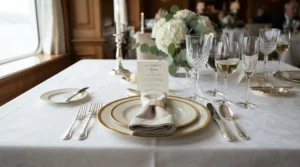
A formal table setting follows a logic that’s more functional than fussy. Emily Post’s guidance for the formal place setting says it’s meant for a meal of more than three courses, such as a dinner party or a holiday meal. Glassware sits to the upper right of the plate, arranged so guests reach for the right glass at the right time.
Here’s the layout, as etiquette sources describe it:
- Water glass: closest to the knife tip, on the right.
- Wine glasses: lined up behind or beside the water glass, descending in size from the upper right. Larger red goblets go toward the back, smaller whites in front.
- Champagne flute: if you’re toasting at the start, place it in front of the white wine glass. Emily Post’s team notes it stays from the beginning and is cleared before dessert.
- Utensils: use the mnemonic FORKS (forks, plate, knives, spoon), and set only what you’ll actually use.
Etiquette sources also say a tablecloth is expected for a formal meal, and candles should appear only when the meal is after dark. Keep centerpieces low enough that guests can see each other, a point Lizzie Post emphasizes in an interview about holiday tables.
You can read the Emily Post Institute’s own Thanksgiving table setting guides for the formal six-course, four-course and informal three-course layouts. The practical takeaway: you only need the glasses your menu demands. A formal six-course meal needs a full lineup, while a Thanksgiving dinner with pie may need just water and wine.
Dinner Party Etiquette: Glassware Rules Hosts Often Get Wrong
Good dinner party etiquette around glassware is mostly about reducing friction. Here are the mistakes I’d watch for, based on the table-setting conventions above.
Setting every glass “just in case.” Formal guidance is to set only what will be used. A cluttered table with five glasses and two wines in the menu confuses guests and crowds the setting.
Ignoring order of use. Glasses descend by size from the upper right. If your table reverses that, guests will hesitate before every sip, which defeats the purpose of etiquette.
Forgetting the toasting glass. If you’re opening with Champagne, place the flute in front of the white wine glass as Emily Post’s team recommends, and clear it before dessert.
Skipping the stem. Hosts can gently model holding the stem, which keeps white wine cool and fingerprints off the bowl. It’s good manners and good sense.
Overfilling. A generous pour looks hospitable but leaves no room for aroma and spills easily on a white tablecloth. Pour modestly and refill often.
Etiquette, at its best, is just hospitality with a map. The map says: make it easy for your guests to do the right thing without thinking. Heavy, stable goblets help. Spindly stems that tip when someone gestures do not.
Traditional Cut Stemware for Holiday Table Settings
Holiday tables are where traditional cut stemware for holiday table settings earns its keep. Cut crystal doesn’t need decoration, because candles and string lights do the work: every facet throws a tiny scatter of gold across the cloth.
Cut stemware like Waterford Lismore Essence or the Godinger Dublin takes on an almost festive glow in low light. The Waterford Lismore Essence also comes in a Diamond variant, and retailer reviews describe champagne flutes in that collection as holding bubbles nicely, a good detail for New Year’s toasts. If you prefer something calmer, the plain-bowl Lenox Tuscany Classics Grand Bordeaux lets holiday linens and centerpieces take center stage.
A few holiday-specific tips:
- Keep cut glass away from busy patterned plates. One pattern should lead.
- Use warm white candles rather than scented ones, since fragrance competes with food and wine.
- Let the glasses be the “sparkle” element so you can keep decor simpler.
Seasonal lighting changes how crystal behaves, so test your setup an hour before guests arrive. If a glass looks dull under your dining light, it’ll look dull in photos too, and you still have time to swap.
Traditional Stemware Set for Hosting Thanksgiving Dinner
Thanksgiving is the stress test. A traditional stemware set for hosting Thanksgiving dinner has to handle a crowd, a long meal, dishwasher cycles, and relatives who “just need one more refill.” Emily Post’s team notes that many people serve just the big Thanksgiving meal and pie, so the table can be simpler than a six-course setup. Water and one wine glass often suffice.
Here’s a scenario. Say you’re hosting twelve, with a budget of a few hundred dollars and a dishwasher you trust. A sensible plan:
- Buy three sets of four Lenox Tuscany Classics Grand Bordeaux (twelve red-wine glasses), using the “around $50-$75 per set of four” range as your budget baseline.
- Add two boxes of Lenox Tuscany Classics Champagne Flutes if you want a pre-dinner toast.
- Use existing water goblets, or add a few Godinger Dublin goblets if you want that cut sparkle on the table.
Prefer lower risk? Choose break-resistant, dishwasher-safe options like the Schott Zwiesel Tritan Forte so cleanup doesn’t become a second event.
One more real-world signal: a Perigold reviewer of Lenox Tuscany stemless glasses said they’d be great for hosting Thanksgiving this year. It’s a small anecdote, but it shows these sets are being bought for exactly this use.

Seasonal Hosting Sets: Building a Collection Without Overbuying
Seasonal hosting sets are a smarter way to think about glassware than “buy a 48-piece service for eight.” The idea is simple: build a core set that covers every gathering, then add seasonal pieces only when they earn their place.
The core (always on the table): A dozen all-purpose wine goblets or Bordeaux glasses, like the Lenox Tuscany Classics Grand Bordeaux, plus water goblets that match.
The toast layer: A set of six flutes, like the Lenox Tuscany Classics Champagne Flutes, for New Year’s, anniversaries and holiday openers.
The statement layer: A few cut crystal pieces, like Godinger Dublin or Waterford Lismore Essence, for tables where you want sparkle and the guest list is smaller.
The rotation: Store seasonal extras upright, away from temperature swings, and bring them out only when the menu needs them.
A caution I’d give anyone: mixing brands feels thrifty until you realize rim thickness and stem height vary. At a formal table, mismatched glasses read as “I raided the cabinet.” Stick to one family for the core and let accents be the contrast.
Practical Usage Guide: Care, Storage and Your First 30 Days
Crystal care is less mysterious than reputation suggests. Here’s the schedule I’d follow.
Washing. Waterford’s own care guidance for its Lismore Diamond flutes is to wash separately in warm soapy water, rinse thoroughly, and dry with a lint-free cloth. Dishwasher-safe lines, like Lismore Essence, Schott Zwiesel Tritan Forte, and the Lenox Tuscany Classics stems, still benefit from a gentle cycle and no overcrowding.
Storage. A luxury crystal guide advises storing stemware upright, because the rim is the most fragile part, and avoiding sudden temperature changes that can stress the glass.
First 30 days.
- Week 1: Unbox immediately and check for chips or cracks while return windows are open.
- Week 2: Do a dry run with the full table setting in the order described above.
- Week 3: Test hand-washing or your dishwasher cycle with one or two glasses before trusting the full set.
- Week 4: Log any issues and contact the seller or brand support if something looks off.
For a deeper dive into crystal’s history and handling, the crystal vs glass explainer from Cognac.com offers a useful primer, including why you shouldn’t store wine in lead crystal for long periods.
Problem → Solution Guide: Common Glassware Headaches
Problem: Glasses arrive chipped or shattered. Retailer reviews for fragile stemware sometimes mention packaging problems, including one complaint about shattered champagne saucers. Solution: inspect immediately, photograph damage, and contact the seller. Brands like Lenox advertise a breakage replacement program.
Problem: You don’t have enough glasses for the guest list. Solution: buy sets that scale (six-packs like the Lenox Tuscany Classics Champagne Flutes), and plan for two glasses per guest at a formal meal.
Problem: Cloudy or spotted glass. Solution: dry with a lint-free cloth immediately after rinsing, and avoid overcrowding the dishwasher.
Problem: The set looks busy against your china. Solution: switch to a plainer profile like the Villeroy & Boch Boston or Lenox Tuscany Classics Grand Bordeaux, and let the plates carry the pattern.
Problem: You can’t tell if a glass is real crystal. Solution: try the simple checks sellers describe, like weight, clarity, and the bell-like ring when tapped, and verify lead content on the label. Remember that “crystal” labeling varies by region.
Features That Actually Matter (And Those That Don’t)
Matters: rim thickness. A thin rim makes wine feel effortless, and it’s what separates fine stemware from sturdy-but-clunky.
Matters: dishwasher safety. If you won’t hand-wash, don’t buy glasses that require it.
Matters: bowl shape. Reds want room; whites want a narrower bowl to stay cooler.
Matters: warranty. A breakage program or clear return policy is real insurance.
Doesn’t matter as much: lead content for looks alone. Modern lead-free crystal achieves comparable brilliance according to luxury glassware guides.
Doesn’t matter: a famous pattern name if you’re hosting casually. A beautiful pattern is lovely, but if guests are going to hold glasses by the bowl and clink them like pint glasses, you may be paying for an audience that isn’t watching.
Doesn’t matter: sets of 24 pieces. More pieces means more storage and more breakage. Start with the glass types you actually pour.
Long-Term Cost & Maintenance: What Crystal Really Costs
| Tier | Typical Examples | Upfront Cost | Ongoing Care | Value Verdict |
|---|---|---|---|---|
| Budget | Godinger Dublin | Lowest | Hand wash | Best starter |
| Mid-range | Lenox Tuscany Classics | Moderate ($50-$75 range per four) | Dishwasher safe | Best everyday value |
| Premium | Waterford Lismore Essence | Highest | Gentler care | Heirloom-grade |
Cost per use is the honest metric. A premium set used four times a year for twenty years costs pennies per use, while a budget set that chips in year two costs more in the long run. A breakage program, like the one attached to Lenox pieces, changes that math in your favor.
Maintenance cost is mostly time. Dishwasher-safe stems cut it nearly to zero, while hand-wash-only crystal is a small ritual. If you enjoy rituals, great. If not, buy accordingly.
So which tier should you choose? Choose premium if the glassware itself is part of the pleasure. Choose mid-range if the party is the point. Choose budget if you’re still discovering what kind of host you are.

FAQ: Traditional Stemware for Formal Dinner Parties
❓ How many wine glasses do I need per guest for a formal dinner?
❓ Is lead-free crystal as good as lead crystal for formal dinners?
❓ Can I put crystal stemware in the dishwasher?
❓ Where does the water glass go in a formal table setting?
❓ What's the best traditional stemware set for a first-time host?
Conclusion: Set the Table, Then Enjoy Your Own Party
Choosing traditional stemware for formal dinner parties isn’t about chasing the fanciest label. It’s about matching the glass to the way you actually host. If you love ritual and heirlooms, the Waterford Lismore Essence is the emotional pick. If you want Waterford styling without the full commitment, the Marquis by Waterford Markham is worth a closer look. If you like quiet elegance, the Villeroy & Boch Boston fits. For practical reds and real dishwashers, the Lenox Tuscany Classics Grand Bordeaux and Schott Zwiesel Tritan Forte shine, and the Godinger Dublin is the low-risk way to start. Add the Lenox Tuscany Classics Champagne Flutes when it’s time to toast.
A final thought on where to start. Whichever set you choose, learn the basic layout, keep the table uncluttered, and light the candles after dark. Everything else is just hospitality with better glassware.
✨ Ready to build your table?
Check current pricing on your favorite set above, start with one box, and add pieces as your guest list grows. Your next dinner party deserves glasses that sparkle as much as the conversation! 🥂
Recommended for You
- Traditional Wine Stemware Set: 7 Best Buys For 2026
- Classic All Purpose Wine Glasses For Beginners: 7 Proven Picks (2026)
- Classic Wine Glasses For Holiday Entertaining: 7 Stunning Picks 2026
Disclaimer: This article contains affiliate links. As an Amazon Associate, I earn from qualifying purchases. If you purchase products through these links, we may earn a small commission at no additional cost to you.
✨ Found this helpful? Share it with your friends! 💬🤗
