
In This Article
Here’s the argument that ruins every dinner party: your sister swears by the coupe because it looks like something Marilyn Monroe would sip from, while your uncle insists the flute is the only “correct” way to drink champagne. Both of them are a little right, and both are missing half the story. The short version — champagne flutes vs coupe comes down to a trade-off between carbonation and aroma. A flute’s narrow bowl slows the bubbles down and keeps them dancing for twenty extra minutes; a coupe’s wide, shallow bowl lets those same bubbles escape fast but opens up more surface area for the wine’s nose to actually reach yours.

That trade-off isn’t folklore. Physicist Gérard Liger-Belair has spent two decades studying exactly how bubbles form and behave in a glass, and his lab’s findings quietly rewired how the whole industry thinks about stemware. Champagne flutes vs coupe isn’t a fashion debate anymore — it’s a question with a physics answer, and once you know it, choosing between a flute, a coupe, or a tulip stops being guesswork.
This guide walks through seven real, buyable glasses spanning budget to heirloom-quality crystal, breaks down when each shape actually wins, and answers the questions people type into Google at 11 p.m. before a wedding registry deadline — from aroma loss in narrow glasses to which shape bartenders are quietly switching to in 2026. Grab a glass (any glass, for now) and let’s get into it.
Quick Comparison Table
| Glass Shape | Bubble Retention | Aroma Delivery | Best For |
|---|---|---|---|
| Flute | Excellent — narrow bowl traps CO2 | Limited — small surface area | Toasts, weddings, visual “bubble show” |
| Coupe | Weak — bubbles dissipate fast | Good — wide open surface | Retro cocktail parties, short sipping sessions |
| Tulip | Very good — tapered rim slows escape | Excellent — wide bowl, narrow top concentrates scent | Serious tasting, dinner pairing, everyday sipping |
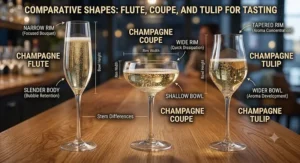
A flute wins if your priority is that photogenic column of bubbles rising for the length of a toast, but it quietly traps aroma molecules below the narrow rim where your nose never meets them. A coupe flips that entirely — gorgeous for a five-minute champagne tower moment, disappointing if you’re actually trying to taste a $60 bottle of vintage brut. The tulip, unsurprisingly, is the compromise sommeliers keep landing on: enough bowl width to let aromatics develop, enough taper at the rim to hold onto both scent and sparkle.
💬 Already have a favorite shape in mind? Scroll down to the exact model worth buying — we tested specs, not just Instagram appeal.
Top 7 Champagne Glasses: Expert Analysis
1. Riedel Extreme Rosé/Champagne — best aroma capture in a stemmed glass
The Riedel Extreme Rosé/Champagne takes the tulip concept and stretches the bowl slightly wider than most, and that extra real estate is the whole point. The lead-free crystal bowl tapers gradually rather than pinching sharply at the rim, which means the wine’s aromatics — brioche, green apple, toasted almond, whatever’s hiding in your vintage — have room to develop before reaching your nose. At roughly 8.4 ounces, it holds a generous pour without looking clumsy on a table set for a dinner pairing.
Based on the shape comparison alone, this is the glass for people who’ve outgrown the “champagne is just for toasting” phase and want to actually taste what they’re drinking. Reviewers consistently note that the stem is thinner and more fragile than Riedel’s mainstream Vinum line, so this isn’t a glass you hand to a boisterous best man mid-speech. It rewards a slower, more contemplative pour.
Pros:
- ✅ Wide bowl reveals aromatics most flutes hide
- ✅ Lead-free crystal keeps clarity without the weight
- ✅ Doubles well for rosé and lighter still wines
Cons:
- ❌ Thin stem is prone to snapping if mishandled
- ❌ Hand-wash only despite the price point
Expect to land in the $60-$90 range for a set of two, and given how often you’ll reach for it beyond just champagne, the value case holds up better than a single-purpose flute ever could.

2. Waterford Lismore Toasting Flute Pair — best heirloom-quality flute
If your goal is a glass you’ll still be using — and photographing — at your 25th anniversary, the Waterford Lismore Toasting Flute Pair is the one to register for. The signature diamond-and-wedge cut pattern is hand-cut into genuine Irish crystal, and the weight in your hand is unmistakably substantial compared to machine-pressed alternatives. At roughly 7 ounces, it’s sized closer to traditional flute proportions than the oversized novelty flutes flooding the market.
What most buyers overlook about a glass like this is that the cut pattern isn’t just decorative — the faceted surface creates extra nucleation points, meaning more bubble streams form along the ridges rather than just from the bottom of the bowl, so the visual effect is genuinely more dramatic than a plain flute at a comparable price. Reviewers consistently mention how the pattern catches candlelight at events, which is precisely why it’s remained a wedding-registry staple for decades.
Pros:
- ✅ Hand-cut crystal with a recognizable heritage pattern
- ✅ Extra nucleation points create a livelier bubble stream
- ✅ Substantial weight signals genuine investment-grade quality
Cons:
- ❌ Narrow bowl still limits aroma compared to a tulip
- ❌ Requires careful hand-washing to protect the cut pattern
Pricing sits in the premium tier — expect somewhere in the $130-$180 range for a pair — but for a couple planning to use these glasses at every milestone for the next twenty years, the cost-per-occasion math actually favors the splurge.
3. Zwiesel Glas Pure Champagne Glass — most practical everyday tulip
German engineering shows up in unglamorous but important ways here. The Zwiesel Glas Pure Champagne Glass uses Tritan crystal glass technology, which means it’s genuinely dishwasher-safe without the cloudy fade that ruins cheaper “dishwasher safe” stemware after a dozen cycles. The bowl follows a modern tulip profile — rounder than a flute, tighter at the rim than a coupe — built for people who drink sparkling wine on a Tuesday, not just at weddings.
Here’s what the spec sheet won’t tell you, but everyday use reveals: the rim is machine-finished but thin enough that it doesn’t feel like a compromise glass, which is where a lot of “durable” stemware quietly fails. Reviewers consistently report that these survive years of regular dishwasher use with minimal etching, which for a glass under this price point is a genuinely rare claim.
Pros:
- ✅ Machine-durable Tritan crystal survives daily dishwasher cycles
- ✅ Modern tulip shape balances aroma and bubble retention
- ✅ Thin rim despite the reinforced, durable construction
Cons:
- ❌ Less ornate than crystal-cut competitors
- ❌ Bowl shape is less dramatic for photo-worthy toasts
At around $40-$55 for a set of four, this is the glass to buy when you want “special occasion” quality without babying it — arguably the strongest everyday value on this list.
4. JoyJolt Layla Collection Champagne Flutes — best mid-range crystal flute
The JoyJolt Layla Collection Champagne Flutes strikes a balance a lot of mid-tier flutes miss: it looks and feels like it costs more than it does. Made from premium crystal sourced from the Czech Republic, the 6.7-ounce capacity hits the sweet spot for a proper pour without tipping into oversized-novelty territory, and the tapered bulb at the base of the bowl helps slow carbonation loss compared to straight-walled competitors.
On paper this means you’re getting genuine European crystal manufacturing at a domestic-brand price, which is exactly why this line shows up so often on wedding registries. The reinforced stem is worth calling out specifically — thin flute stems are the most common breakage point in this category, and a slightly thicker stem here reduces that risk without making the glass look clunky. Reviewers consistently praise the clarity and how light refracts through the crystal at the table.
Pros:
- ✅ Genuine Czech crystal at a mid-range price
- ✅ Reinforced stem reduces the most common breakage point
- ✅ Tapered bulb helps slow carbonation loss
Cons:
- ❌ Hand-wash recommended despite the durability upgrades
- ❌ Set of four only — awkward for larger gatherings
Expect a price in the $30-$45 range for the set, which lands this as the most defensible middle ground between disposable party flutes and true investment crystal.
5. JoyJolt Milo Stemless Champagne Flutes — best stemless option for casual pours
Stemless glassware gets dismissed as a gimmick, but the JoyJolt Milo Stemless Champagne Flutes make a legitimate case for it in a household that also drinks mimosas, prosecco, and the occasional sparkling rosé on a random Wednesday. At 9.5 ounces, the capacity is noticeably larger than traditional flutes, and the stemless base means no stem to snap off in a dishwasher rack or a toddler’s grip.
Based on the design logic, dropping the stem trades a bit of temperature insulation — your hand warms the wine faster than it would holding a stem — for real-world durability and versatility that a fragile flute simply can’t offer. This is a glass built for the household that hosts often but doesn’t want a cabinet full of single-purpose stemware. Reviewers consistently note that the wider mouth compared to standard flutes makes it double nicely as an everyday water or juice glass, which is the real selling point for a set of eight.
Pros:
- ✅ Stemless base virtually eliminates the most common breakage
- ✅ Larger 9.5oz capacity handles mimosas and cocktails too
- ✅ Set of 8 covers larger gatherings without repurchasing
Cons:
- ❌ No stem means faster hand-warming of the wine
- ❌ Bubble visual effect is less dramatic than a tall flute
Priced around $25-$35 for the full set of eight, this is the clear budget-per-glass winner on this list if versatility matters more to you than ceremony.

6. Libbey Signature Kentfield Coupe Glasses — best budget coupe for cocktail parties
For anyone chasing that Gatsby-era aesthetic without an heirloom budget, the Libbey Signature Kentfield Coupe Glasses deliver the classic wide, shallow coupe bowl on a stemmed base that’s dishwasher-safe — a rare combination in this category. Sized generously for a coupe, it doubles comfortably as a cocktail glass for anything served “up,” from a Manhattan to a French 75.
Here’s the honest trade-off worth weighing: a coupe’s open bowl means your bubbles vanish noticeably faster than in a flute or tulip, so this shape is genuinely better suited to a five-minute champagne toast or a cocktail hour than a slow, contemplative pour. What most buyers overlook is that this isn’t a flaw specific to this glass — it’s baked into the coupe shape itself, and no amount of crystal quality changes that physics. Reviewers consistently praise how photogenic these look stacked into a champagne tower at a wedding reception.
Pros:
- ✅ Dishwasher-safe despite the coupe’s delicate look
- ✅ Doubles as a versatile cocktail glass beyond champagne
- ✅ Genuinely budget-friendly for the retro aesthetic
Cons:
- ❌ Bubbles and chill dissipate noticeably faster than a flute
- ❌ Wide bowl makes spills more likely with active pouring
Expect around $20-$30 for a set of four, making this the most affordable route into the coupe aesthetic without settling for flimsy acrylic.
7. Godinger Vintage Coupe Glasses — best vintage-style alternative coupe
Rounding out the list, the Godinger Vintage Coupe Glasses lean harder into old-Hollywood detailing than the Libbey option, with a slightly more pronounced stem taper and subtle etched detailing on some sets that catches light beautifully under low bar lighting. This is the glass for someone building a full vintage bar cart rather than just a champagne-specific setup.
Based on the spec comparison, the bowl is a touch shallower than the Kentfield, which speeds up bubble loss even further but also makes these more stable to carry in a full round for a party. Honest analysis here: buy this pair if you’re prioritizing aesthetic and versatility across cocktails over pure champagne performance — this was never designed to compete with a tulip on aroma. Aggregated review sentiment for this style of coupe consistently mentions durability concerns with the thinner stems if used frequently for large events, so hand-wash care matters more here than with the reinforced options above.
Pros:
- ✅ Vintage detailing suits a full cocktail bar setup
- ✅ Shallow, stable bowl carries well in a full round
- ✅ Genuinely affordable entry point into coupe glassware
Cons:
- ❌ Thinner stem is less forgiving of frequent event use
- ❌ Fastest bubble and chill loss of any glass on this list
Priced similarly around $25-$35 for a set of four, this is best reserved for households that want one coupe set doing double duty across their whole bar cart rather than a champagne-only purchase.
Practical Usage Guide: Setting Up Your Home Bar for Champagne
Buying the right glass is half the battle — how you use it decides whether you actually get the payoff. Chill your glasses in the freezer for 10-15 minutes before pouring rather than relying on ice, since ice residue on the rim actually knocks bubbles out of the wine faster than a properly frosted glass would. Pour at a slight angle down the side of the bowl rather than straight down the center; a direct pour creates a rush of foam that wastes carbonation before it ever reaches your mouth.
A common first-30-days mistake: running crystal stemware through a standard dishwasher cycle on the “sanitize” setting, which is often hot enough to introduce micro-stress cracks in delicate stems over repeated washes. Hand-wash with lukewarm water and a soft cloth, and dry upside down on a rack rather than standing them right-side-up, which traps moisture at the base of the bowl. One maintenance trick worth knowing: never use dish soap with heavy fragrance additives, since residual soap film is one of the biggest — and most overlooked — causes of flat, lifeless bubbles even in a perfectly good glass.
Real-World Scenarios: Matching the Glass to the Occasion
Picture three different people shopping for champagne glasses this month. First, a college student hosting a graduation mimosa brunch on a tight budget who needs something sturdy, dishwasher-safe, and multi-purpose — the JoyJolt Milo Stemless Champagne Flutes fit that brief almost perfectly, since the larger capacity handles orange juice as easily as champagne and nothing fragile needs babying the morning after finals.
Second, a couple registering for their wedding who want one “everyday” set and one “special occasion” set — pairing the Zwiesel Glas Pure Champagne Glass for weekly use with the Waterford Lismore Toasting Flute Pair reserved for anniversaries covers both budget and ceremony without redundant purchases. Third, someone hosting a monthly wine-tasting group who genuinely cares about nosing out tasting notes — the Riedel Extreme Rosé/Champagne is the only glass on this list actually built for that level of scrutiny, and buying a full set of six or eight makes more sense than a token pair.
How to Choose the Best Champagne Glass Shape
Answering the question everyone eventually Googles — here’s the actual decision process, broken into concrete steps:
- Decide your priority: bubbles or aroma. If the visual spectacle of rising bubbles matters most, lean flute; if you actually want to smell and taste the wine’s complexity, lean tulip.
- Consider how often you’ll actually use it. A glass reserved for one toast a year can be delicate; a glass in weekly rotation needs to survive real dishwasher cycles.
- Match the shape to the champagne style. A crisp, young non-vintage brut shows fine in a flute; an aged vintage or grower champagne rewards the extra aromatic space of a tulip.
- Factor in stem fragility versus your household. Homes with kids, roommates, or frequent parties should weight stemless or reinforced-stem options higher regardless of shape.
- Set a realistic budget band first. Deciding “under $40 for a set of four” before browsing prevents the classic trap of falling for a $200 pair you’ll be too nervous to actually use.
- Check dishwasher-safety claims against real reviews, not just marketing copy — plenty of “dishwasher safe” stemware clouds within a year of regular use.
- Buy at least two shapes if you entertain often. A flute for celebratory toasts and a tulip or coupe for slower sipping covers essentially every scenario this list has walked through.
Champagne Flutes vs Coupe: The Full Breakdown
Let’s settle the actual champagne flute vs coupe vs tulip debate with the physics behind it rather than the aesthetics. A flute’s narrow bowl minimizes surface area, which is precisely why bubbles last longer — there’s simply less room for carbon dioxide to escape into the air at once. Physicists studying bubble and flow patterns in champagne have found that the droplets thrown off by bursting bubbles carry a much higher concentration of aroma compounds than the liquid itself, which is the mechanism that makes bubble behavior matter for more than just looks — it’s directly tied to how much aroma actually reaches your nose.
A coupe inverts that trade entirely. Its wide, shallow bowl maximizes surface area, which sounds like it should help aroma — and it does, briefly — but it also lets carbonation escape so fast that within a few minutes the champagne can taste noticeably flatter than the same pour in a flute. The tulip splits the difference deliberately: a bowl wide enough to let aromatics build, tapering at the rim just enough to slow — though not stop — that same bubble escape. This is exactly why professional tasting rooms overwhelmingly favor the tulip over either “traditional” option; it’s not nostalgia driving that choice, it’s a direct compromise between the flute’s strength and the coupe’s.
| Factor | Flute | Coupe | Tulip |
|---|---|---|---|
| Bubble longevity | Best | Worst | Very good |
| Aroma exposure | Weakest | Strong initially, fades | Best sustained |
| Stability / spill risk | Low | Higher (wide bowl) | Low |
| Ideal use case | Toasts, weddings | Cocktail hour, décor | Everyday sipping, tasting |
The table above makes the coupe’s appeal obvious for a five-minute champagne tower, but if you’re planning to nurse a single glass through a two-hour dinner, that same wide bowl works against you the entire time.
Wide Glass vs Narrow Glass: What Aroma Loss in a Flute Actually Looks Like
Champagne aroma loss in a flute isn’t a myth wine snobs invented to sell tulip glasses — it’s a documented, measurable effect of surface geometry. As bubbles rise and burst at the surface, they eject tiny droplets that carry aroma compounds into the air above the glass, and a narrow flute simply gives fewer of those droplets room to disperse toward your nose before they settle back down or evaporate unnoticed. A wide glass, by contrast, spreads that same aromatic release across a much larger surface, which is why a wine you’d call “fine but unremarkable” in a flute can suddenly show noticeably more complexity in a wider bowl.
That doesn’t make the narrow glass wrong — it makes it optimized for a different goal. If bubble persistence and that classic rising-column visual is the entire point of the occasion (weddings, milestone toasts, champagne towers), narrow wins outright. If you’re actually trying to evaluate what’s in the glass, wide wins, and the tulip’s tapered-top compromise exists specifically to recover some of that lost aroma without fully sacrificing the bubbles a narrow bowl protects.
Coupe or Flute for Champagne: A Straight Answer
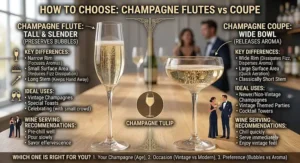
If someone’s asking this expecting a single “correct” answer, here it is honestly: neither is universally correct, and anyone claiming otherwise is selling something. Choose the flute when the moment is about ceremony — a wedding toast, a New Year’s countdown, a birthday where the visual of endless rising bubbles matters more than nuanced tasting notes. Choose the coupe when the moment is about aesthetic and pace — a retro-themed cocktail party, a champagne tower centerpiece, or a quick celebratory sip rather than a slow-savored glass. Neither shape is “wrong” for champagne; they’re simply optimized for different moments, and most serious drinkers eventually own both plus a tulip for everyday use.
Common Mistakes When Buying Champagne Glasses
The most frequent mistake is buying based purely on how a glass photographs rather than how it performs — a stunning coupe set looks incredible in wedding photos and disappoints by the second pour once the bubbles are gone. A close second: assuming “dishwasher safe” claims are equal across brands, when in reality the crystal composition and rim thickness vary enormously in how well they survive repeated hot cycles. Buyers frequently underestimate breakage risk too, picking the most delicate, thin-stemmed option for a household that regularly hosts twenty-person parties, then wondering why half the set is gone within a year.
Another overlooked error is buying only one shape at all. Committing entirely to flutes means no good option for a slower tasting session, while committing entirely to coupes means every toast loses its fizz within minutes. Finally, plenty of shoppers ignore capacity entirely — a 4-ounce flute looks elegant but requires awkward, frequent refilling at any real gathering, while an oversized 10-ounce flute invites overpouring that wastes both champagne and its carbonation.
✨ Ready to stop guessing and start pouring? Check current pricing on any of the picks above before your next celebration.
What to Expect: Real-World Performance at the Table
Specs only tell part of the story, so here’s what actually happens once the cork is out. In a proper flute, expect a steady, fine stream of bubbles rising continuously for a solid ten to fifteen minutes before visibly slowing — a genuinely photogenic effect that a coupe simply can’t replicate for more than a few minutes. In a coupe, expect noticeable flattening within roughly five to eight minutes, meaning it’s a glass built for a toast, not a lingering conversation over a bottle.
In a tulip, expect a middle ground: bubbles persist nearly as long as a flute, but every time you bring the glass toward your face, you’ll notice more genuine aroma — toast, citrus, brioche, whatever the bottle offers — than the same wine poured into a flute would reveal. Reviewers across all three shapes consistently report that glass temperature matters as much as shape; a room-temperature glass warms the wine within minutes regardless of bowl geometry, which is why pre-chilling stemware (mentioned earlier) genuinely changes the tasting experience more than most people assume.
Modern Champagne Serving Trends for 2026
The modern champagne serving trend heading into 2026 is a clear, sustained shift away from the “flute for everything” default that dominated the 1980s through early 2000s. Restaurants and wine bars are increasingly serving sparkling wine in standard white-wine-style glasses or dedicated tulips rather than flutes, prioritizing what’s actually in the bottle over the visual spectacle of bubbles. This mirrors a broader historical pattern documented in the history of European champagne glassware: the coupe and the flute dominated at different points over the past century, until the tulip shape gradually won over the industry’s most serious critics and champagne houses, as aroma and taste took priority over pure visual effect.
At the same time, the coupe hasn’t disappeared — if anything, it’s having a genuine style revival at cocktail-forward events and retro-themed weddings, precisely because it photographs beautifully and suits a fast-paced celebration. The realistic 2026 trend isn’t “one shape wins,” it’s households and venues increasingly owning multiple shapes and matching the glass to the occasion rather than defaulting to whatever’s already in the cabinet.
Long-Term Cost & Maintenance: Crystal vs Everyday Glass
Crystal stemware costs more upfront, but the real total-cost-of-ownership question is breakage rate over time, not sticker price alone. A $25 set of four everyday glasses that breaks two glasses a year effectively costs more over three years than a $70 reinforced-stem set that survives intact, once you factor in replacement shopping and the awkwardness of a mismatched remaining set. Dishwasher-safe options like the Zwiesel Glas Pure Champagne Glass reduce the ongoing labor cost of hand-washing, which matters more than people initially budget for if you entertain regularly.
| Glass Type | Upfront Cost | Care Required | 3-Year Value Verdict |
|---|---|---|---|
| Everyday dishwasher-safe (e.g. Zwiesel Glas Pure Champagne Glass) | Mid-range | Low | Strong — lowest total cost for frequent use |
| Heirloom crystal (e.g. Waterford Lismore Toasting Flute Pair) | Premium | High (hand-wash only) | Strong for rare, ceremonial use only |
| Budget coupe (e.g. Libbey Signature Kentfield Coupe Glasses) | Low | Moderate | Good for occasional cocktail-party use |
Looking at the table above, the smartest long-term move for most households is owning one everyday-durable set and one ceremonial set, rather than trying to find a single glass that does both jobs — no shape or price point manages that convincingly.
Features That Actually Matter (And Those That Don’t)
Marketing copy loves to hype “hand-cut crystal” and “premium etching,” but the features genuinely worth paying for are rim thickness, stem reinforcement, and verified dishwasher durability — the things that determine whether you’re still using the set in three years. A thinner rim genuinely does improve how the wine feels against your lips and can marginally affect perceived taste, so it’s one of the few “luxury” claims backed by a real sensory difference.
What doesn’t matter nearly as much as brands imply: elaborate stem shapes, colored tints, or gold rim detailing. These are purely aesthetic, and in the case of colored glass, can actually work against you by obscuring the wine’s true color and clarity — something any serious taster would flag immediately. Capacity claims deserve more scrutiny than they get too; a listed “8 ounces” sometimes refers to the glass’s total volume to the rim, not a realistic pour size, so cross-check against actual reviewer photos rather than trusting the spec sheet alone.
Best Champagne Glass Shape by Occasion: A Decision Framework
Use this simple framework instead of agonizing over every purchase:
- If it’s a wedding toast or milestone celebration → choose a flute, because the visual bubble effect matters more than nuanced tasting in that five-minute window.
- If it’s a slow dinner pairing or serious tasting → choose a tulip, because aroma development outweighs pure carbonation duration.
- If it’s a retro cocktail party or champagne tower → choose a coupe, because the aesthetic and stacking practicality outweigh how long the fizz lasts.
- If it’s daily or weekly casual drinking → choose a dishwasher-safe stemless or reinforced-stem option, because durability beats ceremony for frequent use.
- If you only want to buy one shape ever → choose a tulip, because it’s the only shape that performs reasonably well across every one of the scenarios above.
FAQ
❓ Is a champagne flute or coupe better for weddings?
❓ Why do bubbles disappear faster in a coupe than a flute?
❓ Does glass shape really change how champagne tastes?
❓ What is the best all-around champagne glass shape?
❓ Can I put crystal champagne glasses in the dishwasher?
Conclusion
The champagne flutes vs coupe debate was never really about which glass is objectively superior — it’s about which trade-off suits the moment you’re actually in. Flutes protect bubbles and deliver visual drama, coupes deliver retro style and quick-sip practicality, and tulips split the difference for anyone who genuinely wants to taste what they’re drinking rather than just watch it sparkle. Across the seven glasses covered here, from the aroma-forward Riedel Extreme Rosé/Champagne to the budget-friendly JoyJolt Milo Stemless Champagne Flutes, there’s a legitimate case for owning more than one shape rather than searching for a single perfect glass that does everything.
If you host often, the smartest move is pairing one dishwasher-safe everyday set with one special-occasion set reserved for the moments that call for real ceremony. Champagne is forgiving enough to taste good in almost anything — but once you understand the real difference glass shape makes, it’s hard to go back to grabbing whatever’s closest in the cabinet.
Peer-reviewed research on sparkling wine tasting has repeatedly shown that glass shape measurably influences how aromas are perceived during tasting, and that single fact is really the entire case for thinking harder about the glass in your hand next time you pour.
Recommended for You
- Best Sparkling Wine Glasses 2026: 7 Top Picks Ranked
- 7 Best Cava Glasses in 2026: Tulip vs Flute, Ranked
- Best Prosecco Glasses in 2026: 7 Sets Worth the Toast
Disclaimer: This article contains affiliate links. As an Amazon Associate, I earn from qualifying purchases. If you purchase products through these links, we may earn a small commission at no additional cost to you.
✨ Found this helpful? Share it with your friends! 💬🤗
